Hindu priest murdered for confronting drug consumption at temple by Muslim men; bludgeoned to death with stone grinding slab
 Faridabad, Haryana, India
  29 August, 2025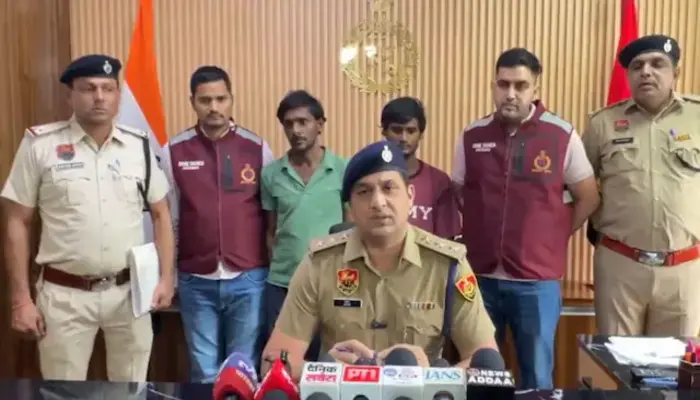
Case Summary
In Faridabad, Haryana, 65-year-old Hindu temple priest Omprakash was murdered after confronting four Muslim men who were consuming intoxicants near a Hanuman Temple. The men followed him to the temple premises, assaulted him and struck him on the head with a stone grinding slab. After the killing, they took the priest’s belongings from the temple. On the night of 30 August 2026, four Muslim men obtained smack in Delhi and travelled by auto-rickshaw to the Hanuman Temple on Sector-30 Bypass Road, Faridabad. They sat near the temple, beside a canal and close to the Sector-30 Bypass Road cut, at a secluded location within the jurisdiction of Sector-31 Police Station, and consumed alcohol and drugs, including smack. Omprakash lived alone in a small hut at the temple, where he performed religious duties. He approached the men, objected to their consuming intoxicants near the religious site and told them to leave. The confrontation escalated after the men became angry at being stopped. The four followed Omprakash towards the temple premises and assaulted him. During the attack, they picked up a stone grinding slab kept in the temple and struck him on the head. He sustained severe injuries and died at the scene. After the murder, the men took the priest’s belongings from the temple and fled in an auto-rickshaw. The vehicle belonged to Rohtash, a resident of Old Faridabad, and had been used by the four men to travel from Delhi after obtaining smack. Crime Branch DLF later recovered the auto-rickshaw used in the incident. On 31 August 2026, Omprakash’s body was found near the canal behind the temple. Police reached the scene, conducted an inspection and sent the body for post-mortem examination. His cousin, Ashok Kumar, a resident of Ahirwada, Old Faridabad, lodged a complaint, following which Sector-31 Police Station registered a murder case against unknown persons. The investigation was subsequently transferred to Crime Branch DLF, also known as Crime Investigation Agency DLF. Assistant Commissioner of Police, Crime, Aman Yadav, supervised the investigation. Crime Branch DLF identified 20-year-old Asif alias T.T. and 34-year-old Asif alias Kalia as two of the participants. Asif alias T.T. was a resident of Husaini village, Mathura district, Uttar Pradesh, while Asif alias Kalia was a resident of Bamani village, Bharatpur district, Rajasthan. Both were living in Kisan Mazdoor Colony on Bypass Road in Faridabad and worked as auto-rickshaw drivers. They were friends and were described by police as being addicted to intoxicants. Police arrested Asif alias T.T. and Asif alias Kalia after establishing their connection with the murder. During questioning, police reconstructed the circumstances leading to the attack. Police records showed that Asif alias T.T. already had three First Information Reports registered against him, including one case under the Arms Act and two theft cases. Police also identified the other two participants who had been with the arrested men and began efforts to locate them. On 1 October 2026, Crime Branch DLF arrested the third accused, Rohtash, a resident of Old Faridabad, in connection with the murder. Police produced him before a court and sent him to judicial custody. Police spokesperson Yashpal stated that preliminary questioning established Rohtash’s connection with the group and that the four men had travelled in his auto-rickshaw from Delhi after obtaining smack. The same vehicle was used to leave the scene after the priest’s belongings were taken, and Crime Branch DLF recovered it.
Why it is Hate Crime ?
This case contains several elements that could raise concerns about a possible religious dimension. The victim was a Hindu temple priest, the confrontation took place in the vicinity of a Hanuman temple, and the perpetrators were Muslim men who followed him onto the temple premises before killing him. The use of a temple object, a stone grinding slab kept within the temple, during the assault and the subsequent removal of the priest’s belongings from the temple premises further add to the circumstances that warrant scrutiny. These factors make the case relevant from a Hinduphobia perspective and bear similarities to incidents in which violence against Hindus has occurred in or around their religious spaces. However, the available evidence does not clearly establish that Omprakash was targeted because he was Hindu or because he was a temple priest. The immediate sequence reconstructed during the investigation indicates that the confrontation began after Omprakash objected to the four men consuming alcohol and drugs near the temple and asked them to leave. The violence appears to have escalated from this confrontation. The accused were also described by police as being involved in drug use, and the subsequent removal of the priest’s belongings raises the possibility of robbery or theft as an additional motive. At the same time, the available information does not provide evidence that would definitively rule out a religious dimension. There is no clear indication of what the accused said during the confrontation, whether they made derogatory remarks about Hinduism, whether Omprakash was singled out because of his religious identity, or whether the temple itself was targeted. The fact that the violence ultimately followed the priest into a Hindu religious space also leaves questions about whether the religious setting played any role beyond being the location where the confrontation ended. The distinction is therefore important. The circumstances are concerning enough to raise the possibility of religiously motivated violence, but they do not provide the explicit evidence required to establish that religious hostility was the underlying motive. The victim’s Hindu identity, the temple setting and the religious nature of his role cannot, on their own, establish a hate crime. The case has consequently been classified as ‘Undecided’. Its circumstances contain elements that warrant consideration from a Hinduphobia perspective, but the available evidence presently supports a competing explanation involving confrontation, intoxication and possible robbery. Unless further investigation establishes that Omprakash was attacked specifically because of his Hindu identity or that anti-Hindu hostility motivated the perpetrators, the religious motive remains uncertain.
Victim Details
Total Victim
1
Deceased
1
Gender
- Male 1
- Female 0
- Third Gender 0
- Unknown 0
Caste
- SC/ST 0
- OBC 0
- General 1
- Unknown 0
Age Group
- Minor 0
- Adult 0
- Senior Citizen 1
- Unknown 0


Case Status
Case sub-judice


Perpetrators Details
Perpetrators
Muslim Extremists
Perpetrators Range
From 2 To 5
Perpetrators Gender
male
 Sources




