Hindu temple attacked in Hyderabad; Muslim man desecrates idol of Hindu goddess while shouting "Allahu Akbar"
 Hyderabad, Telangana, India
  2 October, 2026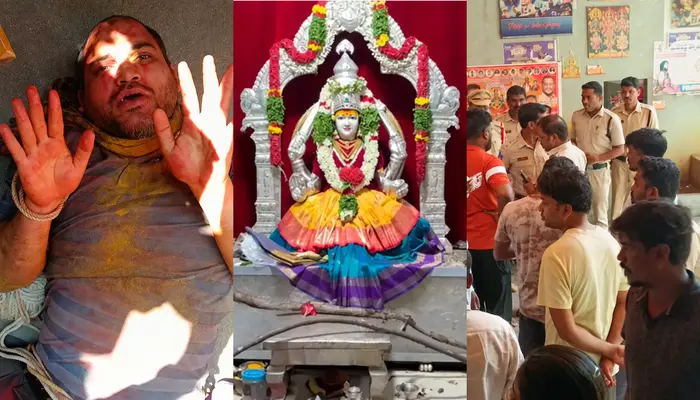
Case Summary
In Hyderabad, Telangana, a Hindu temple was attacked by a Muslim man named Mohammed Ansari. The accused thrashed the idol of Santoshi Maa with sticks and attempted to desecrate it, while shouting "Allahu Akbar". The incident occurred on 2 October 2026, at the Santoshi Mata Temple near the Dilsukhnagar bus depot. The Muslim accused, Mohammed Ansari, entered the temple premises at around 10:05 am and began causing a disturbance while the priest and devotees were present. Ansari shouted “Allahu Akbar” and then struck the idol of Santoshi Mata with sticks in an attempt to destroy it. When the temple priest attempted to stop him, he also attacked the priest with a stick. Subsequently, the priest and devotees present at the temple intervened and apprehended Ansari. They informed the Chaitanyapuri police through Dial 100, following which police personnel reached the temple and took him into custody. The incident occurred within the jurisdiction of the Chaitanyapuri police station. Police registered a case and began investigating the circumstances surrounding Ansari’s entry into the temple and the motive behind the incident. Furthermore, the police also claimed that the accused was undergoing mental health treatment at the time of the incident.
Why it is Hate Crime ?
The first primary category selected is- Attack on Hindu religious representations. The subcategory selected is- Desecration of Hindu religious symbol. Icons and symbols or a religious representation of a spiritual ideal are widely revered in Hinduism. Iconography is of vital significance in the Hindu milieu. It helps connect people’s spiritual beliefs with the real world. Iconography within the Hindu faith takes several shapes and forms. Murtis are of most significance to Hindus, to which daily rituals, prayers and offerings are done. Besides the murtis, there are several other symbols which have deep significance in the Hindu faith – the Om and Swastika for example. Since these Hindu religious symbols hold paramount importance in Hinduism, any desecration of symbols, icons, murtis, religious representations and manifestations, is driven by animosity towards the faith itself which manifests itself through these murtis, icons and symbols. Therefore, any desecration of these Hindu religious symbols and representations is considered religiously motivated hate crimes under this category. The other sub-category selected here is - Attack on temples. In Hinduism, a temple is the abode of the Deity. The Deity in the Temple is consecrated, thereby, making it a real, breathing entity. Hindus believe that not just the Deity but the temple premises itself are sacred to Hindus since Hindus hold the faith that the entire Temple space is an amalgamation of the divine energy of the deity. Given the central significance of Temples in Hindu Dharma, any attack against a Hindu Temple or its peripheral premises is an attack on the faith itself and is born out of animosity towards the faith, of which, the Temple is a central tenet. Any manner of attack against a Temple and/or its premises would therefore be considered a religiously motivated hate crime. The second primary category selected here is - Hate speech against Hindus. Within it, the sub-category selected here is - Violent threats. Violent threats, explicit, implicit or implied, is the most dangerous form of hate speech since it goes beyond discriminatory and prejudicial language to express the intent of causing harm to an individual or a group of people based on their religious identity and faith. There could be several different kinds of threats that are issued to Hindus based on religious animosity. An explicit threat would mean the direct threat of violence towards an individual Hindu, a group of Hindus or Hindus at large. Physical violence, death threats, threats of destruction of property belonging to Hindus and threats of genocide would mean explicit threats against Hindus for their religious identity. Implicit threats may not be a direct threat but implied through the use of symbols of actions – for example – in the Nupur Sharma case, other than explicit threats, there were also implicit threats when Islamists took to the streets to burn and beat her effigies. It implies that they want to do the same to Nupur Sharma – thereby is considered an implicit threat. Violent threats can be delivered in person, through letters, phone calls, graffiti, or increasingly through social media and other online platforms. It would be important to understand that a threat – explicit or implicit, online or offline – to an individual who happens to be a Hindu does not qualify as a religiously motivated threat. Such a threat, while vile and dangerous, could be owing to non-religious reasons and/or personal animosity. To qualify as a religiously motivated threat, it would need to exhibit an indication that the individual is being targeted for religious reasons and/or owing to his/her religious identity as a Hindu. The other primary category selected here is - Attack not resulting in death. Within it, the sub-category selected here is - Attacked for opposing radicals or trying to save victim. In several cases, Hindus are attacked for opposing religiously motivated crimes being committed against a fellow Hindu or simply for voicing an opinion opposing radical elements, who either have in the past or continue to persecute Hindus. In such cases, the initial attack against the victim, against which the Hindu was trying to defend the victim, would also need to be classified as a religiously motivated hate crime. Since the initial crime itself was religiously motivated and the subsequent crime of attempting to save the victim or speaking against the radical elements ends up inviting a violent attack, it would also be classified as a religiously motivated hate crime under this category. The religious dimension of the incident was demonstrated by the fact that the accused specifically targeted a Hindu place of worship and desecrated the idol of Santoshi Mata, a revered Hindu deity, while shouting “Allahu Akbar”. The choice of a Hindu temple and a sacred Hindu object as the targets, combined with the raising of Islamic slogans, demonstrated that the conduct was rooted in religious hatred. In Hinduism, idols are sacred representations through which devotees establish a tangible focus for worship and offer prayers, rituals and devotion to the deity. They are not merely decorative objects but occupy an important place within Hindu religious practice and are treated with reverence as part of the ritual life of a temple. Santoshi Mata is a revered Hindu goddess, and her idol was a sacred object at the heart of worship within the temple. The deliberate attempt to strike and damage the idol therefore constituted a direct act of desecration, targeting a sacred symbol of the Hindu faith and violating the sanctity of an object venerated by Hindu devotees. Another point to highlight in this incident is that the Muslim accused shouted “Allahu Akbar” while carrying out the attack. Traditionally, this slogan is a religious chant of glorification; however, Muslim extremists have weaponised it as a battle cry to intimidate Hindus and assert Islamic supremacy. In this case, the accused raised it precisely as he launched their attack on the Hindu place of worship, mirroring patterns in other similar incidents including the 2020 Delhi anti Hindu riots where Muslim mobs targeted Hindu homes and temples, the 2022 Karauli violence in Rajasthan with Hindu shops set ablaze, the September 2025 Bareilly clashes during the “I Love Mohammad” poster controversy, and the December 2025 lynching of Dipu Chandra Das in Mymensingh, Bangladesh, where the same slogan was used during a fatal attack over a blasphemy allegation. In each of these instances, the slogan accompanied acts of aggression directed against Hindus and their religious or economic institutions. The use of such slogans during acts of violence against Hindu places of worship underscores how religious expressions are deployed by Muslims to legitimise aggression in the name of Allah. The invocation of such slogans during attacks reflects an Islamist supremacist mindset in which perpetrators believe their actions align with religious duty, thereby dehumanising Hindu victims and encouraging further violence. This dynamic contributes to the normalisation of hostility against Hindus and their places of worship, showcasing overt religious animosity. The repeated use of such slogans during coordinated acts of violence reveals an underlying pattern of religious intolerance in which aggression is sanctified under the guise of faith-driven retaliation. The same pattern is observed very clearly in this current case. The violence against the temple priest further reinforced the religious dimension of the incident. When the priest intervened to protect the deity and prevent the attack on the idol, the accused also turned his aggression towards him and struck him with a stick. The priest was targeted in his capacity as the person performing and safeguarding Hindu worship at the temple, linking the violence against him directly to the defence of the Hindu sacred space and deity. The incident also demonstrated how Hindus who intervene to defend their religious practices and sacred spaces can themselves become targets of violence. His intervention was met with physical violence, demonstrating that the attack extended beyond the idol itself to a person actively protecting the Hindu religious site and its sanctity. In this case, some may attempt to argue that the incident was not rooted in religious animosity but resulted from the accused’s mental-health condition, as the police stated that he was undergoing mental-health treatment. However, it is important to note here that in several cases where Muslims vandalise or desecrate Hindu places of worship, a common narrative used to explain away the conduct is to attribute the crime to the perpetrator’s mental health, suggesting that the incident occurred because the perpetrator was ‘mentally ill’ or ‘mentally unstable’. Furthermore, the police, in many such cases where the crime has been committed against the Hindu faith by a non-Hindu perpetrator, deny that the crime committed was in any way motivated by a religious bias and attribute it to the perpetrator’s mental health. Many a time the police downplay incidents of low-level communal crime because it is their jurisdiction that comes under question. The police also often say that the crime was committed because the accused was mentally unstable because they wish to ensure that, owing to the crime already committed, there is no further flare-up in the area. Likewise, in this case too, when a Muslim man was caught desecrating the Hindu idol, the police claimed that he was undergoing mental health treatment. The use of the "mental illness" trope to justify crimes targeting Hindu temples or idols by Muslim perpetrators raises critical questions. If perpetrators are indeed mentally unstable, why do they specifically target Hindu idols and places of worship, leaving mosques untouched? Even in this, this selective focus suggests that such acts are not driven by mental health issues but by religious animosity. The repeated use of this narrative to downplay crimes against Hindus reflects a strategic effort to whitewash religious hatred, obscuring the true motivations and intentions behind the attacks. Taken together, the targeting of the Santoshi Mata idol, its desecration, the raising of Islamic slogans, and the violence against the priest established a clear religious dimension. The conduct therefore extended beyond physical damage to temple property and directly targeted Hindu religious worship and its sacred symbols. Thus, this case was added to the tracker.
Victim Details
Total Victim
1
Deceased
0
Gender
- Male 1
- Female 0
- Third Gender 0
- Unknown 0
Caste
- SC/ST 0
- OBC 0
- General 1
- Unknown 0
Age Group
- Minor 0
- Adult 1
- Senior Citizen 0
- Unknown 0


Case Status
Arrested


Perpetrators Details
Perpetrators
Muslim Extremists
Perpetrators Range
One Person
Perpetrators Gender
male
 Sources




