'Brahmins Usurped Tata Empire': DMK politician targets Hindus belonging to Brahmin community with casteist remarks
 Tamil Nadu, India
 28 September, 2026
Case Summary
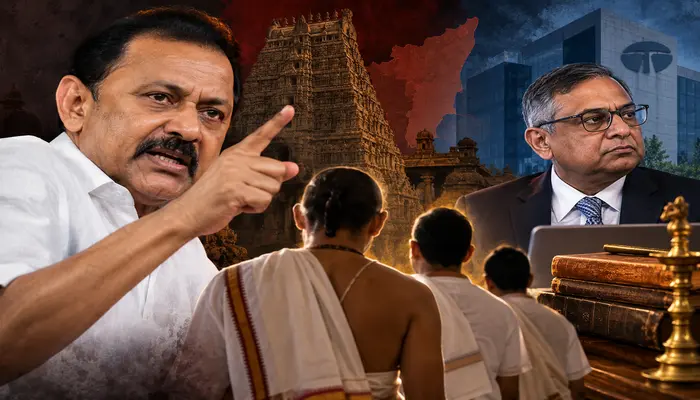
Dravida Munnetra Kazhagam (DMK) former Rajya Sabha Member of Parliament, M. M. Abdulla, posted casteist remarks targeting the Hindu Brahmin community on social media on 29th September 2026. The comments came in the context of the corporate dispute between Tata Sons and Tata Trusts over the reappointment of Tata Sons Chairman N. Chandrasekaran. In the Tamil post, which was subsequently deleted, Abdulla wrote: “It took 200 years for the Parsis to build this empire! But a few years were enough for the Brahmins to usurp it! Tamil Nadu was the only state that understood this politics for more than half a century! That understanding is now diminishing. By the time it begins to be understood again, Tamil Nadu and the Tamil race will have lost their importance and gone so far backwards that they cannot recover! Dravidian politics is our politics! If Tamil Nadu and Tamils do not wake up even now, it will never happen. He framed the corporate development as a threat to Tamil Nadu and Dravidian politics. On 30 September 2026, Abdulla made another social media post targeting Chandrasekaran and Hindu intellectual heritage after the latter suggested establishing a university blending Hindu Shastras with modern fields such as Artificial Intelligence (AI) and computer science. Sharing the development, Abdulla wrote: “This guy was silent so far. Now he wants RSS support! So he is public about this”, referring to the Rashtriya Swayamsevak Sangh (RSS).
Why it is Hate Crime ?
The primary category for this case is: Hate speech against Hindus. The subcategory for this case is: Anti-Hindu slurs, mocking faiths. Anti-Hindu slurs and the deliberate mocking of the Hindu faith owing to religious animosity involve the usage of derogatory terms, stereotypes, or offensive references to religious practices, symbols, or figures. One of the common anti-Hindu slurs used against Hindus is “cow-worshipper” and “cow piss drinker”. The intention of using this term is to demean and mock Hindus as a group and their religious beliefs since Hindus consider the cow holy. Additionally, some symbols and the slurs attached to them have a historical context that exacerbates the insult, hate, stereotyping, dehumanisation and oppression against Hindus. Cow worship has been used for centuries to denigrate Hindus, insult their faith and oppress Hindus specifically as a religious group. There has been overwhelming documentation about how cow slaughter has been used to persecute Hindus with cow meat being thrown in temples and places of worship. There has also been overwhelming documentation where cow meat (beef) has been force-fed to Hindus to either forcefully convert them to Islam or denigrate their faith. Apart from cow worship, the Swastika – which holds deep religious significance for the Hindus – has also been misinterpreted and distorted to use as a slur against Hindus. Similarly, the worship of the Shivling has been used by supremacist ideologies and religions to denigrate Hindus owing to religious animosity. Such slurs and denigration stem out of inherent animosity and hate towards Hindus and their faith, therefore, it is categorised as hate speech targeted at Hindus specifically owing to their religious identity. In this instance, the remarks targeted an entire community rather than addressing a legitimate business or governance matter. The issue under public discussion concerned corporate leadership and board decisions involving Tata Sons and Tata Trusts. Instead of engaging with corporate governance, legal procedures, or administrative merits, M. M. Abdulla shifted the discourse into a collective attack based on birth and religious identity. By claiming that Parsis took two centuries to build an institution while Brahmins took only a few years to “usurp” it, he framed professional corporate leadership through a communal lens, portraying the entire Hindu community as deceitful intruders who take over institutions that do not belong to them. Generalising any group of people as predatory or untrustworthy is a well-recognised form of prejudice. Hindus belonging to the Brahmin community form an integral part of the Hindu religious and social fabric, with deep historical ties to religious literature, ritual traditions, and cultural heritage. Painting the entire community with a broad, negative brush and declaring them a collective threat to the state normalises hostility against them. Portraying a community's professional presence as an act of “usurpation” moves the conversation away from democratic political critique and enters into identity-based demonisation. The hostility extended further when the politician attacked the proposal to study and preserve Hindu intellectual traditions. When Tata Sons Chairman N. Chandrasekaran suggested establishing an institution that combined modern fields like Artificial Intelligence with traditional Hindu Shastras, Abdulla targeted him publicly. The Shastras represent foundational scriptures, philosophy, and classical knowledge systems of the Hindu faith. Depicting an initiative to study these sacred texts as an illegitimate act designed merely to gain ideological favour displays an underlying contempt for Hindu heritage and religious knowledge systems. While political discourse frequently involves sharp disagreements, reducing corporate and academic proposals to communal attacks crosses the line into hate speech. The statements relied on collective stereotyping of a Hindu community and trivialised Hindu religious scriptures. For these reasons, this incident falls within the scope of anti-Hindu hate speech. Some may argue that the remarks were merely anti-Brahmin rather than anti-Hindu. However, that distinction is artificial in this context. Brahmin identity derives its meaning from the broader framework of Hindu religious tradition, and the accused's comments specifically targeted Brahmins in relation to Hindu temples, temple administration, and Hindu religious symbols. The fundamental motivation behind this rhetoric was therefore to stoke resentment against the Hindu Brahmin community by portraying it as a threat to Tamil identity and Dravidian politics, while casting the promotion of Hindu Shastras and traditional knowledge as an expression of RSS influence. Rather than confining criticism to specific individuals or institutions, Abdulla's remarks directed suspicion and hostility towards an entire Hindu-associated community. His words were not merely casual insults or political criticism. They reflected a deeper hostility, using a corporate dispute and a proposal to promote Hindu knowledge systems as opportunities to demean the Brahmin community and belittle Hindu beliefs, traditions and intellectual heritage. By portraying a Hindu community as a threat and treating its religious and cultural traditions with contempt, the remarks reinforced prejudice against Hindus. This incident is therefore being categorised in the Hinduphobia Tracker as a religiously motivated hate crime targeting the Hindu Brahmin community.


Case Status
Unknown


Perpetrators Details
Perpetrators
State and Establishment
Perpetrators Range
One Person
Perpetrators Gender
male
 Sources



