Hindu tribals targeted for Christian conversion through inducements and recurring prayer meetings in Guskara, Purba Bardhaman
 Bardhaman, West Bengal, India
 29 September, 2026
Case Summary
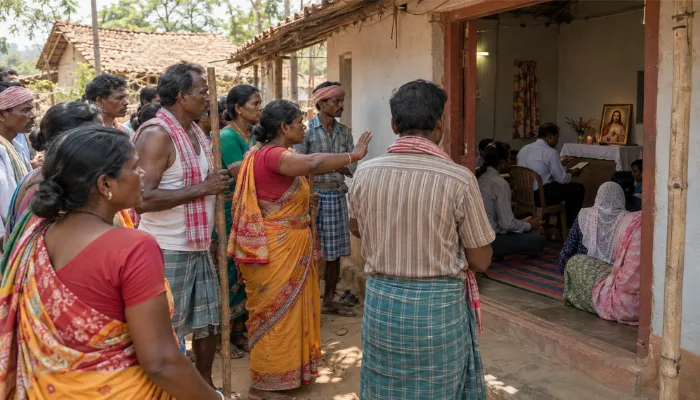
In Purba Bardhaman district, West Bengal, local Hindu tribal residents were targeted and induced into Christian religious conversion through recurring prayer meetings. The gatherings were held at the home of a tribal woman from Kamalpur village who had previously converted to Christianity. Villagers intervened after learning that external Christian missionaries were regularly visiting the locality and using the gatherings to influence other tribal residents towards conversion. After her conversion, the woman set up a Christian prayer venue inside her house, locally described as a "Jesus Mandir" (Temple), where an image of Jesus was installed, and regular prayers and religious rituals were held. The gatherings took place routinely, including on Sundays and other specified days. Christian missionaries from outside the village regularly attended these prayer meetings and attempted to persuade and allure other tribal residents to convert to Christianity under the guise of curing illnesses. After becoming aware of the conversion activity, members of the local tribal community and other villagers assembled and confronted those conducting the gatherings. The villagers objected to the continued proselytisation activity and stopped the prayer meetings and missionary gatherings operating from the residence. After the community intervention, the conversion-related gatherings at the location stopped.
Why it is Hate Crime ?
The primary category selected for this case is: Predatory proselytisation. The subcategory selected for this case is: Conversion/ attempts to convert by inducement. Predatory Proselytisation is not just limited to threats, harassment, force and violence, but it also has contours of stealth. In several cases, the Hindu victim is exploited to convert, with non-Hindus taking advantage of their poverty. In such cases, the Hindu victim who is suffering financially is offered monetary benefits, including lucrative offers for jobs, health treatment, education, etc., to induce the victim to change his/her religion. In such cases, the religious identity of the victim and the aim to disenfranchise him from his faith form the heart of the crime. Also, taking advantage of and exploiting an individual’s economic vulnerabilities is widely acknowledged as exploitation, forms of which are often penalised by law. Such cases therefore are considered religiously motivated hate crimes since the victim’s religious identity forms the very heart of the crime itself. This case was documented as a religiously motivated hate crime because the conversion effort operated through inducement and targeted religious influence directed at members of a tribal Hindu community. The central element was the attempt to weaken the victims’ existing religious affiliation by drawing them into a new faith through persuasion accompanied by allurements. In such cases, the Hindu identity of the targeted individuals is not incidental; it is precisely the identity that the proselytising activity seeks to replace. Inducement-based conversion carries a coercive character when social or economic vulnerability is deliberately used as leverage over religious choice. A person facing hardship may formally appear to exercise consent, yet that decision can be distorted when material assistance, opportunity, support or other benefits are tied to abandoning an existing faith. Exploiting such vulnerability transforms proselytisation from the mere communication of religious belief into a mechanism for influencing religious identity through unequal bargaining power. The recurring prayer gatherings and the involvement of outside missionaries also created an organised environment through which sustained religious influence could be exercised. Repeated access to a vulnerable community can gradually normalise dependence, build trust and create pressure to dissociate from existing religious practices. Where inducements form part of that process, the objective extends beyond preaching and becomes an effort to draw individuals away from their inherited Hindu religious identity through calculated influence and material attraction. The religious hostility in such cases lies in the attempt to disenfranchise Hindus from their own faith by exploiting vulnerability rather than respecting genuinely independent religious choice. The available account described the villagers as being allured towards conversion, although it did not specify the exact benefit that was offered. The combination of targeted proselytisation, inducement and sustained missionary outreach therefore formed the basis for treating the incident as an attack on the religious autonomy and continuity of the Hindu tribal community. Moreover, it stems from inherent hostility towards the victim's professed faith since Abrahamic faiths believe that any non-adherent to the faith is subject to being dehumanised till they convert. This mindset does not merely tolerate the existence of another faith but seeks its erasure or assimilation. As a result, Hindus are often targeted not because of who they are as individuals, but because of their religious identity. The violence, deception, or humiliation inflicted in such cases is therefore not random, but part of a broader ideological hostility toward Hinduism and its symbols, practices, and adherents. Here, too, the predatory actions stemmed from doctrinal animosity towards the Hindu faith, which is why this case is being documented as a religiously motivated hate crime. Disclaimer: The Hinduphobia Tracker records an incident based on the date on which the victim suffered the ordeal. In this case, the available material did not specify the exact date on which the conversion-related activities and recurring prayer meetings began. Therefore, 30th September 2026, the date on which the incident was reported, has been recorded as the indicative incident date for documentation purposes only.


Case Status
Complaint filed


Perpetrators Details
Perpetrators
Christian Extremists
Perpetrators Range
One Person
Perpetrators Gender
female
 Sources



