Hindu priests and their devotion mocked through false portrayal by leftist journalist on social media
 India
India  24 September, 2026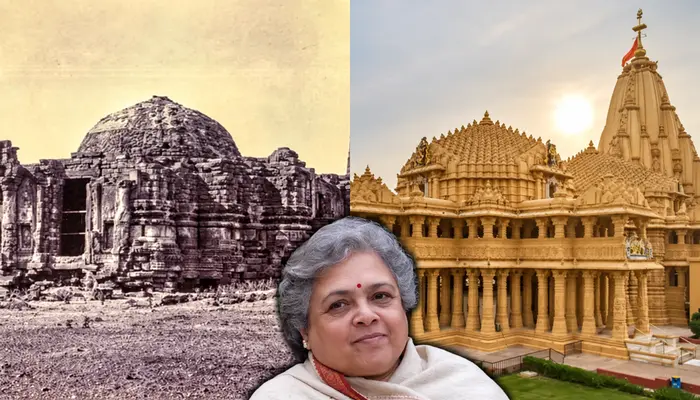
Case Summary
Leftist journalist Mrinal Pande spread a misleading account of Hindu resistance during the attack on the Somnath Temple by Islamic invaders. In doing so, she distorted the historical record and also mocked Brahmin priests by belittling their efforts to protect the sanctity of the temple during Mahmud Ghazni’s invasion. On 25 September 2026, Pande wrote in a social media post that when the Somnath Temple was being looted by the armies of Mahmud of Ghazni, its priests had simply sat outside the temple singing bhajans and seeking God’s blessings. Pande made the remark in response to an X post by Sohit Mishra, who had written, “When Rome was burning, Nero played the flute!” She deliberately drew a parallel between the familiar account of Nero supposedly playing the flute while Rome burned and her own portrayal of the Brahmin priests of Somnath as sitting outside the temple and singing bhajans while Mahmud Ghazni’s forces looted it. Through her post, she reduced the priests to passive spectators who supposedly chose prayer over resistance as their temple was being attacked and by doing so Pande turned a brutal episode in the history of Hindu persecution into an occasion to ridicule and belittle the very people associated with safeguarding the sanctity of the temple. Her post referred to the destruction and plunder of the Somnath Temple, one of Hinduism’s twelve Jyotirlingas dedicated to Lord Shiva. By portraying the Brahmin priests as sitting outside the temple and merely singing bhajans while it was under attack, Pande not only cast them as cowardly and passive but also mocked Hindu religious devotion. This portrayal is at odds with historical accounts of the Somnath attack, which describe Brahmin priests, temple guards and local devotees taking part in the defence of the temple. According to these accounts, Hindus repeatedly fought to protect the revered shrine during Mahmud Ghazni’s invasion and during the 18 Islamist attacks documented against the temple over its history.
Why it is Hate Crime ?
This case has been added to the tracker under the primary category of - Hate speech against Hindus. Within it, the sub-category selected here is - Anti Hindu subversion and prejudice. Hate speech is defined as any speech, gesture, conduct, writing, or display that is prejudicial against a specific individual and/or group of people, which is leading to or may lead to violence, prejudicial action or hate against that individual and/or group. Media plays a specific and overarching reach in perpetuating prejudicial attitudes towards a community owing to unfair, untrue coverage and/or misrepresentation/misinterpretation, selective coverage and/or omission of facts of/pertaining to issues affecting a specific religious group. This type of bias can dehumanise the victim group, making it easier for others to justify harmful actions against them, which aligns with the objectives of hate speech laws aimed at preventing such harm. It is often observed that the media takes a prejudicial stand against the Hindu community driven by their need to shield the aggressor community which happens to be a numeric minority, however, is the one perpetrating violence against Hindus. For example, the media is often quick to contextualise religiously motivated crimes against Hindus, omit or misrepresent facts that point towards religiously motivated hate crimes, justify and/or downplay religiously motivated hate crimes or simply present fake news to stereotype Hindus. Such media bias leads to the denial of persecution and is often used to dehumanise Hindus, leading to justification for violence against them. For example, the media covered several fake allegations of Hindus targeting Muslims and forcing them to chant Jai Shree Ram. Most of these cases were proved false and fabricated after police investigation. These fake news reports were subsequently never retracted or clarified. Such fake news led to the justification of violence and dehumanisation of Hindus based on the argument that since Hindus targeted Muslims and forced them to chant Jai Shree Ram, the dehumanisation of Hindus and violence against them was par for the course and merely a retaliation. Such media bias leads to prejudicial portrayal of Hindus and offers a justification for violence against them and therefore, is considered hate speech under this category. The other subcategory is: Anti-Hindu slurs, mocking faith. Anti-Hindu slurs and the deliberate mocking of the Hindu faith owing to religious animosity involve the usage of derogatory terms, stereotypes, or offensive references to religious practices, symbols, or figures. One of the common anti-Hindu slurs used against Hindus is “cow-worshipper” and “cow piss drinker”. The intention of using this term is to demean and mock Hindus as a group and their religious beliefs since Hindus consider the cow holy. Additionally, some symbols and the slurs attached to them have a historical context that exacerbates the insult, hate, stereotyping, dehumanisation and oppression against Hindus. Cow worship has been used for centuries to denigrate Hindus, insult their faith and oppress Hindus specifically as a religious group. There has been overwhelming documentation about how cow slaughter has been used to persecute Hindus with cow meat being thrown in temples and places of worship. There has also been overwhelming documentation where cow meat (beef) has been force-fed to Hindus to either forcefully convert them to Islam or denigrate their faith. Apart from cow worship, the Swastika – which holds deep religious significance for the Hindus – has also been misinterpreted and distorted to use as a slur against Hindus. Similarly, the worship of the Shivling has been used by supremacist ideologies and religions to denigrate Hindus owing to religious animosity. Such slurs and denigration stem out of inherent animosity and hate towards Hindus and their faith, therefore, it is categorised as hate speech targeted at Hindus specifically owing to their religious identity. The incident qualifies as a hate crime because the statement used a false and misleading portrayal of a historical event to denigrate Hindu religious figures and their conduct in defending a sacred Hindu place of worship. By claiming that the Brahmin priests of the Somnath Temple merely sat outside singing bhajans and seeking God’s blessings while the temple was being attacked, Mrinal Pande portrayed them as passive, cowardly and unwilling to defend their sacred place of worship. This portrayal is inconsistent with historical accounts that describe Brahmins and devotees assisting the temple garrison in resisting Mahmud of Ghazni’s forces. Historian Muhammad Nazim, in his 1931 historical study "The Life and Times of Sultan Mahmud of Ghazna", records that the temple garrison was assisted by Brahmins and devotees in defending the fort. He further records that after the invading forces breached the walls, Hindus entered the temple, prayed before the deity and then launched a counter-attack against the attackers. By presenting these Hindu defenders instead as people who simply sat outside singing bhajans, Pande distorted the historical account and used this portrayal to denigrate Brahmin priests. Pande further reinforced this derogatory portrayal by drawing a false equivalence between the Brahmin priests of Somnath and the familiar account of Roman Emperor Nero supposedly playing the flute while Rome burned. By comparing the priests’ supposed singing of bhajans during the attack to Nero’s supposed indifference to the destruction around him, she framed Hindu religious devotion as evidence of indifference to the attack on their sacred place of worship. The comparison therefore reinforced the false portrayal of the Brahmin priests as indifferent spectators rather than participants in the defence of the temple. The statement also ridiculed Hindu religious practices by presenting prayer, bhajans and seeking divine blessings as signs of helplessness rather than expressions of faith and devotion. Somnath is one of the twelve Jyotirlingas dedicated to Lord Shiva and is therefore a major Hindu sacred site. The historical account cited above specifically records Hindu defenders praying before the deity before mounting another attack against the invading forces. Thus, the act of devotion that Pande used as an object of ridicule was connected with the defenders’ determination to resist the attack. Her portrayal therefore demeaned not merely individual priests, but recognisably Hindu forms of worship and the religious faith they represented. The portrayal further trivialised the resistance and sacrifice of Hindus who defended Somnath. Historical accounts describe Brahmins, temple devotees and the garrison participating in the defence of the temple, with the defenders continuing to resist even after the invading forces had breached the fortifications. A separate, much later account in the "Tarikh-i-Alfi", compiled in the sixteenth century, records that a group of Brahmins offered Mahmud several crores of gold coins if he would spare the sacred idol, but that he refused and ordered its destruction. This further reflects the historical tradition of Brahmin efforts to protect the sacred object rather than the image of indifferent priests presented in Pande’s post. Her portrayal consequently reduced a complex episode involving resistance, devotion and attempts to protect the shrine to a caricature of Hindu priests sitting helplessly outside the temple. Taken together, the statement went beyond a disagreement over the interpretation of a historical event. It used Somnath, a major Hindu sacred site, its Brahmin priests, worship of Lord Shiva and the religious devotion of its defenders as the basis for a contemptuous portrayal of Hindus. By presenting Hindu priests as passive and cowardly, while using their devotional practices as the basis for ridicule and disregarding historical accounts of resistance, Pande demeaned Hindu religious figures and the faith they represented. The religious identity of the people and practices being ridiculed was therefore central to the derogatory nature of the statement. This negative potrayal, coupled with distortion of historical facts, can be seen as a form of hate speech, further deepening animosity toward Hindus and their faith and this is why this case has been added to the tracker.


Case Status
Unknown


Perpetrators Details
Perpetrators
Others
Perpetrators Range
One Person
Perpetrators Gender
female
 Sources




