Hindu sentiments outraged; Muslim man in Bangladesh posts iconoclastic image of Lord Ram with mocking remarks on social media
 Narayanganj District, Bangladesh
  28 September, 2026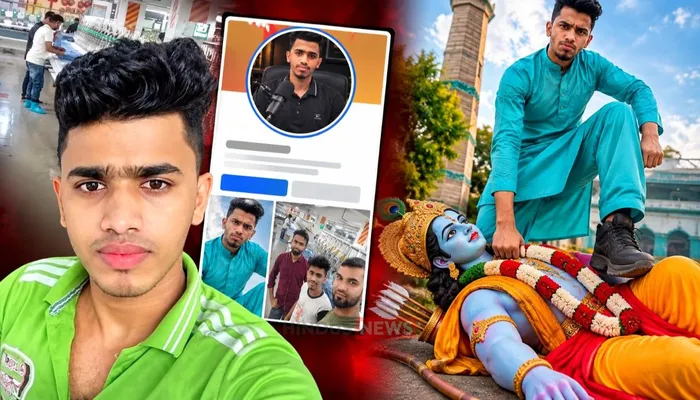
Case Summary
In Narayanganj, Bangladesh, a Muslim man named Faisal created and published an objectionable, iconoclastic AI-generated image depicting Lord Ram, a revered Hindu deity, on social media. The image showed Faisal standing on top of Lord Ram, placing his foot on him while holding him by the neck, thereby portraying the Hindu deity in a position of humiliation and subjugation. According to media reports, Faisal operated a Facebook handle under the name “Faisal Vai”. Alongside the derogatory image, he posted the caption “Ki rag korla”, meaning “Why did you get angry?”. The post attracted hundreds of reactions and comments, while a screenshot of the post displayed Facebook’s “AI content” label. The accused's account was named “Faisal Vai” and identified the user as a “Digital creator”. The profile listed Narayanganj as its location and, at the time the screenshots were taken, had approximately 7,300 followers, followed around 2,100 accounts and had approximately 720 posts. Reports also revealed that the account’s cover photo contained a statement directed at Hindus. It further stated that the profile contained multiple objectionable images and videos involving Hindu gods and goddesses. This incident occurred against the broader backdrop of the historical persecution faced by Hindus in Bangladesh. While the Hindu minority has endured discrimination, targeted violence, and religious hostility over decades, such persecution has intensified in distinct spurts during periods of political and social instability. The latest major escalation began after the ouster of Sheikh Hasina’s government in August 2024, continued after the death of Sharif Osman Bin Hadi in December 2025, and resurfaced in the immediate aftermath of the 13th National Parliamentary Election in 2026. Following the ouster of Sheikh Hasina, multiple incidents involving attacks on Hindu homes, temples and religious institutions were documented, alongside intimidation, arson and mob violence targeting Hindu localities. The Hinduphobia Tracker recorded 336 incidents involving the Hindu minority during this period, reflecting the scale of the escalation and the continuing vulnerability of Hindus in Bangladesh. A further spurt of violence followed the death of Sharif Osman Bin Hadi, a Muslim political activist and student leader known for his anti-Hindu and anti-India rhetoric, in December 2025. In the aftermath, Hindu communities were subjected to retaliatory violence, with Hindu homes and properties selectively attacked and several families forced to flee. Among the victims was Dipu Chandra Das, who was lynched and whose body was subsequently set ablaze by a Muslim mob over false blasphemy allegations. The Hinduphobia Tracker documented 51 incidents of anti-Hindu violence in the period following Hadi’s death alone, further illustrating how existing hostility towards the Hindu minority intensified during moments of communal mobilisation. During the same period, posters and written material calling for the extermination of Hindus were also displayed in public spaces. Such rhetoric, when viewed alongside incidents of arson, vandalism, assault and targeted intimidation, reflected an environment in which hostility towards Hindus was not merely episodic but repeatedly resurfaced in more intense forms during periods of unrest. The most recent escalation followed the 13th National Parliamentary Election in 2026. In the immediate aftermath of the election results, Hindu families in districts including Noakhali, Rangpur, Nilphamari, Sylhet, Thakurgaon and Dinajpur faced attacks involving arson, looting, assault and vandalism of Hindu homes and temples. In several instances, Hindu properties were selectively targeted, and families were threatened with displacement. The present incident therefore occurred within a much longer history of persecution of Hindus in Bangladesh, where hostility towards the community has persisted over time and intensified in repeated spurts. The latest cycle began after Sheikh Hasina's ouster. It continued through subsequent periods of political and communal upheaval, leaving the Hindu minority increasingly vulnerable to targeted violence, intimidation and religious hostility.
Why it is Hate Crime ?
This case is being added to the tracker under the primary category: Attack on Hindu religious representations. The subcategory selected is: Iconoclastic representation of Hindu Gods/Goddesses. An icon is a symbol of someone or something that is revered, or a religious representation of a spiritual ideal. Iconography is of vital significance in the Hindu milieu. It helps connect people’s spiritual beliefs with the real world. Iconography within the Hindu faith takes several shapes and forms. Murtis are of most significance to Hindus, to which daily rituals, prayers and offerings are done. Besides the murtis, there are several other symbols which have deep significance in the Hindu faith – the Om and Swastika for example. Any iconoclastic representation of these symbols, images and murtis is an affront to the religious beliefs and faith of the Hindu community itself since the symbols and icons are deeply religious in nature. In this sub-category of crime, we would record hate crimes and iconoclastic representations, in words, art, or any other form of representations of symbols that hold religious significance for the Hindu community. Since these symbols, icons and murtis are central to the Hindu faith, any iconoclastic representation of these symbols is born out of animosity towards the faith itself, manifesting itself through these symbols and therefore, these representations would be considered religiously motivated hated crimes. The second primary category selected is: Hate Speech against Hindus. The subcategory selected is: Anti-Hindu slurs, mocking faith. Anti-Hindu slurs and the deliberate mocking of the Hindu faith owing to religious animosity involve the usage of derogatory terms, stereotypes, or offensive references to religious practices, symbols, or figures. One of the common anti-Hindu slurs used against Hindus is “cow-worshipper” and “cow piss drinker”. The intention of using this term is to demean and mock Hindus as a group and their religious beliefs since Hindus consider the cow holy. Additionally, some symbols and the slurs attached to them have a historical context that exacerbates the insult, hate, stereotyping, dehumanisation and oppression against Hindus. Cow worship has been used for centuries to denigrate Hindus, insult their faith and oppress Hindus specifically as a religious group. There has been overwhelming documentation about how cow slaughter has been used to persecute Hindus with cow meat being thrown in temples and places of worship. There has also been overwhelming documentation where cow meat (beef) has been force-fed to Hindus to either forcefully convert them to Islam or denigrate their faith. Apart from cow worship, the Swastika – which holds deep religious significance for the Hindus – has also been misinterpreted and distorted to use as a slur against Hindus. Similarly, the worship of the Shivling has been used by supremacist ideologies and religions to denigrate Hindus owing to religious animosity. Such slurs and denigration stem out of inherent animosity and hate towards Hindus and their faith, therefore, it is categorised as hate speech targeted at Hindus specifically owing to their religious identity. This case is an example of a religiously motivated hate crime because the Muslim perpetrator deliberately mocked Hindu religious sentiments by posting derogatory content targeting Lord Ram. The hostile nature of the act forms the basis for its inclusion in the Hinduphobia Tracker database. Lord Ram holds profound religious significance in Hinduism. He is revered as an incarnation of Lord Vishnu and as an embodiment of dharma, righteousness, virtue and devotion. He is worshipped by millions of Hindus worldwide and holds a central place in Hindu religious and cultural traditions. Hindu deities are deeply revered by the community, and their images and representations hold sacred significance in worship and religious practice. Against this religious context, the creation and publication of an iconoclastic image showing the perpetrator standing on Lord Ram, placing his foot on him and holding him by the neck, amounts to a deliberate act of disrespect. Portraying a revered deity in a position of humiliation and subjugation degrades a sacred figure of the Hindu faith and demonstrates hostility towards Hinduism. The accompanying caption, “Ki rag korla”, meaning “Why did you get angry?”, further mocked Hindus for their reaction to the offensive depiction. The combination of the degrading portrayal and the mocking caption shows that the act was intended not only to denigrate a revered Hindu deity but also to ridicule the faith and sentiments of Hindus. The fact that the perpetrator had previously also made derogatory statements directed at Hindus, while his account contained multiple objectionable images and videos involving Hindu gods and goddesses. This indicates that the incident was not an isolated act but part of a repeated pattern of denigrating Hinduism and its sacred figures. The recurrence of such content further demonstrates hostility towards the Hindu faith rather than an isolated or incidental act of expression. Since this case meets the parameters of a religiously driven offence, it is being added to the hate crime database of the Hinduphobia Tracker. Disclaimer: Hinduphobia Tracker records incident dates based on when the crime occurs rather than when it is reported by the media. In this case, the media reports did not state the exact date on which the offence occurred. However, the report was published on 30 September 2026, while the screenshots indicated that the post had been published one day earlier. Based on these two pieces of information, 29 September 2026 is being selected as the indicative incident date for documentation purposes only.


Case Status
Unknown


Perpetrators Details
Perpetrators
Muslim Extremists
Perpetrators Range
One Person
Perpetrators Gender
male
 Sources




