Hindu Shiva temple land encroached upon in Majhawali, Sambhal; villagers seek removal of illegal occupation in Sambhal, Uttar Pradesh
 Sambhal, Uttar Pradesh, India
  30 August, 2026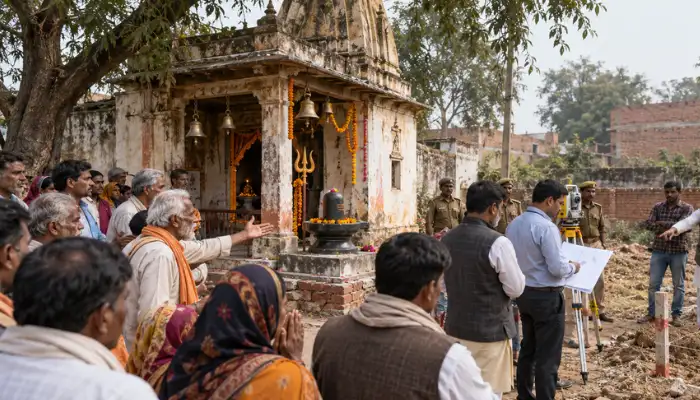
Case Summary
In Majhawali village, under Baniya Thether police station in Sambhal district, Uttar Pradesh, land belonging to a Shiva temple was illegally occupied, prompting villagers to approach the District Magistrate to remove the encroachment. According to the villagers, Gata No. 762, measuring 0.045 hectares, was recorded in official revenue records in the name of the Shiva temple, but powerful local individuals had taken possession of the land. The villagers stated that the Shiva temple was approximately 50–60 years old and had been used for worship and local religious fairs for several years. They wanted to renovate the temple and construct a boundary wall around the premises, but the individual occupying the disputed land opposed the proposed work and asserted that the property belonged to him privately. A complaint concerning the encroachment had earlier been submitted to the Sub-Divisional Magistrate of Chandausi on 31st August 2026. Following the complaint, a revenue team comprising the Revenue Inspector, Naib Tehsildar and Lekhpal conducted an on-site measurement of the temple land on 9th September 2026. Despite the measurement proceedings, the villagers stated that the encroachment remained in place. The villagers subsequently submitted an application to the District Magistrate, seeking immediate administrative action to remove the encroachment and restore the land recorded in the temple’s name. They also sought to proceed with renovation of the temple and construction of the boundary wall without interference. The representation carried the signatures of villagers and representatives of the Maharishi Bhagwan Valmiki Mahasabha, who approached the administration. The representatives were Pankaj Giri, Sanjeev Giri, Khachedu, Bablu Giri, Raghav, Anand, Nitin Puri, Naresh, Shripal, Avadhesh, Kishanpal, Vishesh Kumar, Kunwarpal, Chhatrapal and others.
Why it is Hate Crime ?
The primary category for this case is: Attack on Hindu religious representations. The subcategory for this case is: Encroachment or illicit takeover of temple land/land near a temple. In Hinduism, a temple is the abode of the Deity. The Deity in the Temple is consecrated, thereby making it a real, breathing entity. Hindus believe that not just the Deity but the temple premises itself are sacred to Hindus since Hindus hold the faith that the entire Temple space is an amalgamation of the divine energy of the deity. Not only the Temple but the Temple premises in their entirety are considered sacred by Hindus. In several cases, the premises of the Temple and/or religious centre are illicitly taken over by institutions belonging to other faiths – like the Waqf board or the Church. Other times, the temple property, land or the property of religious centres are illicitly encroached upon by non-Hindu groups. Any illicit takeover or encroachment is a crime ab initio; however, when non-Hindu groups illicitly take over or encroach on the sacred land of Hindus, it is an affront to the Hindu community and is therefore classified as a religiously motivated hate crime under this category. This case was recorded as a religious hate crime because the encroachment affected property attached to a Hindu place of worship and therefore interfered with the material foundation of a functioning religious institution. The significance of the conduct arose from the character of the property itself: it formed part of the sacred space through which the Hindu community maintained its relationship with the temple and exercised its religious rights. In Hinduism, a temple is regarded as the abode of the Deity, and its sanctity extends beyond the sanctum to the premises and land integrally connected with the religious institution. Such property supports worship, religious gatherings, festivals, maintenance, preservation and the continued functioning of the temple. Interference with temple land therefore affects more than ownership or possession; it can restrict the community’s ability to preserve the sacred space and sustain the religious practices associated with it. The encroachment also carried significance because control over temple property determines whether the Hindu community can protect, maintain and develop its own religious premises. When possession is asserted over land belonging to a temple, the affected community can be prevented from securing the site, carrying out necessary preservation work or ensuring that the premises remain available for religious use. The resulting harm is therefore institutional as well as physical, because it weakens the temple’s practical ability to function as a protected Hindu religious space. The matter consequently went beyond an ordinary private property disagreement. It involved interference with land dedicated to a Hindu religious institution and affected the community’s ability to exercise control over property meant to sustain that institution. The encroachment therefore struck at the preservation, autonomy and continuity of Hindu religious practice, which formed the basis for documenting the incident as a religiously motivated hate crime. Disclaimer: The Hinduphobia Tracker records incidents based on when an event occurred or when the victim’s ordeal began. In this case, the exact date on which the encroachment of the Shiva temple land first began was not specified in the available media reports. However, the villagers had formally approached the Chandausi SDM on 31st August 2026 regarding the encroachment. Therefore, 31st August 2026 has been recorded as the indicative incident date for documentation purposes only.


Case Status
Complaint filed


Perpetrators Details
Perpetrators
Others
Perpetrators Range
Unknown
Perpetrators Gender
unknown
 Sources




