Hindu family subjected to repeated bombing, vandalism and death threats over ransom demand in Rajbari, Bangladesh
 Rajbari District, Bangladesh
  12 September, 2026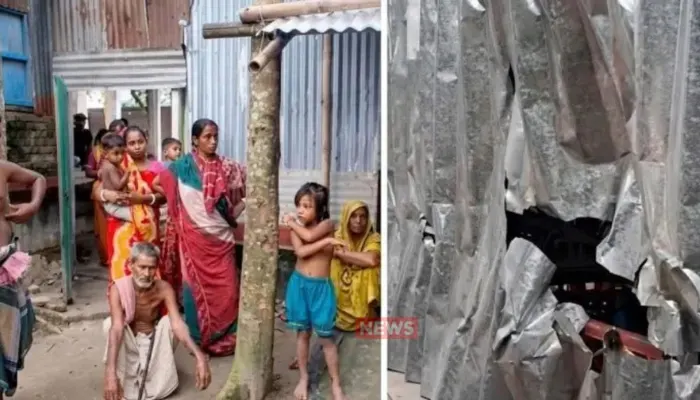
Case Summary
In Rishipara, Rajbari district, Bangladesh, the Hindu family of Sushil Rishi, which belonged to the local Sanatan Dharma community, was subjected to repeated attacks involving bombing, vandalism, looting, ransom demands and death threats. Local Hindu residents and community members stated that the family was being repeatedly targeted because of its Hindu identity. The latest attack took place at approximately 12:30 AM on 28th September 2026, around fifteen days after an earlier attack on the same household. During the latest attack, the perpetrators entered and vandalised the residence while elderly family members, women and children were present. Explosions were set off around the property, creating panic among the family and residents of Rishipara. Cash, gold ornaments and valuable foreign-made lights were also taken from the house. Sushil Rishi stated that the family had faced a similar attack approximately 15 days earlier, during which the perpetrators demanded 2 lakh BDT. After the family did not pay the demanded amount, the threats and intimidation continued, followed by the more serious attack on 28th September. Sushil’s daughter, Arpana Rishi, stated that the perpetrators had separately contacted her two brothers living abroad and demanded 5 lakh BDT. They threatened to kill their elderly father if the money was not paid within the stipulated period, subjecting the family to continued coercion through ransom demands and explicit threats of lethal violence. Sushil also connected the repeated attacks to a longstanding land-related and social dispute with individuals from the same village, stating that the violence against his household was being carried out with their encouragement. At the same time, members of the local Sanatan Hindu community expressed concern that the sustained intimidation formed part of repeated targeting of Hindu minority families in the area and stated that Sushil Rishi’s family had been attacked because of its Hindu identity. Following the latest incident, personnel from Pangsha Model Police Station visited the residence during the night. Officer-in-Charge Sheikh Mainul Islam stated that the initial police inquiry viewed the matter as connected to a land dispute and advised the family to submit a written complaint. Local Hindu community representatives subsequently demanded an impartial investigation, identification and punishment of those responsible, and effective protection for the family against further attacks and threats. This incident occurred against the broader backdrop of the historical persecution faced by Hindus in Bangladesh. While the Hindu minority has endured discrimination, targeted violence, and religious hostility over decades, such persecution has intensified in distinct spurts during periods of political and social instability. The latest major escalation began and continued after the ouster of Sheikh Hasina’s government in August 2024, followed by another surge after the death of Sharif Osman Bin Hadi in December 2025, and subsequently in the immediate aftermath of the 13th National Parliamentary Election in 2026. Following the ouster of Sheikh Hasina, multiple incidents involving attacks on Hindu homes, temples and religious institutions were documented, alongside intimidation, arson and mob violence targeting Hindu localities. The Hinduphobia Tracker recorded 336 incidents involving the Hindu minority during this period, reflecting the scale of the escalation and the continuing vulnerability of Hindus in Bangladesh. A further spurt of violence followed the death of Sharif Osman Bin Hadi, a Muslim political activist and student leader known for his anti-Hindu and anti-India rhetoric, in December 2025. In the aftermath, Hindu communities were subjected to retaliatory violence, with Hindu homes and properties selectively attacked and several families forced to flee. Among the victims was Dipu Chandra Das, who was lynched and whose body was subsequently set ablaze by a Muslim mob over false blasphemy allegations. The Hinduphobia Tracker documented 51 incidents of anti-Hindu violence in the period following Hadi’s death alone, further illustrating how existing hostility towards the Hindu minority intensified during moments of communal mobilisation. During the same period, posters and written material calling for the extermination of Hindus were also displayed in public spaces. Such rhetoric, when viewed alongside incidents of arson, vandalism, assault and targeted intimidation, reflected an environment in which hostility towards Hindus was not merely episodic but repeatedly resurfaced in more intense forms during periods of unrest. The most recent escalation followed the 13th National Parliamentary Election in 2026. In the immediate aftermath of the election results, Hindu families in districts including Noakhali, Rangpur, Nilphamari, Sylhet, Thakurgaon and Dinajpur faced attacks involving arson, looting, assault and vandalism of Hindu homes and temples. In several instances, Hindu properties were selectively targeted, and families were threatened with displacement. The present incident therefore occurred within a much longer history of persecution of Hindus in Bangladesh, where hostility towards the community has persisted over time and intensified in repeated spurts. The latest cycle began after the ouster of Sheikh Hasina and continued through subsequent periods of political and communal upheaval, leaving the Hindu minority increasingly vulnerable to targeted violence, intimidation and religious hostility.
Why it is Hate Crime ?
The primary category selected for this case is: Attack not resulting in death. The subcategory selected for this case is: Attacked for Hindu identity. In several cases, Hindus are attacked merely for their Hindu identity without any perceived provocation. A classic example of this category of religiously motivated hate crime is a murder in 2016. 7 ISIS terrorists were convicted for shooting a school principal in Kanpur because they got ‘triggered’ seeing the Kalava on his wrist and the tilak that he had put. In this case, the Hindu victim had offered no provocation except for his Hindu religious identity. The motivation for the murder was purely religious, driven by religious supremacy. Such cases where Hindus are targeted merely for their religious identity would be documented as a hate crime under this category. The other primary category selected for this case is: Hate speech against Hindus. The subcategory selected for this case is: Violent threats. Violent threats, explicit, implicit or implied, are the most dangerous form of hate speech since they go beyond discriminatory and prejudicial language to express the intent of causing harm to an individual or a group of people based on their religious identity and faith. There could be several different kinds of threats that are issued to Hindus based on religious animosity. An explicit threat would mean the direct threat of violence towards an individual Hindu, a group of Hindus or Hindus at large. Physical violence, death threats, threats of destruction of property belonging to Hindus and threats of genocide would mean explicit threats against Hindus for their religious identity. Implicit threats may not be a direct threat but implied through the use of symbols or actions – for example – in the Nupur Sharma case, other than explicit threats, there were also implicit threats when Islamists took to the streets to burn and beat her effigies. It implies that they want to do the same to Nupur Sharma; therefore, it is considered an implicit threat. Violent threats can be delivered in person, through letters, phone calls, graffiti, or increasingly through social media and other online platforms. It would be important to understand that a threat – explicit or implicit, online or offline – to an individual who happens to be a Hindu does not qualify as a religiously motivated threat. Such a threat, while vile and dangerous, could be owing to non-religious reasons and/or personal animosity. To qualify as a religiously motivated threat, it would need to exhibit an indication that the individual is being targeted for religious reasons and/or owing to his/her religious identity as a Hindu. This case has been categorised as a religiously motivated hate crime because the conduct reflected targeted hostility and intimidation against a Hindu minority family, with violence and explicit threats being used to create fear and insecurity on account of their vulnerable religious identity. The repeated targeting of the household carried a broader communal significance because the family belonged to the local Sanatan Hindu community, and other residents themselves connected the sustained violence against them with their Hindu identity. The attacks therefore affected more than the immediate physical security of one household; they reinforced a climate in which a Hindu minority family was made to feel unsafe within its own residence and vulnerable to continued intimidation. The death threats directed at the elderly head of the family represented an especially severe form of coercion. The threat was not abstract or rhetorical: it was communicated alongside monetary demands and against the background of prior violence. This gave the intimidation immediate credibility and placed the family under sustained pressure by making the victim’s life contingent upon compliance with the perpetrators’ demands. Such conduct transformed extortion into a direct threat of lethal violence. The bombing and vandalism further demonstrated that the intimidation was collective rather than limited to a private confrontation between individuals. The entire household, including elderly members, women and children, was exposed to fear and insecurity. Violence directed at a family home in this manner had the effect of undermining the family’s ability to live peacefully in its own locality and communicated that the threat extended to every member of the household. The religious dimension was strengthened by the family’s identification with the local Sanatan Dharma community and by statements from other Hindu residents that the repeated targeting was connected to their Hindu identity. At the same time, the family also referred to an existing land and social dispute. The case therefore involved an immediate property-related context alongside a broader pattern of hostility that local Hindu residents understood as directed against a vulnerable Hindu minority household. Taken together, the repeated intimidation, credible death threats, bombing and collective targeting of the household reflected a sustained campaign of fear against a Hindu family. The significance of the case lay not only in the individual acts of violence, but in the way those acts combined to threaten the family’s security, dignity and continued ability to remain safely within its own community. Disclaimer: The Hinduphobia Tracker records incidents based on the date on which they occurred or when the victim’s ordeal began. In this case, the family stated that they had been subjected to a similar attack approximately 15 days before the 28th September 2026 incident, while the exact date of that earlier attack was not specifically stated. Therefore, 13th September 2026 has been recorded as the indicative incident date for documentation purposes only.
Victim Details
Total Victim
4
Deceased
0
Gender
- Male 3
- Female 1
- Third Gender 0
- Unknown 0
Caste
- SC/ST 0
- OBC 0
- General 0
- Unknown 4
Age Group
- Minor 0
- Adult 3
- Senior Citizen 0
- Unknown 1


Case Status
Unknown


Perpetrators Details
Perpetrators
Muslim Extremists
Perpetrators Range
Unknown
Perpetrators Gender
unknown
 Sources




