Hindu youth assaulted by madarsa mob after Muslim journalist spread false accusation against him in Sunamganj, Bangladesh
 Sunamganj District, Bangladesh
  27 September, 2026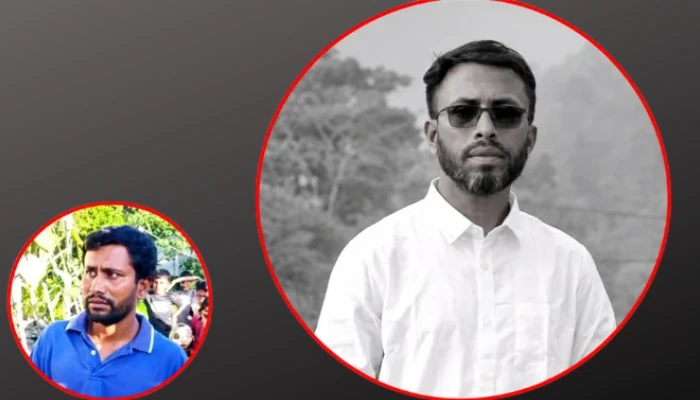
Case Summary
In Dirai, Sunamganj, Bangladesh, a Hindu youth, Rony Baidya, was publicly humiliated and physically assaulted by a Muslim man. The accused journalist, Moshahid Ahmed, circulated a misleading Facebook video accusing him of involvement in immoral activities without presenting any evidence. Following the circulation of the video, a group of youths from a local madarsa gathered at the spot and beat Rony, while local sources stated that his position as a Hindu religious minority contributed to the discriminatory treatment he faced. Rony was a local working-class youth residing in Dirai. On 28th September 2026, Moshahid Ahmed published a video on his Facebook account portraying Rony as having been caught engaging in immoral conduct. The accusation spread locally before anyone could verify the incident impartially. After the video circulated, several Muslim youths associated with a local madarsa reached the location and physically assaulted Rony. He was subjected to mob violence and public humiliation based on an accusation that had not been verified. Police later arrived after receiving information and brought the situation under control. About four hours later, Moshahid Ahmed deleted the original video from his Facebook account and posted another message acknowledging that Rony was innocent and had no involvement in the alleged immoral activity. He said inquiries in the locality produced no evidence against Rony and asked other users who had shared the earlier video to remove it. The subsequent clarification came only after Rony had already been publicly defamed and physically attacked. The incident generated anger among residents, who questioned how an unverified social-media accusation could expose a Hindu minority youth to mob violence and damage his dignity before the facts were examined. Residents subsequently demanded a fair investigation, action against those responsible for the assault, and accountability for circulating the false accusation. They also called for measures to prevent members of Bangladesh’s Hindu minority from being subjected to harassment, violence and public humiliation based on unverified accusations. The Hinduphobia Tracker team tried to retain information about Moshahid Ahmed from his existing Facebook account, but could not obtain any information because his social media account had been removed or shadow-banned. This incident occurred against the broader backdrop of the historical persecution faced by Hindus in Bangladesh. While the Hindu minority has endured discrimination, targeted violence, and religious hostility over decades, such persecution has intensified in distinct spurts during periods of political and social instability. The latest major escalation began after the ouster of Sheikh Hasina’s government in August 2024, continued after the death of Sharif Osman Bin Hadi in December 2025, and resurfaced in the immediate aftermath of the 13th National Parliamentary Election in 2026. Following the ouster of Sheikh Hasina, multiple incidents involving attacks on Hindu homes, temples and religious institutions were documented, alongside intimidation, arson and mob violence targeting Hindu localities. The Hinduphobia Tracker recorded 336 incidents involving the Hindu minority during this period, reflecting the scale of the escalation and the continuing vulnerability of Hindus in Bangladesh. A further spurt of violence followed the death of Sharif Osman Bin Hadi, a Muslim political activist and student leader known for his anti-Hindu and anti-India rhetoric, in December 2025. In the aftermath, Hindu communities were subjected to retaliatory violence, with Hindu homes and properties selectively attacked and several families forced to flee. Among the victims was Dipu Chandra Das, who was lynched and whose body was subsequently set ablaze by a Muslim mob over false blasphemy allegations. The Hinduphobia Tracker documented 51 incidents of anti-Hindu violence in the period following Hadi’s death alone, further illustrating how existing hostility towards the Hindu minority intensified during moments of communal mobilisation. During the same period, posters and written material calling for the extermination of Hindus were also displayed in public spaces. Such rhetoric, when viewed alongside incidents of arson, vandalism, assault and targeted intimidation, reflected an environment in which hostility towards Hindus was not merely episodic but repeatedly resurfaced in more intense forms during periods of unrest. The most recent escalation followed the 13th National Parliamentary Election in 2026. In the immediate aftermath of the election results, Hindu families in districts including Noakhali, Rangpur, Nilphamari, Sylhet, Thakurgaon and Dinajpur faced attacks involving arson, looting, assault and vandalism of Hindu homes and temples. In several instances, Hindu properties were selectively targeted, and families were threatened with displacement. The present incident therefore occurred within a much longer history of persecution of Hindus in Bangladesh, where hostility towards the community has persisted over time and intensified in repeated spurts. The latest cycle began after the ouster of Sheikh Hasina and continued through subsequent periods of political and communal upheaval, leaving the Hindu minority increasingly vulnerable to targeted violence, intimidation and religious hostility.
Why it is Hate Crime ?
This incident has been added under the category- Attack not resulting in death. Under this, teh subcategory selected is- Attacked for Hindu identity. In several cases, Hindus are attacked merely for their Hindu identity without any perceived provocation. A classic example of this category of religiously motivated hate crime is a murder in 2016. 7 ISIS terrorists were convicted for shooting a school principal in Kanpur because they got ‘triggered’ seeing the Kalava on his wrist and tilak that he had put. In this, the Hindu victim had offered no provocation except for his Hindu religious identity. The motivation for the murder was purely religious, driven by religious supremacy. Such cases where Hindus are targeted merely for their religious identity would be documented as a hate crime under this category. The religious dimension of this incident lies in the way an unverified accusation against a member of Bangladesh’s Hindu minority rapidly translated into collective punishment. What is particularly significant is not merely that Rony was assaulted, but the apparent ease with which a Muslim group mobilised against him without first establishing whether the accusation was true. The allegation was subsequently withdrawn and Rony acknowledged as innocent, demonstrating that the violence had preceded any meaningful verification of the claim. Rony’s Hindu identity is therefore an important factor in assessing the incident. He was a Hindu youth belonging to a vulnerable religious minority, while those who mobilised against him were Muslim youths associated with a local madarsa. The available account indicates that his minority status contributed to the discriminatory treatment he received. In this context, the willingness to publicly humiliate and physically punish a Hindu man on the basis of an unverified allegation reflects a level of religious hostility that cannot be separated from the communal setting in which the incident occurred. The most troubling aspect is the low threshold for collective violence against the Hindu victim. The accusation did not have to be established before punishment began. Rony’s innocence was recognised only after he had already been subjected to mob violence. This effectively reversed the basic principle that an accusation must be established before an individual is punished. In this case, being accused was apparently enough to make a Hindu minority youth a target. This becomes particularly significant in the context of the broader environment faced by Hindus in Bangladesh. The Hinduphobia Tracker has documented repeated instances in which Hindu individuals, families, homes and religious institutions have been targeted during periods of political and social instability. Against that backdrop, the Rony Baidya case illustrates how quickly hostility can be activated against a Hindu minority individual. A relatively small and unverified trigger was sufficient to generate collective mobilisation and violence before the facts were established. The incident therefore points to more than irresponsible social-media reporting or ordinary mob behaviour. It demonstrates how religious identity can determine who becomes vulnerable when an accusation begins to circulate. The fact that the victim was Hindu, the attackers were Muslim youths associated with a madarsa, and the accusation was acted upon before it was verified are all relevant indicators of religiously motivated hostility. The case has therefore been included in the Hinduphobia Tracker’s Hate Crime Database because Rony’s Hindu identity was the key factor in the discriminatory treatment and violence he faced. It also illustrates the wider vulnerability of Bangladesh’s Hindu minority, where an unverified accusation can, rapidly become a pretext for collective punishment of a Hindu victim.
Victim Details
Total Victim
1
Deceased
0
Gender
- Male 1
- Female 0
- Third Gender 0
- Unknown 0
Caste
- SC/ST 0
- OBC 0
- General 0
- Unknown 1
Age Group
- Minor 0
- Adult 1
- Senior Citizen 0
- Unknown 0


Case Status
Unknown


Perpetrators Details
Perpetrators
Muslim Extremists
Perpetrators Range
One Person
Perpetrators Gender
male
 Sources




