Minor Hindu girl abducted, raped and taken to Ajmer Dargah by Muslim man; victim was pressured to convert, offer namaz, wear burqa and eat meat
 Bulandshahr, Uttar Pradesh, India
  12 April, 2024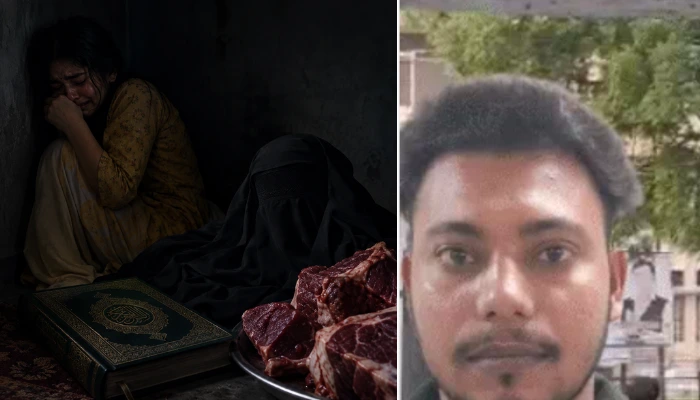
Case Summary
In Bulandshahr, Uttar Pradesh, a 15-year-old Hindu girl was lured into a relationship by a Muslim man named Zaid Khan, a resident of Mohalla Rogan, on the pretext of marriage. She was subsequently abducted, raped, taken to the Ajmer Dargah, confined, and subjected to pressure to convert to Islam. The accused also forced her to wear a burqa, offer namaz, and consume meat and drugs. Two other men, Zaid’s brother Shoaib and father Chhuttan, also supported him and played an important role in the crime. The Hinduphobia Tracker team contacted the police in this case, and they confirmed to us that the victim belonged to the Hindu community. According to reports, the incident occurred in 2024, when the girl’s mother and other family members had gone to the fields to harvest wheat. During this time, Zaid arrived at their home along with his brother Shoaib and father Chhuttan and took the 15-year-old girl away on the pretext that he would marry her. A young man from the village witnessed the girl being taken away. On April 13, 2024, a complaint was filed regarding her abduction. Zaid first took her to Aligarh and then to Agra, where he raped her in a hotel. He subsequently took her to Jaipur and then to the Ajmer Dargah in Rajasthan. In Ajmer, Zaid confined the minor in a room for several days. During this period, he repeatedly pressured her to convert to Islam, forced her to wear a burqa and offer namaz, and made her consume drugs and non-vegetarian food. The girl eventually managed to switch on her mobile phone, allowing the police to trace her location. Following this, on April 30, 2024, police traced her to the area near Ajmer railway station, arrested Zaid and safely recovered the minor. Her medical examination also confirmed rape and injuries. Following the investigation, police filed a chargesheet against Zaid, his brother Shoaib and their father Chhuttan under provisions relating to kidnapping, abduction with intent to compel marriage, wrongful confinement, rape of a girl below 16, the Protection of Children from Sexual Offences Act, and the Uttar Pradesh Prohibition of Unlawful Conversion of Religion Act, 2021. During the trial, the prosecution examined 10 witnesses, including the victim, a doctor and the investigating officer. The court also considered the victim’s school records, medical report and other evidence establishing her age and the circumstances of the crime. After a trial lasting nearly two years, Special Judge, Protection of Children from Sexual Offences Act-I, Manoj Kumar Mishra, convicted Zaid and sentenced him to life imprisonment. Zaid was sentenced to life imprisonment and fined ₹25,000 under Section 376(3) of the Indian Penal Code for raping the minor. Under Section 5(1) of the Uttar Pradesh Prohibition of Unlawful Conversion of Religion Act, 2021, he was sentenced to 10 years’ imprisonment and fined ₹50,000 for forcing the minor to convert, with an additional 10 months’ imprisonment in case of non-payment. Under Section 366 of the Indian Penal Code, he received 10 years’ imprisonment and a ₹10,000 fine for abducting the minor with the intent to compel marriage, with an additional 10 months’ imprisonment for non-payment. Under Sections 363 and 368 of the Indian Penal Code, Zaid was sentenced to seven years’ imprisonment and fined ₹7,000 for each offence of kidnapping and wrongfully confining the minor, with an additional seven months’ imprisonment for non-payment of each fine. The court imposed a total fine of approximately ₹2.99 lakh and ordered ₹2 lakh in compensation to be paid to the victim under Section 5(2) of the Uttar Pradesh Prohibition of Unlawful Conversion of Religion Act, 2021. All the sentences were ordered to run concurrently. Zaid was sent to District Jail, Bulandshahr, to serve his sentence, while Shoaib and Chhuttan were acquitted after being given the benefit of the doubt due to a lack of sufficient evidence.
Why it is Hate Crime ?
The first primary category selected in this case is: Predatory Proselytisation. The subcategory selected is: Proselytisation by grooming, brainwashing, manipulation or subtle indoctrination. The tertiary categories are: Rape and sexual assault/harassment and Conversion of minor. Religious brainwashing essentially means the often subtle and forcible indoctrination to induce someone to give up their religious beliefs to accept contrasting regimented ideas. Religious grooming or brainwashing also involves propaganda and manipulation. It involves the systematic effort, driven by religious malice and indoctrination, to persuade “non-believers’ to accept allegiance, command, or doctrine to and of a contrasting faith. Cases of such grooming or brainwashing are far more nuanced than direct threats, coercion, inducement and violence. In such cases, it is often seen that there is repeated, subtle and continual manipulation of the victim to induce disaffection towards their own faith and acceptance of the contrasting faith of the perpetrator. While subtle indoctrination is widely acknowledged as predatory, an element which is often understated in such conversions or the attempts of such conversion is the role of loyalty and trust which might develop between the perpetrator and the victim. Fiduciary relationships are often abused to affect such religious conversion. For example, an educator transmitting religious doctrine of a competing faith to a Hindu student. The Hindu student is likely to accept what the teacher is transmitting owing to existence of the fiduciary relationship. The exploitation of the fiduciary relationship to religiously indoctrinate victims would also be included in this category. Since the underlying animosity towards the victim’s faith forms the basis of predatory proselytization, such cases are considered religiously motivated hate crimes. The other subcategory selected is: Harassment, threats, coercion for conversion. Harassment covers a wide range of behaviours of an offensive nature. It is commonly understood as behaviour that demeans, humiliates, and intimidates a person, including threats and coercion. Harassment and threats, in this case, find their root on discriminatory grounds which has the effect of nullifying a person’s rights or infringing upon his freedom to exercise his right specifically owing to the victim’s religious identity. Verbal and physical threats and psychological or physical harassment are often used against Hindu victims because they choose to practice their professed religion. Religious harassment also includes forced and involuntary conversions by harassment, threats or coercion. Coercion includes intimidatory tactics like force-feeding a Hindu victim beef to convert to another religion, forceful circumcision etc. In several cases documented, non-Hindu perpetrators or those who harbour specific animosity towards Hinduism, harass victims simply based on their religious identity. Such cases often also include harassment to ensure the Hindu victim abandons his/her professed religion and adopts the religion of the perpetrator. Such cases where Hindu victims are harassed to convert to the perpetrator’s religion are rooted in animosity towards the victim’s religious identity and are therefore documented as religiously motivated hate crimes. The second primary category selected in this case is: Crimes against women in relationships and other sexual crimes. The subcategory selected is: Brainwashed and/or Groomed. The tertiary categories selected are: Rape and sexual assault/harassment and Conversion of Minor. In our database, we have not added incidents where women have converted to another religion of their free will and no allegations of forced/involuntary conversion have been made. However, there are certain cases of conversion where the consent itself is a result of the brainwashing or grooming of a minor by the non-Hindu perpetrator trying to victimise a woman for her Hindu religious identity. The phenomenon of grooming points to non-Hindu perpetrators identifying their Hindu victims’ vulnerabilities and exploiting them over months and sometimes years, to extract the supposed ‘consent’ in order to convert their religion. In most cases of grooming, the victims are minors or the grooming started when the victim was a minor. In other cases of grooming, the non-Hindu perpetrator brainwashes and grooms a minor victim to extract their trust and then proceeds to rape them repeatedly with the intent of converting them to their faith. It is pertinent to understand here that when the victim is a minor, the ‘consent’ to convert or enter into a romantic relationship with an adult itself is redundant – addressed by POCSO. While every case of conversion of a minor and incidents of establishing a physical relationship with a minor by an adult is a crime, for the purpose of this database, a case would be considered a hate crime only if there is a distinct religious angle to the grooming. For example, in the UK, if a Hindu minor is targeted by Pakistani grooming gangs, it would be considered a hate crime because the victims are specifically targeted owing to their non-Muslim religious identity with the perpetrators being Muslim. In other cases, if a Hindu minor is brainwashed into entering a physical relationship with the non-Hindu adult perpetrator and the family alleges grooming/brainwashing of the minor to convert her religion, it would form a part of this database. If the victim is a Hindu adult, the case would form a part of this database only if the victim herself says that she was brainwashed/groomed to convert her religion. However, if the victim is deceased (murdered or otherwise), the case would form a part of this database if her family/friends provided testimony that the victim was brainwashed/groomed to convert her religion. Since these crimes have a distinct religious angle where the victim is being targeted owing to her Hindu religious identity, these cases are considered a hate crime. The other subcategory selected is: Forced conversion before marriage. The tertiary categories selected are: Forced to follow non-Hindu religious practices, Forced to go to Mosque, and Forced to wear Hijab. In such cases, a non-Hindu man is in a relationship with a Hindu woman when the pressure to convert her religion begins to manifest. In such cases, typically, two patterns emerge. First, when the relationship is consensual, and the religious identity of the perpetrator is known to the Hindu woman in the relationship, however, at some point during the relationship, the non-Hindu man starts to force the victim to convert her religion and give up her Hindu religious identity. The second is when the woman gets into a marriage with the man pretending to share her faith. Later, when the truth is revealed, the man starts pressuring the woman to convert her religion and give up her religious identity. In both the situations, the methods used to force the victim to convert her religion often revolve around force-feeding beef, forcing her to wear hijab, forcing her to read the Kalma or even pressurizing the victim to do ‘Nikah’, which is marriage under Islamic law, with a prerequisite being conversion to Islam. Cases where a Hindu woman consensually converts to Islam in a relationship will be left out of the hate crime database, even though it could be argued in several cases that the conversion was a result of religious brainwashing. This case is a clear example of a religiously driven hate crime, as a minor Hindu girl was lured into a relationship, abducted, taken to the Ajmer Dargah, raped, and repeatedly pressured to abandon her Hindu faith. She was forced to convert to Islam, offer namaz, wear a burqa, and consume meat and drugs. These acts targeted her religious identity through conversion, rituals, dress, food and confinement. The sustained attempt to disconnect her from Hinduism and impose an Islamic identity demonstrates clear religious hostility. The fact that the victim was a minor is particularly significant. At 15 years of age, she was legally a child and highly vulnerable to manipulation, coercion and exploitation. Given her age and lack of maturity, she was not in a position to fully understand the implications of being forced to adopt another religion. The coercive methods used against her show that genuine consent or a voluntary change of conscience was absent from the outset. Her vulnerability as a minor was exploited to pressure her to convert to Islam and adopt Islamic practices. This deliberate exploitation of a Hindu minor’s vulnerability in pursuit of religious conversion makes the incident a religiously motivated hate crime against a Hindu victim. The manner in which the victim was initially lured into a relationship and subsequently abducted demonstrates the predatory nature of the crime from its inception. The relationship was initiated under the pretext of marriage and was followed by the physical removal of the minor from her family and community. By abducting her away from her Hindu family, the perpetrator removed her from her immediate support and protective environment and placed her in circumstances where he exercised control over her. The subsequent confinement, pressure to convert and imposition of Islamic practices show how the initial luring and abduction formed part of a continuing pattern of coercion. Isolation from the victim's family and Hindu social environment made her increasingly vulnerable to religious coercion and facilitated the attempts to alter her religious identity. Such acts of luring, abduction, isolation and confinement, when used as mechanisms to facilitate religious conversion, amount to harassment and coercion for conversion and demonstrate hostility towards the victim's religious identity. The rape of the victim after her abduction was a serious form of violence within the broader conversion attempt. She was abducted, isolated and taken to different locations before being confined and pressured to convert to Islam. The sexual assault further increased her vulnerability and was followed by continued religious coercion. In this context, the rape was not an isolated act of violence but part of a wider pattern of domination and coercion directed at a Hindu minor. The combination of sexual violence and forced religious practices demonstrates the religious hostility involved in the crime. The forced attempt to convert the victim to Islam directly targeted her religious autonomy. Religious belief is an integral component of personal identity, conscience and individual autonomy, and the imposition of a religious identity through force is fundamentally different from a voluntary change of faith. Here, the victim was not placed in circumstances in which she was freely considering another religion; she was abducted, confined and subjected to sustained coercion before being pressured to abandon Hinduism. The attempt to force a minor Hindu girl to adopt Islam under such circumstances demonstrates disregard for her existing religious identity and her autonomy over matters of faith. The coercive nature of the conversion attempt therefore constitutes a direct manifestation of religious hostility. The victim was also forced to offer namaz and wear a burqa, demonstrating that the coercion extended beyond merely demanding a formal declaration of conversion. Islamic religious practices and forms of dress were imposed upon her as part of the broader attempt to alter her identity and way of life. Being compelled to participate in namaz and wear a burqa placed the victim under pressure to visibly and behaviourally conform to an Islamic identity. These acts were therefore connected to the wider attempt to disconnect her from her Hindu identity and progressively impose another religious identity upon her. The repeated imposition of religious practices and dress on an abducted Hindu minor demonstrates that the coercion operated at the level of her everyday identity and not merely at the level of a formal conversion. The fact that the victim was taken to the Ajmer Dargah is also significant in understanding the environment in which the conversion pressure was exercised. She was taken away from her Hindu family and brought into an explicitly Islamic religious setting, where she was subsequently confined and subjected to religious coercion. Placing a minor Hindu victim in such an environment while simultaneously pressuring her to convert and imposing Islamic practices upon her formed part of the broader process of transforming the environment around her and weakening her connection to her original faith. The forced relocation to a religious shrine, followed by confinement and religious pressure, demonstrates how the perpetrator sought to exercise control over the victim's surroundings as well as her religious choices. The use of an Islamic religious setting in conjunction with coercive conversion therefore forms part of the religiously hostile character of the crime. The forced consumption of meat and drugs further demonstrates the extent to which the perpetrator sought to violate the victim's personal and religious boundaries and sever her from her Hindu identity. Although a significant number of Hindus consume meat, vegetarianism is an important religious and cultural practice for a substantial section of the Hindu community. In this case, forcing a Hindu minor to consume meat was not an isolated dietary act; it occurred alongside the pressure to convert to Islam, the forced performance of namaz, the imposition of a burqa and her confinement in an Islamic religious environment. The act therefore formed part of a broader attempt to make the victim transgress practices associated with her Hindu identity and progressively impose an Islamic identity upon her. Historically, Muslim extremists and medieval Muslim invaders in the Indian subcontinent also used the forced consumption of beef, meat or other forms of food transgression as a means of humiliating Hindus, violating their religious sensibilities and, in accounts of religious persecution, pressuring them towards conversion. In this case, the perpetrator's forced consumption of meat, coupled with drugs and the other coercive measures directed at her faith, reflects the same underlying mechanism of violating religious boundaries to facilitate the abandonment of Hindu identity. The deliberate targeting of practices carrying religious significance, within a larger campaign of forced conversion, demonstrates the religious hostility driving the crime. The religious character of the crime is further established by the fact that the evidence was presented before a court and Zaid was convicted after trial. The prosecution examined 10 witnesses, including the victim, a doctor and the investigating officer, while the court considered the medical report, school records and other evidence establishing the victim's age and the circumstances of the crime. Zaid was ultimately convicted and sentenced to life imprisonment, along with sentences for unlawful religious conversion, abduction and related offences. The conviction establishes that the central acts underlying the case were proved before the court and were not merely untested accusations. The sequence of abduction, rape, confinement, coercive conversion and imposition of religious practices demonstrates a sustained pattern of domination in which the victim's Hindu identity was disregarded and subjected to repeated attempts at erasure. The perpetrator's conduct demonstrates hostility towards the victim's existing religious identity and a determination to replace it through coercion rather than voluntary choice. Since this case meets the parameters of a religiously motivated hate crime, it is being added to the Hinduphobia Tracker's hate crime database. Disclaimer: The Hinduphobia Tracker records incident dates based on when the victim’s ordeal begins, rather than when the incident is reported by the media. However, in this case, the media reports do not specify the exact date when the victim’s ordeal began. They only state that the complaint was filed on 13 April 2024. Hence, 13 April 2024 has been selected as the indicative incident date for documentation purposes only. In this case, three perpetrators, Zaid Khan, Chhuttan and Shoaib, were initially named in the chargesheet. However, Chhuttan and Shoaib were acquitted by the court due to lack of evidence. Therefore, the perpetrator count has been recorded as one for documentation purposes only.
Victim Details
Total Victim
1
Deceased
0
Gender
- Male 0
- Female 1
- Third Gender 0
- Unknown 0
Caste
- SC/ST 0
- OBC 0
- General 0
- Unknown 1
Age Group
- Minor 1
- Adult 0
- Senior Citizen 0
- Unknown 0


Case Status
Perpetrator held guilty by court


Perpetrators Details
Perpetrators
Muslim Extremists
Perpetrators Range
One Person
Perpetrators Gender
male
 Sources




