Hindus targeted for Christian conversion through financial inducements under pretext of prayer meeting in Rewa, Madhya Pradesh
 Rewa, Madhya Pradesh, India
  27 September, 2026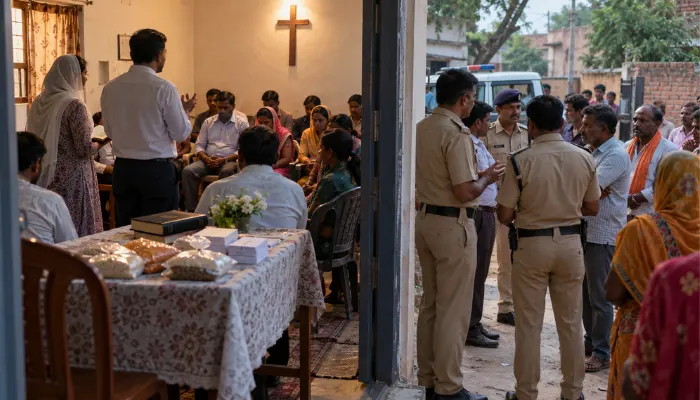
Case Summary
In Sohagi town, Rewa district, Madhya Pradesh, Hindus were targeted for Christian religious conversion through a prayer meeting where financial assistance and other material inducements were offered to encourage them to change their faith. Residents objected to the gathering, following which Sohagi Police intervened and arrested two people in connection with the conversion activity. Residents stated that large numbers of people regularly attended prayer meetings at the location. During the latest gathering, residents reached the premises and protested after learning that Hindu attendees were being encouraged towards Christianity through monetary assistance and other inducements. As the confrontation intensified, Sohagi police arrived and brought the situation under control. Police personnel spoke to both those conducting the prayer meeting and the protesting residents before taking members of both sides to the police station for questioning. At the police station, officers gathered information about the activities during the prayer meeting and examined the complaint about religious conversion. A written complaint was subsequently submitted, on the basis of which police initiated legal action. Sohagi Police Station in-charge Kamlesh Sahu stated that two people were arrested in connection with conversion through inducement and coercion. Police also registered a case against an unidentified individual. Police began examining who had attended the gathering, the nature of the activities conducted there and the financial or other inducements used to encourage religious conversion.
Why it is Hate Crime ?
The primary category selected for this case is: Predatory proselytisation. The subcategory selected for this case is: Conversion/attempts to convert by inducement. Predatory Proselytisation is not just limited to threats, harassment, force and violence, but it also has contours of stealth. In several cases, the Hindu victim is exploited to convert, with non-Hindus taking advantage of their poverty. In such cases, the Hindu victim who is suffering financially is offered monetary benefits, including lucrative offers for jobs, health treatment, education, etc., to induce the victim to change his/her religion. In such cases, the religious identity of the victim and the aim to disenfranchise him from his faith form the heart of the crime. Also, taking advantage of and exploiting an individual’s economic vulnerabilities is widely acknowledged as exploitation, forms of which are often penalised by law. Such cases therefore are considered religiously motivated hate crimes since the victim’s religious identity forms the very heart of the crime itself. This case has been categorised as a religiously motivated hate crime because the core religious marker was the attempt to draw Hindu participants away from their existing faith by linking religious conversion with material benefits. This made the victims’ Hindu identity central to the activity rather than incidental. First, the use of financial assistance and other inducements mattered because it sought to influence religious conversion through material dependency rather than genuine religious conviction. Economic vulnerability can make monetary support or other benefits particularly persuasive to individuals facing financial hardship. When such assistance is connected with an effort to persuade Hindus to abandon their faith and adopt Christianity, their vulnerability becomes a means of facilitating religious conversion. This undermines religious autonomy because material need, rather than personal belief, influences the decision to change faith. Secondly, the prayer meeting provided a setting through which the conversion activity could be carried out repeatedly and collectively. Residents stated that large numbers of people regularly attended gatherings at the location, indicating that the meeting was not an isolated interaction. Such recurring gatherings create opportunities to approach Hindu participants, build familiarity and repeatedly present material assistance alongside Christian religious teachings. In the context of conversion through inducement, this combination of religious outreach and economic incentives becomes predatory because it exploits the circumstances of vulnerable individuals to encourage them to relinquish their existing religious identity. Such conduct treats the victims’ Hindu identity as something to be displaced through material influence and reflects hostility towards their continued adherence to Hinduism. Moreover, it stems from inherent hostility towards the victim's professed faith since Abrahamic faiths believe that any non-adherent to the faith is subject to being dehumanised till they convert. This mindset does not merely tolerate the existence of another faith but seeks its erasure or assimilation. As a result, Hindus are often targeted not because of who they are as individuals, but because of their religious identity. The violence, deception, or humiliation inflicted in such cases is therefore not random, but part of a broader ideological hostility toward Hinduism and its symbols, practices, and adherents. Here, too, the predatory actions stemmed from doctrinal animosity towards the Hindu faith, which is why this case is being documented as a religiously motivated hate crime. Disclaimer: The exact identities and number of the Christian individuals involved in conducting the prayer meeting and conversion have not yet been confirmed. Apart from their association with the Christian prayer gathering and proselytisation activity, their names, ages, addresses and other identifying details remain unknown. Therefore, the Hinduphobia Tracker has recorded the perpetrators' exact count as unknown for documentation purposes.


Case Status
Complaint filed


Perpetrators Details
Perpetrators
Christian Extremists
Perpetrators Range
Unknown
Perpetrators Gender
unknown
 Sources




