Hindu Rajput women's collective self-sacrifice Jauhar labelled "evil practice", Muslim women eulogised for not practising “Sati” in NIOS textbook
 India
India  27 September, 2026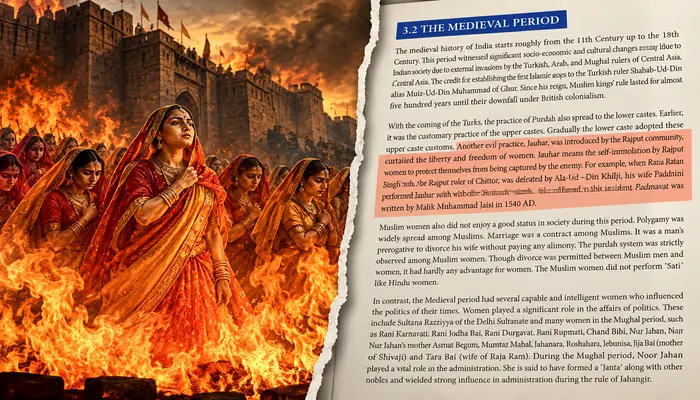
Case Summary
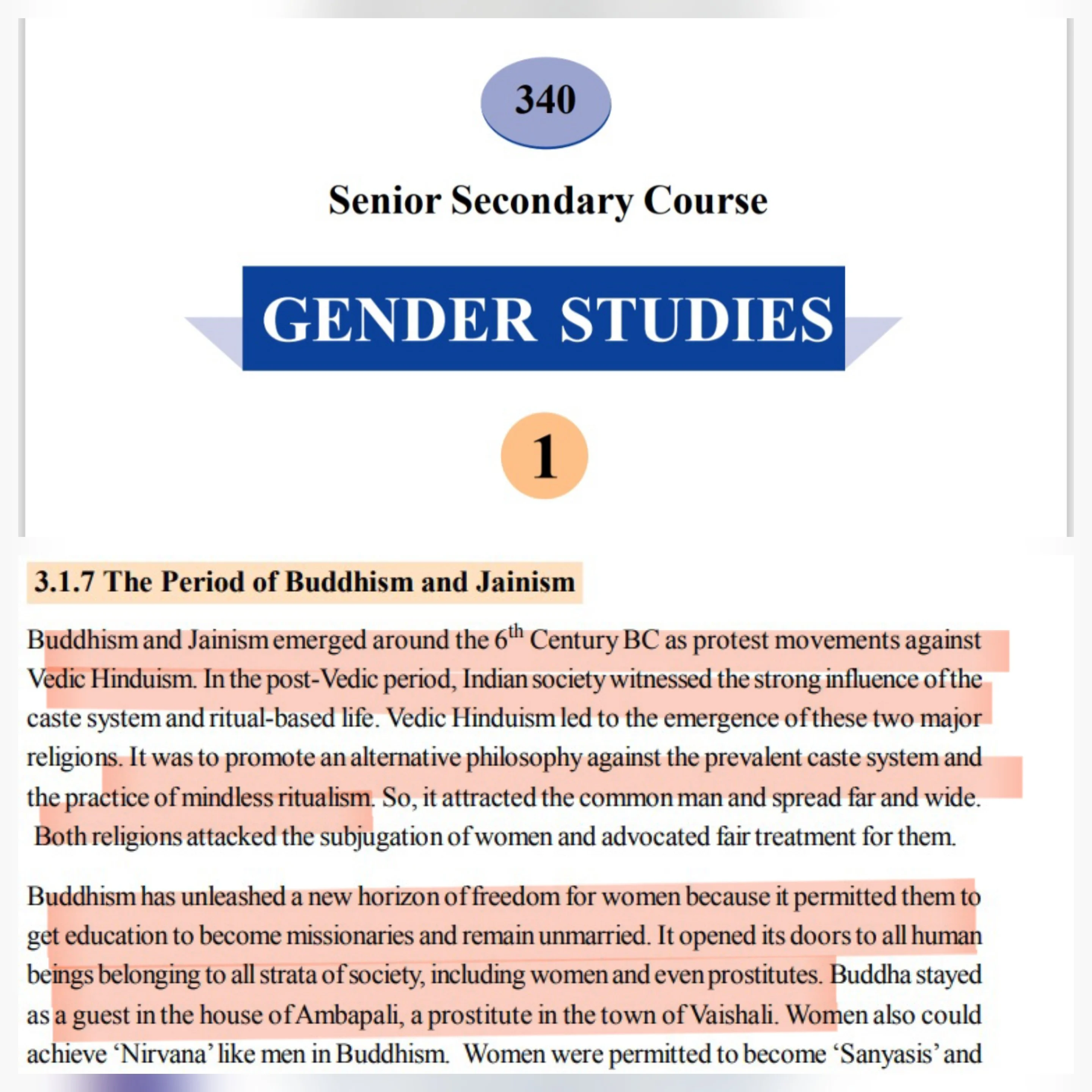
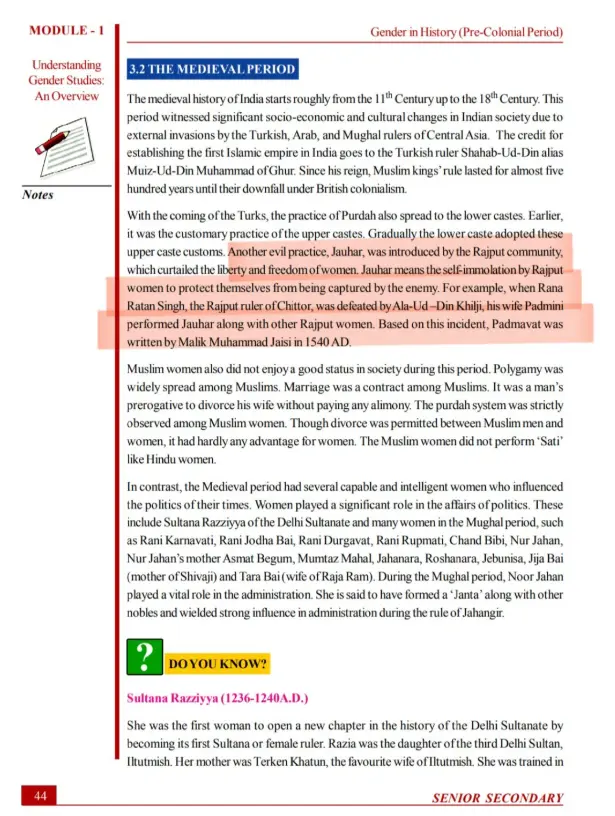
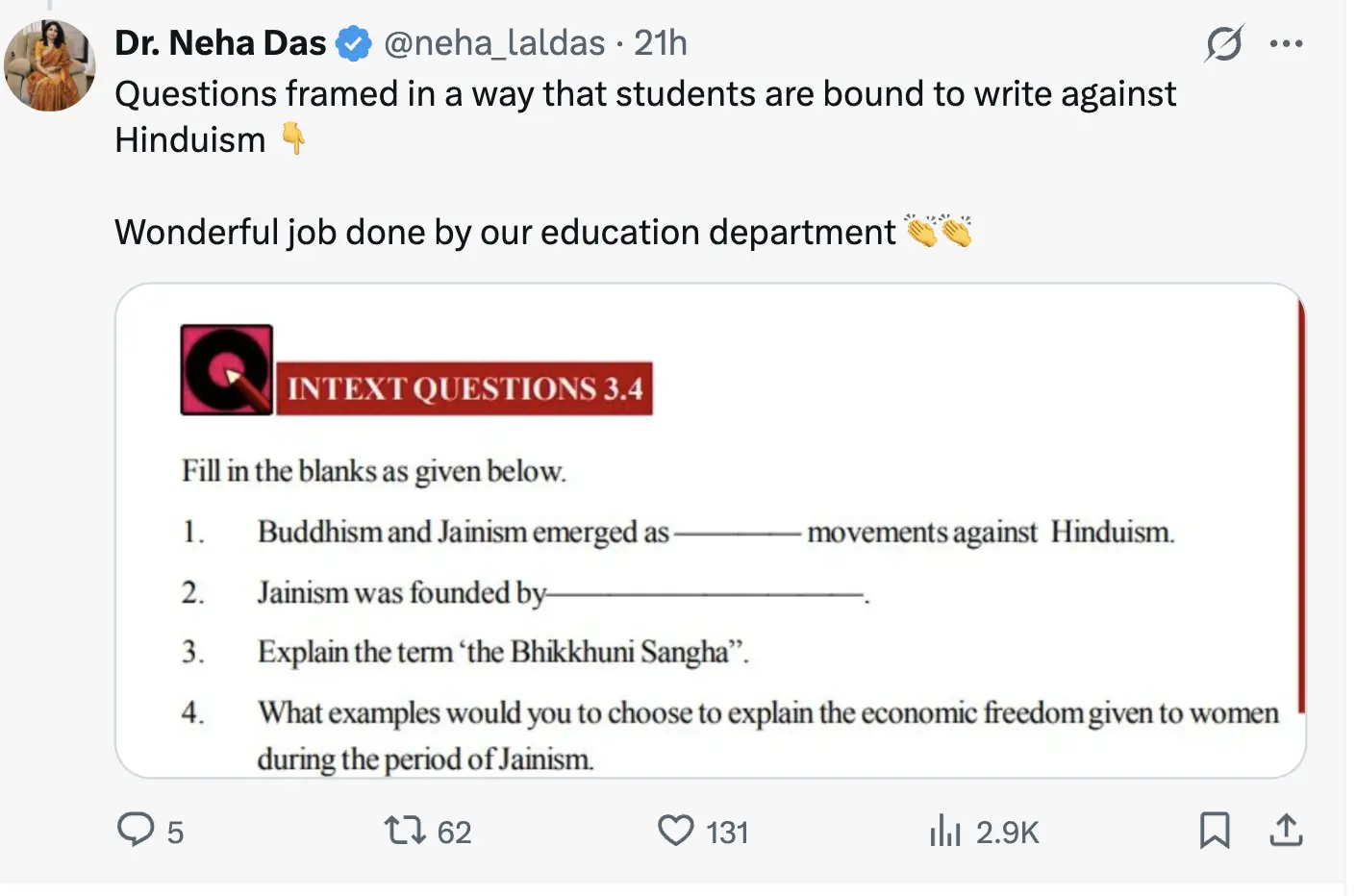
A controversy has emerged over passages in the National Institute of Open Schooling (NIOS) Senior Secondary Gender Studies textbook, Course 340, after social media user Dr Neha Das shared screenshots of sections on Jauhar, Sati, Vedic Hinduism, Buddhism, and Jainism. One highlighted passage appears on Page 44, in Module 1, “Understanding Gender Studies: An Overview,” under Section 3.2, “The Medieval Period.” The section discusses social, economic and cultural changes in Indian society between the 11th and 18th centuries. While discussing the status of women during the medieval period, the textbook states that with the coming of the Turks, the practice of Purdah spread to the lower castes, whereas it had earlier been customary among the upper castes. It then states: “Another evil practice, Jauhar, was introduced by the Rajput community, which curtailed the liberty and freedom of women.” The textbook explains Jauhar as self-immolation by Rajput women to protect themselves from being captured by the enemy. As an example, it states that after Rana Ratan Singh, the Rajput ruler of Chittor, was defeated by Alauddin Khilji, his wife Padmini performed Jauhar along with other Rajput women. It further states that, based on this incident, Malik Muhammad Jayasi wrote Padmavat in 1540 AD. The same section separately discusses the status of Muslim women during the medieval period. It states that Muslim women did not enjoy a good status in society and notes that polygamy was widely practised among Muslims. It further says that marriage was a contract among Muslims and that it was a man’s prerogative to divorce his wife without paying her alimony. The section also states that the purdah system was strictly observed among Muslim women and that, although divorce was permitted, it was hardly advantageous for women. The passage then makes a specific comparison with Hindu women, stating: “The Muslim women did not perform ‘Sati’ like Hindu women.” The section then lists several women who influenced medieval politics. These include Sultana Raziyya of the Delhi Sultanate, Rani Karnavati, Rani Jodha Bai, Rani Durgavat, Rani Rumpati, Chandi Bibi, Nur Jahan, Asmat Begum, Mumtaz Mahal, Jahanara, Roshanara, Jebunisa, Jijabai, and Tara Bai. The textbook also states that Nur Jahan played a vital role in administration and wielded strong influence during Jahangir's rule. A separate screenshot shared by Dr Neha Das concerns Section 3.1.7, “The Period of Buddhism and Jainism,” from the same textbook. The section states that Buddhism and Jainism emerged around the 6th century BC as protest movements against Vedic Hinduism. It says that in the post-Vedic period, Indian society witnessed the strong influence of the caste system and ritual-based life, and states: “Vedic Hinduism led to the emergence of these two major religions.” The textbook further says that Buddhism and Jainism promoted an alternative philosophy against the prevalent caste system and the practice of “mindless ritualism.” It adds that both religions challenged the subjugation of women and advocated fair treatment for them. The section then describes women's position in Buddhism, stating: “Buddhism has unleashed a new horizon of freedom for women.” It explains that women were permitted to receive education, become missionaries and remain unmarried. It further states that Buddhism opened its doors to people from all strata of society, including women and prostitutes, and refers to Ambapali, a prostitute from Vaishali, as an example of Buddha staying as a guest in her house. The text also states that women could achieve “Nirvana” like men in Buddhism and that women were permitted to become “Sanyasis.” Another screenshot shows the “Intext Questions 3.4” accompanying this section. One question asks students to complete the statement: “Buddhism and Jainism emerged as ______ movements against Hinduism.” Other questions ask students to explain the Bhikkhuni Sangha and to provide examples of the economic freedom given to women during the period of Jainism. The screenshots shared by Dr Neha Das bring together passages from the same NIOS textbook on Jauhar and Sati in the medieval period, the status of Muslim women, and the treatment of Vedic Hinduism, Buddhism and Jainism. The material subsequently drew public attention on social media because of how it presents these subjects to Senior Secondary students. The National Institute of Open Schooling (NIOS) is an autonomous organisation under the Ministry of Education, Government of India. It dates back to 1979, when CBSE began the Open School project. The Government of India established the National Open School in 1989, and renamed it the National Institute of Open Schooling in 2002. NIOS provides secondary and senior secondary education through the open and distance learning system and publishes study material for its students. The issue has also emerged amid a wider debate over how Indian history is presented in school textbooks following changes and rationalisation of NCERT materials. The NIOS controversy has brought renewed attention to how Hindu traditions, historical practices and civilisational developments are described in educational material used by students.
Case Images
Why it is Hate Crime ?
This case is being added to the tracker under the primary category: Hate Speech against Hindus. The subcategory selected is: Anti Hindu subversion and prejudice. Hate speech is defined as any speech, gesture, conduct, writing, or display that is prejudicial against a specific individual and/or group of people, which is leading to or may lead to violence, prejudicial action or hate against that individual and/or group. Media plays a specific and overarching reach in perpetuating prejudicial attitudes towards a community owing to unfair, untrue coverage and/or misrepresentation/misinterpretation, selective coverage and/or omission of facts of/pertaining to issues affecting a specific religious group. This type of bias can dehumanise the victim group, making it easier for others to justify harmful actions against them, which aligns with the objectives of hate speech laws aimed at preventing such harm. It is often observed that the media takes a prejudicial stand against the Hindu community driven by their need to shield the aggressor community which happens to be a numeric minority, however, is the one perpetrating violence against Hindus. For example, the media is often quick to contextualise religiously motivated crimes against Hindus, omit or misrepresent facts that point towards religiously motivated hate crimes, justify and/or downplay religiously motivated hate crimes or simply present fake news to stereotype Hindus. Such media bias leads to the denial of persecution and is often used to dehumanise Hindus, leading to justification for violence against them. For example, the media covered several fake allegations of Hindus targeting Muslims and forcing them to chant Jai Shree Ram. Most of these cases were proved false and fabricated after police investigation. These fake news reports were subsequently never retracted or clarified. Such fake news led to the justification of violence and dehumanisation of Hindus based on the argument that since Hindus targeted Muslims and forced them to chant Jai Shree Ram, the dehumanisation of Hindus and violence against them was par for the course and merely a retaliation. Such media bias leads to prejudicial portrayal of Hindus and offers a justification for violence against them and therefore, is considered hate speech under this category. The other category selected here is- Subversion of scriptures. Subverting the religious scriptures of Hindus has particularly devastating consequences. Subversion of the scriptures of Hindus is often done to justify or promote hatred, discrimination, or violence against specific individuals or groups of Hindus. Religious scriptures are often nuanced and those who harbour religious animosity towards Hindus often misquote or misrepresent the scripture to legitimise their animosity and hate towards the faith and its adherents. Any such misquoting of scriptures or subversion to justify hate, violence and discrimination against Hindus owing to religious animosity is hate speech and is categorised as such. The hate-crime dimension of this case lies in the repeated negative framing of Hindu traditions within educational material, where practices associated with Hindu society are presented primarily as evidence of oppression, backwardness and social failure. The concern is not that historical practices such as Jauhar, Sati, caste or ritualism should be beyond criticism. Rather, the problem lies in presenting them through sweeping and pejorative formulations while giving insufficient historical context and using more favourable language when describing other religious traditions. The treatment of Jauhar is particularly significant. Calling it an “evil practice” introduced by the Rajput community reduces a complex and exceptional wartime phenomenon to an internal social failing. The textbook acknowledges that Jauhar was undertaken to avoid capture by an enemy, yet the emphasis remains on the supposed oppression created by Rajput society. This framing shifts attention away from the circumstances of invasion, defeat and threatened captivity and places the moral burden almost entirely on the Hindu community. A practice associated with an extreme historical situation is thereby turned into evidence against Hindu society itself. The comparison with Muslim women adds another layer of prejudice. The textbook acknowledges restrictions such as polygamy, purdah, male-initiated divorce and limited marital rights, but then specifically points out that “Muslim women did not perform ‘Sati’ like Hindu women.” By making this comparison, the text creates an implicit hierarchy in which Muslim women appear to have endured difficult social conditions without resorting to Sati, while Hindu women are presented as having done so. The effect is to portray Muslim women as stronger and more resilient, while casting Hindu women as comparatively weaker and less capable of withstanding the hardships imposed by their society. The comparison becomes especially problematic because the textbook does not adequately explain the different historical circumstances surrounding the practices being compared. A similar asymmetry appears in the treatment of Vedic Hinduism, Buddhism and Jainism. Vedic Hinduism is described through terms such as “mindless ritualism,” caste and the subjugation of women, while Buddhism is described as having “unleashed a new horizon of freedom for women.” The result is a simplistic binary in which the Hindu tradition is associated with repression and social stagnation, while the tradition that emerged in opposition to it is associated with freedom and reform. Such framing does not merely examine historical criticism of Vedic society; it risks reducing an entire religious civilisation to its alleged shortcomings. The problem becomes more significant because this framing is also carried into the student exercise, where Buddhism and Jainism are described as movements “against Hinduism.” When such a characterisation is placed in a question that students are expected to reproduce, the interpretation moves beyond narrative description and becomes part of the lesson students are taught to retain. Educational material has a particularly strong influence on how young people understand their own history and religious traditions. Repeatedly associating Hinduism with terms such as “evil” and “mindless”, while presenting another tradition as a source of a “new horizon of freedom,” can condition students to view their own civilisation through a predominantly negative lens. The absence of balancing historical perspectives further strengthens the concern. A broad characterisation of Vedic society as defined by ritualism and the subjugation of women leaves little room for the documented intellectual and philosophical participation of women such as Gargi, Maitreyi and Ghosha. Their omission is important because these examples complicate any simplistic portrayal of the Vedic tradition as one in which women had no meaningful access to scholarship or religious knowledge. Taken together, the passages create a consistent asymmetry in representation: Hindu traditions are repeatedly framed through condemnation, social backwardness and oppression, while Buddhism is associated with emancipation and Muslim women are implicitly contrasted with Hindu women as having demonstrated greater resilience. The issue therefore is not criticism of a particular historical practice in isolation, but the cumulative stereotyping of Hindu civilisation through selectively negative language and comparisons. Because these portrayals appear in educational material produced for Senior Secondary students by a national educational institution, their impact extends beyond an individual opinion or historical disagreement. The institutional presentation of Hindu traditions in predominantly negative terms risks normalising prejudice against Hinduism and shaping students to see their own religious heritage as inherently regressive. It is this repeated denigration, selective comparison and negative stereotyping of Hindu traditions within educational content that gives the case its anti-Hindu hate-crime dimension.


Case Status
Unknown


Perpetrators Details
Perpetrators
Others
Perpetrators Range
Unknown
Perpetrators Gender
unknown
 Sources




