Minor Hindu girl kidnapped, raped, forcibly converted and married to abductor in Pakistan's Sindh
 Sindh, Pakistan
  7 March, 2021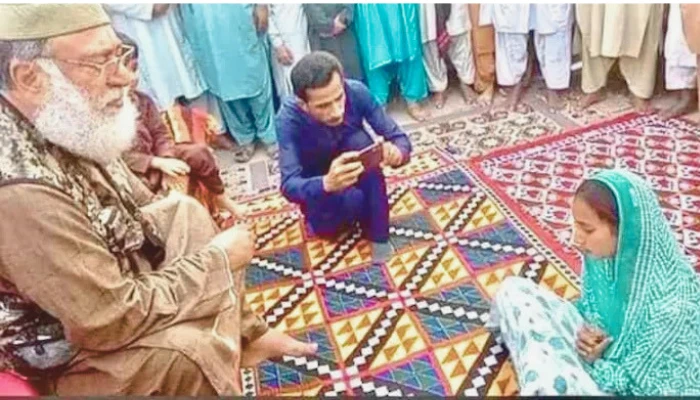
Case Summary
In Tangwani Taluka of Kashmore district, Sindh, Pakistan, a 13-year-old minor Hindu girl, Kavita Bai, was abducted from her home, raped, forcibly converted to Islam and married to the man who abducted her. The conversion was carried out by Barelvi cleric Mian Mithoo, after which the victim was married to the 60-year-old Muslim abductor. The matter resurfaced after a video of the Nikah ceremony went viral on a social media platform on 28 September 2026. The video showed the minor girl sitting on a rug while an aged man sat on a bench, surrounded by several aged Muslim men who were singing As per the India Today report, the victim was abducted by five armed Muslim men from her home on 8 March, 2021. Her father stated that the men dragged her from their residence and took her away in a white vehicle. An FIR was filed in connection with the abduction. The victim subsequently appeared before a court and was forced to state that she was over 18 years old. She further told the court that she had married against the wishes of her parents and sought protection. Following her statement, the victim was shifted from Kashmore to Ghotki. The police registered a case under the Sindh Child Marriage Restraint Act, under which a marriage between an adult and a minor is punishable with imprisonment of up to three years. A medical examination was expected to be ordered to determine the victim's age. The incident once again brought attention to longstanding concerns surrounding forced conversions, abductions and marriages involving women and girls from religious minority communities, particularly Hindus in Pakistan. Rights groups had for years raised concerns about cases involving Hindu and other minority women, particularly those belonging to economically disadvantaged families. Such cases frequently involved abduction, pressure to change religion and marriage without the consent of the woman or her family. The Hinduphobia Tracker had previously documented numerous cases where minor Hindu girls as young as nine years old were abducted, raped and forcibly converted to Islam by Muslim perpetrators and then coerced to marry the perpetrators. For instance, in February 2026, in Mirpurkhas, Sindh, a 13-year-old minor Dalit Hindu girl named Guddi Kolhi was abducted from Mithi, Tharparakar district, Sindh province. Following her abduction, she was forcibly converted and married to a Muslim man. The incident came to light when the victim’s family approached the authorities seeking justice. According to information shared by the victim’s family and local sources, documents issued by a so-called conversion centre linked to Pir Ayub Jan Sarhandi falsely listed the girl’s age as 19 years and passed off the marriage as a legal marriage. In another instance in April 2026, in Sindh, a nine-year-old Hindu girl named Reshma was abducted, forcibly converted to Islam, and married to a 45-year-old Muslim man identified as Wazir Hussain. They took her to a Sufi Dargah for her conversion. The case came to public attention when images of the child in wedding attire went viral. Human rights activists demanded the immediate annulment of the marriage and the safe return of the child, citing violations of child protection laws and fundamental human rights. Time and again, such cases highlighted the persecution faced by Hindu minorities in Pakistan, marked by systemic discrimination, violence, and forced conversions. Hindu women were often abducted, forcibly converted to Islam, and married off to Muslim men with little to no legal recourse. Temples were frequently vandalised or destroyed, and Hindu communities were subjected to social and economic marginalisation. Blasphemy laws were disproportionately used against Hindus, leading to false accusations and severe punishments. Many Hindu families were forced to flee their homes due to religious intolerance, living in constant fear of attacks. This sustained persecution highlighted the dire conditions for Hindus in Pakistan, where their religious identity made them targets of oppression.
Why it is Hate Crime ?
This case has been added to the tracker under the primary category: Predatory Proselytisation. Within this, the subcategory selected is: Harassment, threats, coercion for conversion. Harassment covers a wide range of behaviours of an offensive nature. It is commonly understood as behaviour that demeans, humiliates, and intimidates a person, including threats and coercion. Harassment and threats, in this case, find their root in discriminatory grounds, which have the effect of nullifying a person’s rights or infringing upon his freedom to exercise his rights specifically owing to the victim’s religious identity. Verbal and physical threats and psychological or physical harassment are often used against Hindu victims because they choose to practice their professed religion. Religious harassment also includes forced and involuntary conversions by harassment, threats or coercion. Coercion includes intimidatory tactics like force-feeding a Hindu victim beef to convert to another religion, forceful circumcision, etc. In several documented cases, non-Hindu perpetrators or those who harbour specific animosity towards Hinduism harass victims simply based on their religious identity. Such cases often also include harassment to ensure the Hindu victim abandons his/her professed religion and adopts the religion of the perpetrator. The other subcategory selected is: Proselytisation by grooming, brainwashing, manipulation or subtle indoctrination. The tertiary category under it is: 'Conversion of minor' Religious brainwashing essentially means the often subtle and forcible indoctrination to induce someone to give up their religious beliefs to accept contrasting, regimented ideas. Religious grooming or brainwashing also involves propaganda and manipulation. It involves the systematic effort, driven by religious malice and indoctrination, to persuade “non-believers’ to accept allegiance, command, or doctrine to and of a contrasting faith. Cases of such grooming or brainwashing are far more nuanced than direct threats, coercion, inducement and violence. In such cases, it is often seen that there is repeated, subtle and continual manipulation of the victim to induce disaffection towards their own faith and acceptance of the contrasting faith of the perpetrator. While subtle indoctrination is widely acknowledged as predatory, an element which is often understated in such conversions or in the attempts at such conversion is the role of loyalty and trust which might develop between the perpetrator and the victim. Fiduciary relationships are often abused to affect such religious conversion. For example, an educator transmitting religious doctrine of a competing faith to a Hindu student. The Hindu student is likely to accept what the teacher is transmitting owing to the existence of the fiduciary relationship. The exploitation of the fiduciary relationship to religiously indoctrinate victims would also be included in this category. Since the underlying animosity towards the victim’s faith forms the basis of predatory proselytisation, such cases are considered religiously motivated hate crimes. This case was added to the Hinduphobia Tracker as a religiously motivated hate crime because the victim, at the time of her abduction, was a minor Hindu girl who was abducted, sexually assaulted, forcibly converted to Islam and subsequently married to her abductor. The sequence demonstrated that her Hindu identity was central to the subsequent religious coercion imposed upon her. The age of the victim at the time of her abduction is a key point in the case. Her age made her particularly vulnerable to coercion and deprived the subsequent conversion and marriage of any meaningful basis of voluntary religious choice. The sexual assault, abduction, forced conversion and marriage together constituted a grave violation of her bodily autonomy, religious freedom and rights as a child. The religious nature of the offence was further established by the conversion being imposed after the abduction and sexual violence. The victim was removed from her Hindu family and subjected to a change of faith before being married to the accused. Conversion therefore formed part of the coercive process rather than being an independent development. The marriage further reinforced the religious coercion. It followed the victim's abduction and conversion and placed her in a new religious and marital setting with the very person who had abducted her. This compounded the victim's separation from her family, community and Hindu identity. The case also reflected a documented pattern involving minority girls in Pakistan, particularly Hindu girls, where abduction is followed by sexual violence, conversion and marriage. Human rights documentation has repeatedly recorded concerns over minor girls being converted and married after abduction, as well as attempts to present such victims as adults so that child-marriage protections and criminal liability are avoided. The subsequent claim that the victim was over 18 and married of her own free will reflected a tactic documented in cases involving the abduction and forced conversion of minor Hindu girls in Pakistan. After abducting and isolating a minor girl, the perpetrators force her to state before the authorities or in recorded statements that she is an adult and has married of her own choice. Such statements create a false appearance of adulthood and consent, allowing the perpetrators to present the marriage as lawful and evade the legal consequences of child marriage and abduction. Here, it is also important to explain the dynamics of religious conversions in Pakistan. It is true that many religious conversions worldwide are completely voluntary and undertaken of one's own free will, driven by a change in faith. However, the broader environment facing Hindus in Pakistan further strengthens concerns in cases involving conversion and religious coercion. Religious conversions in Pakistan have an especially predatory nature. Pakistan, being an Islamic nation, harbours specific animosity towards non-Muslims, especially Hindus. Human rights organisations, minority rights groups, and numerous documented cases have shown that abductions, forced conversions, forced marriages, blasphemy accusations, and intimidation are not isolated incidents but form part of a recurring pattern affecting the Hindu minority. Over the years, Hindu families have repeatedly reported that girls were abducted, converted to Islam, married to their abductors, and then prevented from returning to their families through social, religious, and institutional pressure. The situation is made even more severe by Pakistan's blasphemy laws and the atmosphere surrounding them. Blasphemy accusations often carry devastating consequences, including mob violence, social persecution, and extrajudicial killings. For minority Hindus, the mere threat of such an accusation can become a powerful tool of intimidation. Minority rights advocates have repeatedly warned that this climate of fear makes it difficult for Hindu victims and their families to openly resist coercion, challenge conversions, or seek justice without risking further harm. Viewed cumulatively, these incidents point towards a sustained pattern in which Islamists target vulnerable members of the Hindu minority through coercion, intimidation, conversion pressure, and the misuse of religious and legal mechanisms. The repeated nature of these incidents across different regions of Pakistan ascertains a well-established strategy of marginalising Hindu communities and weakening their ability to preserve their religious identity. Against this backdrop, claims that conversions occur entirely of the victim's own free will cannot be assessed in a vacuum. They must be examined in light of the documented reality of anti-Hindu persecution, conversion-related coercion, blasphemy-linked intimidation, and the wider pressures faced by Hindus living as a vulnerable minority in Pakistan. In most cases, even if the Hindus say they converted of their own free will, it is most likely to escape persecution if they don't convert to Islam in Pakistan. In the present case, however, the police did not accept the claim. They registered a case under the Sindh Child Marriage Restraint Act and pursued the victim's actual age. This demonstrated why establishing her age was crucial: a forced statement that a minor is an adult cannot alter the fact of her minority or legitimise a marriage involving a child. Overall, the combination of abduction, sexual violence, forced religious conversion and marriage of a minor Hindu girl, followed by a dispute over her age, places this case within the documented pattern of religious coercion faced by Hindu girls in Pakistan. The targeting of the victim's Hindu identity through forced conversion, after she had already been subjected to serious physical and sexual violence, warrants its inclusion in the Hinduphobia Tracker. Disclaimer: The Hinduphobia Tracker records incidents based on when an event occurred or when the victims' ordeal began rather than when the media reported it. Since the victim was abducted on 8 March 2021, it has been used as the date of the incident.
Victim Details
Total Victim
1
Deceased
0
Gender
- Male 0
- Female 1
- Third Gender 0
- Unknown 0
Caste
- SC/ST 1
- OBC 0
- General 0
- Unknown 0
Age Group
- Minor 1
- Adult 0
- Senior Citizen 0
- Unknown 0


Case Status
Complaint registered


Perpetrators Details
Perpetrators
Muslim Extremists
Perpetrators Range
From 2 To 5
Perpetrators Gender
male
 Sources




