Ganesh immersion procession desecrated; Hindu minors made to perform Islamic act during immersion procession in Taloda, Maharashtra
 Taloda, Maharashtra, India
  24 September, 2026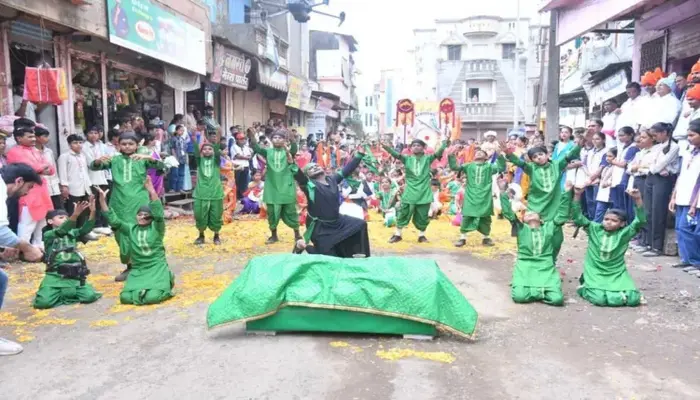
Case Summary
In Taloda, Nandurbar, Maharashtra, a Ganesh immersion procession associated with Nemsushil Vidyamandir was disrupted by the display of an explicitly Islamic structure resembling a tomb or mazar (Muslim shrine). Children were also dressed in Islamic attire and made to dance to Islamic songs during the Hindu religious procession. The incident came to light after a video circulated widely on social media showing a replica mazar, with a man dressed as a peer seen dancing and offering prayers in front of it. Minor children dressed in green Pathan suits were also seen dancing before the tomb to a song invoking Allah. The scene was part of a Ganpati procession, with a large idol of Lord Ganesha visible in the background and a large crowd of devotees and onlookers surrounding the performance. The children danced in formation around the replica mazar, while the man dressed as a peer performed in front of it. The procession appeared to be moving through a public street decorated for the Ganesh festival, with devotees and participants gathered around the tableau. On 25 September 2026, the Islamic display and the act drew objections from Hindu organisations and local residents, who said the Islamic imagery was inappropriate for a procession centred on Lord Ganesha and the religious character of Ganesh Chaturthi. Furthermore, minor Hindu children performed the act, and it became part of the public celebrations surrounding the Hindu festival and the Ganesh immersion procession. Hindu organisations and residents sought an explanation from the school administration regarding the purpose of the display and its relevance to a Ganesh immersion procession. They also sought clarification on the historical basis for the depiction, particularly references linking the display to the coronation of Chhatrapati Shivaji Maharaj. At the time of documenting this incident, the school had not provided a clear, publicly documented explanation for the Islamic display during a Hindu religious event. Hindu organisations therefore raised concerns regarding religious sensitivity and the appropriateness of introducing Islamic imagery into a procession dedicated to Bhagwan Ganesha. They sought a public explanation and apology from the school administration and said they would consider lawful administrative and legal remedies if the school did not address their concerns.
Why it is Hate Crime ?
This case has been added to the tracker under the primary category of - Attack on Hindu religious representations. Within it, the sub-category selected here is- Defiling religious customs. Sanatan Dharma is not a religion of one book, which is to say that while it has religious scriptures that form the central tenets of the faith, there are several traditions followed through thousands of years, mostly passed from generation to generation orally. There are several such customs and traditions that are followed by various Hindus and Hindu sects. Defiling of these traditions and customs is a breach of an individual or group’s religious practices. Such practices can range from dietary restrictions like not eating non-vegetarian food for a certain period of the year, not eating non-vegetarian food at all, not eating beef since the cow is considered holy in Hinduism, the sanctity of religious customs followed in the house (like many ISCKON devotees), etc. Any malicious action leading to the breach of such traditions or defilement of these traditions owing to animosity towards the faith or for the sake of activism stems not only from the lack of faith in the religion itself but also from disregard for the faith of the devotees who follow the customs/traditions and implicit bias against the faith, the tradition itself. Since these specific traditions are central to the faith of the devotees of that specific sect of Hindus, any non-compliance with these traditional rules would be considered a religiously motivated hate crime. The other primary category selected here is - Hate speech against Hindus. Within it, the sub-category selected here is - Anti-Hindu slurs, mocking faith. A religiously motivated hate crime is one where a victim is targeted because of the offender's hostility towards the victim’s professed faith - whether the underlying act, in this case, constitutes a crime in the limited scope of the laws driven by a secular framework. Proselytisation itself is an act that stems out of the proselytizing faith’s inherent and theological hostility towards Hinduism (Sanatan Dharma). Christianity, for example, considers idolatry as a sin and likens it to immorality (https://www.openbible.info/topics/idolatry). Islam has a far more violent approach to idolatry with over 500 mentions of Kufr (non-believer) and Shirk (anything that does not conform to Islamic tenets) found in the Quran. The Quran has several verses that ordain its followers to convert the polytheists (Hindus in this case) by sword. Therefore, it is safe to conclude that the hostility towards Hinduism in Islam and Christianity is theologically embedded. As such, any conversion by Muslims or Christians of Hindus is a result of hostility towards Hinduism. There are cases in fact where even faiths that don’t inherently harbour animosity towards Hinduism have been militarized to express hatred by a section of the adherents of the faith. Such faiths too indulge in predatory proselytization. For this category, we would only focus on those conversions which have a component of coercion, force, threats, harassment, inducement, brainwashing and the like. For this category, though the argument that any conversion to Islam or Christianity stems out of inherent hostility towards Hinduism, we would not take into account conversions where the convert has changed his religion without any coercion or inducement but supposedly, a change of conscience. The other primary category selected here is - Predatory proselytisation. Within it, the sub-category selected here is - Proselytisation by grooming, brainwashing, manipulation or subtle indoctrination. Religious brainwashing essentially means the often subtle and forcible indoctrination to induce someone to give up their religious beliefs to accept contrasting regimented ideas. Religious grooming or brainwashing also involves propaganda and manipulation. It involves the systematic effort, driven by religious malice and indoctrination, to persuade “non-believers’ to accept allegiance, command, or doctrine to and of a contrasting faith. Cases of such grooming or brainwashing are far more nuanced than direct threats, coercion, inducement and violence. In such cases, it is often seen that there is repeated, subtle and continual manipulation of the victim to induce disaffection towards their own faith and acceptance of the contrasting faith of the perpetrator. While subtle indoctrination is widely acknowledged as predatory, an element which is often understated in such conversions or the attempts of such conversion is the role of loyalty and trust which might develop between the perpetrator and the victim. Fiduciary relationships are often abused to affect such religious conversion. For example, an educator transmitting religious doctrine of a competing faith to a Hindu student. The Hindu student is likely to accept what the teacher is transmitting owing to existence of the fiduciary relationship. The exploitation of the fiduciary relationship to religiously indoctrinate victims would also be included in this category. Since the underlying animosity towards the victim’s faith forms the basis of predatory proselytization, such cases are considered religiously motivated hate crimes. The religious dimension of the incident was established by the deliberate incorporation of an explicitly Islamic religious structure and the corresponding act into a public Hindu religious procession. The significance therefore lay not merely in the presence of a particular architectural structure or act, but in using imagery associated with Islam within an occasion centred on Hindu worship and devotion to Bhagwan Ganesha. The display consequently brought an Islamic religious representation into the setting of a Hindu religious observance, directly affecting the character and presentation of that observance. Ganesh Chaturthi is a major Hindu religious festival dedicated to the worship of Bhagwan Ganesha, and the Ganesh immersion procession forms an important part of the festival's religious observance. The procession involves devotees publicly carrying the sacred deity, accompanied by devotional practices, before immersing the Ganesh idol as part of the concluding rituals. It is therefore not an ordinary cultural or public procession, but an important expression of Hindu religious faith and devotion. Introducing an explicitly Islamic religious structure into this setting therefore placed imagery associated with another faith directly within a sacred Hindu context. This differed materially from presenting an Islamic structure in a neutral historical exhibition or classroom setting, as here it was incorporated into an ongoing Hindu religious celebration. The inclusion of an explicitly Islamic structure in a sacred Ganesh immersion procession undermined the religious sanctity of the occasion and was perceived by Hindu organisations and residents as a form of mockery of Hindu religious practice. By placing imagery associated with another faith within a procession dedicated to Bhagwan Ganesha, the conduct intruded on the religious character of the celebration and diminished the significance of an occasion meant to express Hindu devotion. The display was therefore not merely an inappropriate cultural presentation; in the context of the procession, it disrespected Hinduism and made a Hindu religious observance the setting for imagery unrelated to its devotional purpose. The involvement of minor Hindu children further heightened the religious dimension of the incident. The children were not merely exposed to an Islamic representation in a neutral educational setting; they were made to participate in an act featuring an explicitly Islamic structure during a Ganpati procession. Placing Hindu children in this role could leave them with the impression that mocking, diminishing, or displacing aspects of their own religious tradition is acceptable when presented in the name of tolerance, secularism or cultural harmony. This is particularly concerning because children are impressionable and often accept activities presented by teachers and other authority figures as legitimate and appropriate. When an activity places another religion’s imagery at the centre of a Hindu religious celebration and asks Hindu children to participate in it, repeated exposure can gradually normalise the idea that their own faith and its distinct practices should be diluted or treated as secondary in the name of accommodation. Such conditioning can weaken a child’s natural attachment to their own religious traditions and make them less likely to question their gradual displacement. Over time, this kind of environment may also make children more receptive to abandoning or changing their inherited faith when presented with another religious identity as more acceptable or desirable. This is why the participation of minor Hindu children is especially significant from a religious perspective. The educational institution's role makes the issue even more serious. Schools and teachers carry considerable influence over how children understand religion, culture and history. Introducing another religion’s imagery into a Hindu religious procession and presenting the exercise as acceptable or educational risks teaching children that religious sensitivity is a one-way obligation—that Hindu traditions must accommodate the symbols of another faith even during their own religious observances. Rather than fostering genuine tolerance, such an approach can blur religious boundaries and diminish the significance of the child’s own tradition. The absence of a clearly documented educational or historical basis for the display further compounds this concern. If the purpose was genuinely historical or educational, the institution should have been able to explain why the depiction was necessary and how it related to the Ganpati procession. Without such an explanation, Hindu children's participation takes on greater significance: they were not simply learning about another tradition; they were actively enacting its imagery within their own religious celebration. This makes the possibility of subtle religious conditioning an important part of assessing the incident. Taken together, the display's explicitly Islamic character, its incorporation into a Hindu religious procession, the participation of minor Hindu children, and the absence of a clearly established educational or historical basis gave the incident a distinct religious dimension affecting Hindu religious expression. These circumstances supported treating the incident as conduct directed at or affecting a Hindu religious observance. Therefore, this case was added to the hate crime database.


Case Status
Unknown


Perpetrators Details
Perpetrators
Others
Perpetrators Range
Unknown
Perpetrators Gender
unknown
 Sources




