Hindu villagers targeted for religious conversion at Christian prayer meeting in Deoria, Uttar Pradesh
 Deoria, Uttar Pradesh, India
  26 September, 2026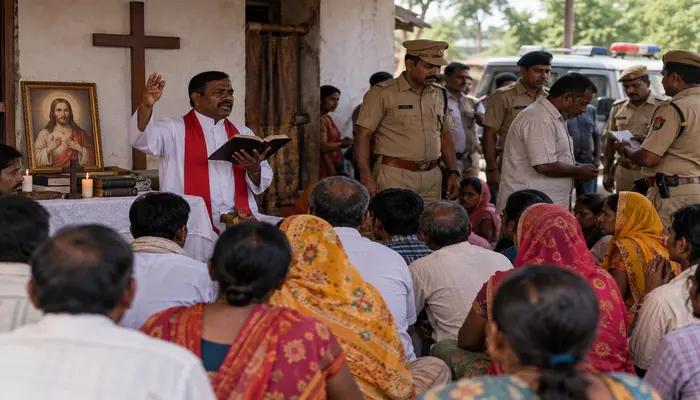
Case Summary
Hindu villagers were lured to a prayer meeting for religious conversion in the Baliwan Khas village under Srirampur police station of Deoria district, Uttar Pradesh. The prayer meeting, dedicated to Jesus Christ, was held on 27 September 2026 at the residence of Ramkunwar Prasad. The prayer meeting had been taking place every Sunday for around a year and had gradually attracted people from nearby and distant villages. Upon receiving information about the conversion activities were taking place, police reached the location and took the pastor conducting the meeting to the police station for questioning. Some media reports also stated that five people present at the gathering were detained and that religious books and other religious material were recovered from the site. According to local residents, between 100 and 200 people attended the meeting on 27 September 2026. However, attendees said that prayers to Jesus Christ had helped them with physical and family problems, and some described experiencing relief after participating in the prayers and reading the Bible. Several women who attended the meeting later went to the police station and protested after the pastor was taken there. Police pacified them and questioned them about the meeting and the reported religious conversion activities. Based on a complaint filed by Shyamji Gupta, police registered a case against Anil and Suresh, residents of West Champaran, Bihar, and Ramkunwar Prasad, the owner of the premises. The police stated that the matter was under investigation and that further action would follow after verification of the reported religious conversion activities.
Why it is Hate Crime ?
The religious nature of the activities was established by the fact that the gathering was a prayer meeting dedicated to Jesus Christ, where attendees participated in Christian prayers and were encouraged to read the Bible. Attendees also described receiving relief from physical and family problems through prayer. Repeatedly presenting Christian prayer as a means of obtaining relief from illness, family difficulties, or other personal problems could influence individuals towards Christianity by creating an association between Christian worship and the resolution of their difficulties. Such an environment could make attendees more receptive to Christian teachings and, over time, to conversion. The circumstances therefore contained elements that could be consistent with grooming, manipulation, or subtle religious indoctrination aimed at drawing individuals towards Christianity. The meetings were recurring religious gatherings centred on Jesus Christ rather than one-time interactions, and participants were exposed repeatedly to Christian prayer and religious literature. Police had also received information regarding religious conversion activities and detained individuals present at one such gathering for questioning. A case was subsequently registered against three individuals in connection with the activities. However, the available reports did not establish that any particular attendee had been converted to Christianity, nor did they establish that any attendee had been subjected to direct coercion, threats, or other confirmed means of forced conversion. Importantly, the women who attended the meetings stated that they had participated voluntarily and that they had experienced relief from physical or family problems after prayer. They denied that forced religious conversion had taken place. However, voluntary participation and a positive perception of the meetings did not by themselves rule out the possibility of grooming or subtle indoctrination. Repeatedly associating Christian prayers with healing and relief can create a strong psychological association between participation in the religious activity and improvement in one’s personal circumstances. This can increase trust in the religious organisers and make an individual progressively more receptive to the religious beliefs and practices being promoted. Such influence, if present, could operate gradually without the use of overt coercion and could therefore be perceived by the participant as voluntary. Since the available evidence indicated possible grooming or subtle religious influence, but did not conclusively establish that a conversion had taken place or that any individual had been subjected to coercive conversion, the case has been added to the Undecided database. The victim count has been recorded as 200 based on reports that approximately 100 to 200 people attended the prayer meeting. The figure has therefore been recorded as an indicative count based on the reported attendance, rather than a confirmed number of victims, and has been used for documentation purposes only.
Victim Details
Total Victim
200
Deceased
0
Gender
- Male 0
- Female 0
- Third Gender 0
- Unknown 200
Caste
- SC/ST 0
- OBC 0
- General 0
- Unknown 200
Age Group
- Minor 0
- Adult 0
- Senior Citizen 0
- Unknown 200


Case Status
Complaint registered


Perpetrators Details
Perpetrators
Christian Extremists
Perpetrators Range
From 2 To 5
Perpetrators Gender
male
 Sources




