Ganesh idol pelted with stones and desecrated during immersion procession in Burhanpur, Madhya Pradesh
 Burhanpur, Madhya Pradesh, India
  25 September, 2026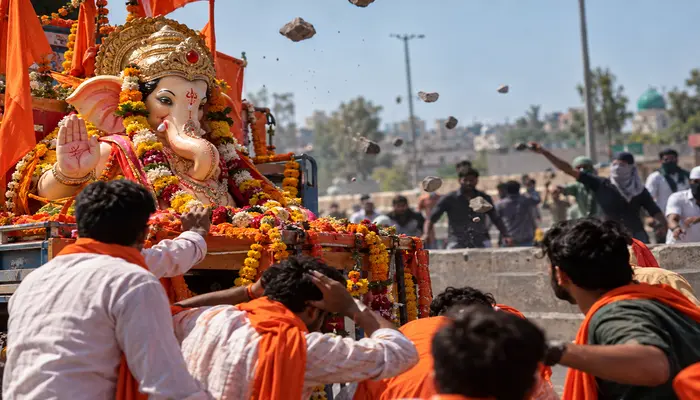
Case Summary
On 26 September 2026, a Ganesh idol being taken for immersion was reportedly subjected to stone-pelting on the Hamidpura Bypass Road in Burhanpur, Madhya Pradesh. According to reports, **members of a Ganesh Mandal** were transporting the Ganesh idol from Lodhipura village to Hatnur for immersion in the Tapti River. During this time, at around 11 am, unidentified individuals pelted stones at the idol while it was passing along the bypass. Following the stone-pelting, **members of the Ganesh Mandal stopped the idol** at Sindhi Basti intersection and began protesting. Police from Ganpati Naka police station reached the spot and spoke with the members to bring the situation under control. Senior administrative and police officials also reached the location, while additional police personnel were deployed and patrolling was increased in the area amid tension following the incident. Members of the Ganesh Mandal subsequently approached Ganpati police and lodged a complaint against unidentified persons. Based on the complaint, police registered a case under Section 298 of the Indian Penal Code and began investigating the incident. Police also initiated efforts to identify and arrest those responsible for the stone-pelting.
Why it is Hate Crime ?
This case has been added to the tracker under the primary category of - Attack on Hindu religious representations. Within it, the sub-category selected here - Desecration of Hindu religious symbols. Icons and symbols or a religious representation of a spiritual ideal are widely revered in Hinduism. Iconography is of vital significance in the Hindu milieu. It helps connect people’s spiritual beliefs with the real world. Iconography within the Hindu faith takes several shapes and forms. Murtis are of most significance to Hindus, to which daily rituals, prayers and offerings are done. Besides the murtis, there are several other symbols which have deep significance in the Hindu faith – the Om and Swastika for example. Since these Hindu religious symbols hold paramount importance in Hinduism, any desecration of symbols, icons, murtis, religious representations and manifestations, is driven by animosity towards the faith itself which manifests itself through these murtis, icons and symbols. Therefore, any desecration of these Hindu religious symbols and representations is considered religiously motivated hate crimes under this category. The other primary category selected here is - Attack not resulting in death. Within it, the sub-category selected here is - Attack on religious procession. The outward celebration and display of religious symbols in an intrinsic part of Hinduism. Religious processions on various festivals are age-old traditions and a way to manifest faith and form a part of the religious practices of Hindus. On several occasions, such religious processions come under attack by non-Hindu mobs, in a manifestation of their animosity towards Hinduism and their practices. The reasons cited for such violent attacks are many and range from crossing a non-Hindu resident-dominated area to playing loud music, crossing from an area where there is a religious structure of another faith etc. The violent attacks are triggered by the outward display of religiosity by Hindus. The attacks are mainly a manifestation of religious supremacist doctrine which believes that idolatry, essentially the Hindu faith, is one that deserves to be annihilated since the very tenets of Hinduism, its practices and traditions are considered a sin in those doctrines. Since these attacks emanate from intrinsic and doctrinal animosity towards Hindus and Hinduism, it is considered a religiously motivated hate crime under this category. The religious dimension of the incident was established by the fact that the Ganesh idol, being carried as part of a Hindu religious observance, was targeted and stone-pelted. The idol was not an ordinary object being transported through the area, but a sacred representation of Lord Ganesha and was being taken for immersion as part of Ganesh Visarjan, a Hindu religious ritual. The act of stone-pelting was therefore directed at an object that was intrinsically connected to the religious identity and worship of the Hindu community. Ganesh Visarjan holds specific religious significance in Hinduism and forms the concluding ritual of the Ganesh festival, during which devotees ceremonially immerse the consecrated idol of Lord Ganesha in a body of water. The procession and transportation of the idol constitute an expression of Hindu religious practice in a public space. Consequently, interference with or an attack directed at the idol during this religious activity affected the community's exercise and expression of its faith, rather than constituting an attack on an unrelated secular object. The nature of the target is particularly significant in assessing the religious dimension of the incident. Lord Ganesha is one of the most widely worshipped Hindu deities, and an idol used in worship is treated as a sacred representation through which devotees perform religious rituals and offer prayers. The targeting of the idol with stones therefore had a direct connection to a Hindu religious representation and constituted an act that desecrated and defiled the sacred object of Hindu worship. This distinguishes the incident from ordinary stone-pelting or random damage to property, as the object subjected to the attack was specifically associated with Hindu worship, and the act violated the sanctity of a religious representation revered by Hindus. The religious significance was further heightened because the idol was being used in Ganesh Visarjan, a ritual in which a worshipped representation of Lord Ganesha is ceremonially immersed as part of the completion of the Ganesh festival. An attack on the idol in this context was not merely interference with a public procession, but an act directed at a sacred representation while it was being used for a specific Hindu religious ritual. The religious character of both the target and the ritual in which it was being used therefore provided a clear basis for recognising the incident as involving hostility towards a Hindu religious practice and representation. On this basis, the case can be categorised as a hate crime because the conduct involved an attack on a sacred Hindu religious representation during a Hindu religious observance.


Case Status
Complaint registered


Perpetrators Details
Perpetrators
Unknown
Perpetrators Range
Unknown
Perpetrators Gender
unknown
 Sources




