Hindu cremation ground desecrated in Kushtia, Bangladesh; Muslim men cook cow-meat, trample funeral pyres with shoes
 Khulna Division, Bangladesh
  21 September, 2026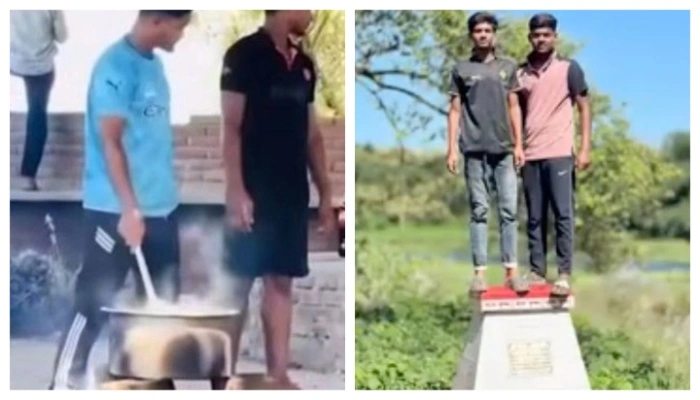
Case Summary
On 22nd September 2026, a group of Muslim youths desecrated the Harinarayanpur Mahashamshan, a sacred Hindu crematorium in Kushtia Sadar Upazila, Bangladesh. The youths trespassed onto the premises to organise a picnic, where they cooked and consumed beef. Violating a deeply sensitive site used by the local Hindu community for the last rites of their relatives, the individuals also stood on cremation pyres and tombs while wearing shoes, recording videos and taking photographs of their actions. Visual evidence of the desecration circulated on social media from an account named 'Anik Hossain', causing intense distress among the local Hindu community. To manage the fallout, local political leaders intervened on the night of 22nd September 2026. They brokered a verbal settlement and promised to guard the crematorium, effectively bypassing a formal legal process. On the morning of 23rd September 2026, S.M. Mamunur Rashid, the Officer-in-Charge of the EB Police Station, summoned the crematorium committee leaders and the families of the accused to the station. They drafted a written settlement letter there. However, the political leaders who brokered the initial verbal agreement did not sign the document. The local Hindu community objected, and only Subash Karmakar, president of the crematorium committee, signed. On the evening of 23rd September 2026, at approximately 7:00 PM, Bakkar, a local associate of the Bangladesh Nationalist Party and the father of one of the accused youths, confronted Bipul Kumar Saha, the general secretary of the crematorium committee. The encounter occurred in front of Jahangir's godown, adjacent to the Lakshman Jute Mill. Bakkar pressured Saha to sign the incomplete settlement letter. When Saha refused to sign until the political leaders affixed their signatures, Bakkar physically assaulted him, beating him with an umbrella to force compliance. Following the physical attack and the desecration of their sacred site, local Hindu organisations demanded an impartial legal investigation. They began preparing peaceful programmes to seek security for their religious spaces and ensure action against the perpetrators. The incident occurred against the backdrop of escalating hostility towards Hindus in Bangladesh. This escalation of violence against Hindus in Bangladesh has unfolded in three distinct phases: first, following the ouster of Sheikh Hasina's government in August 2024; second, after the death of Sharif Osman Bin Hadi in December 2025; and third, in the immediate aftermath of the 13th National Parliamentary Election in 2026. Following the ouster of Sheikh Hasina, multiple reports documented attacks on Hindu homes, temples, and religious institutions, alongside intimidation campaigns, arson, and mob assaults targeting minority neighbourhoods. The Hinduphobia Tracker recorded 336 such incidents against the Hindu minority, underscoring the scale and persistence of anti-Hindu violence during this period. A further escalation occurred following the death of Sharif Osman Bin Hadi, a Muslim political activist and student leader known for his anti-Hindu and anti-India rhetoric. Hadi had been involved in political unrest after the fall of the Hasina government and was killed in Dhaka on 18th December 2025 during clashes. In the aftermath of his death, Hindu communities were blamed and subsequently targeted in retaliatory violence. Hindu homes were selectively set ablaze in multiple localities, forcing families to flee and leaving many displaced. The attacks appeared patterned rather than sporadic, with Muslim mobs focusing on Hindu neighbourhoods, properties, and religious symbols. Among the victims was Dipu Chandra Das, who was lynched to death and his body was set ablaze by a Muslim mob over false blasphemy allegations. The Hinduphobia Tracker documented 51 incidents of anti-Hindu violence in the period following Hadi's death alone. Reports further indicated that posters and written materials calling for the extermination of Hindus were displayed in public spaces. Alongside incidents of arson, vandalism, assault, intimidation, and organised anti-Hindu mobilisation, these developments contributed to a climate of increasing insecurity for the Hindu minority. The third phase of violence emerged after the 13th National Parliamentary Election in 2026. Within days of the announcement of results, Hindu families in districts including Noakhali, Rangpur, Nilphamari, Sylhet, Thakurgaon, and Dinajpur reported attacks involving arson, looting, assault, and vandalism of temples and homes. In several instances, Hindu homes were selectively targeted, looted, and families were threatened with displacement.
Why it is Hate Crime ?
The primary category for this case is: Attack on Hindu religious representation. The subcategory for this case is: Defiling religious customs. Sanatan Dharma is not a religion of one book, which is to say that while it has religious scriptures that form the central tenets of the faith, there are several traditions followed through thousands of years, mostly passed from generation to generation orally. There are several such customs and traditions that are followed by various Hindus and Hindu sects. Defiling of these traditions and customs is a breach of an individual or group’s religious practices. Such practices can range from dietary restrictions like not eating non-vegetarian food for a certain period of the year, not eating non-vegetarian food at all, not eating beef since the cow is considered holy in Hinduism, the sanctity of religious customs followed in the house (like many ISCKON devotees), etc. Any malicious action leading to the breach of such traditions or defilement of these traditions owing to animosity towards the faith or for the sake of activism stems not only from the lack of faith in the religion itself but also from disregard for the faith of the devotees who follow the customs/traditions and implicit bias against the faith, the tradition itself. Since these specific traditions are central to the faith of the devotees of that specific sect of Hindus, any non-compliance with these traditional rules would be considered a religiously motivated hate crime. The second primary category for this case is: Attack not resulting in death. The subcategory for this case is: Attacked for opposing radicals or trying to save victim. In several cases, Hindus are attacked for opposing religiously motivated crimes being committed against a fellow Hindu or simply for voicing an opinion opposing radical elements, who either have in the past or continue to persecute Hindus. In such cases, the initial attack against the victim, against which the Hindu was trying to defend the victim, would also need to be classified as a religiously motivated hate crime. Since the initial crime itself was religiously motivated and the subsequent crime of attempting to save the victim or speaking against the radical elements ends up inviting a violent attack, it would also be classified as a religiously motivated hate crime under this category. The perpetrators explicitly targeted a physical space central to Hindu religious and cultural practices. In Sanatan Dharma, the crematorium is a sacred ground dedicated to the solemn last rites of the deceased. By trespassing into this sensitive space and standing on cremation pyres and tombs while wearing shoes, the youths demonstrated a calculated disregard for Hindu sensibilities. This physical violation was not a mere trespass, but a deliberate act intended to humiliate the local Hindu community and intentionally desecrate their ancestral mourning traditions. The deliberate choice to cook and consume beef within the crematorium grounds further underscored the deep-seated religious animus driving the incident. Dietary customs, particularly the profound reverence for the cow and the strict prohibition of beef consumption, are foundational to Hindu faith. Bringing beef into a sacred Hindu space constituted a malicious weaponisation of contrasting religious norms. This action was explicitly designed to violate the spiritual sanctity of the site and inflict profound emotional distress upon the devotees, reflecting a clear bias against Sanatan Dharma traditions. The subsequent physical assault on the Hindu community representative highlighted the violent coercion routinely deployed against minorities seeking justice. The community leader was targeted specifically because he opposed the radical elements attempting to cover up the initial desecration. By refusing to sign a coerced, unjust settlement, he defended his community's religious dignity. The violence inflicted upon him served as a direct retaliation for his resistance against the normalisation of anti-Hindu hostility and his refusal to submit to majority intimidation. Therefore, this incident qualified as a religiously motivated hate crime because the Hindu community's sacred spaces, religious customs, and active defenders formed the primary targets of the aggression. The sequence of events, from the calculated defilement of a holy site to the violent intimidation of a Hindu representative seeking accountability, demonstrated an organised effort to subjugate the minority community. It reflects a profound disregard for the faith and its practices, stemming from underlying animosity toward Hinduism. This incident exemplifies an intentional effort to insult religious sentiments and mirrors a broader, systemic pattern of persecution in Bangladesh, where radical elements exploited their dominant status to trample upon indigenous Hindu customs and used violence to enforce impunity.


Case Status
Unknown


Perpetrators Details
Perpetrators
Muslim Extremists
Perpetrators Range
From 5 to 10
Perpetrators Gender
male
 Sources




