Hindu Ganpati procession targeted as mosque loudspeaker mobilises Muslim crowd in Malad, Mumbai, devotees attacked
 Malad, Maharashtra, India
  24 September, 2026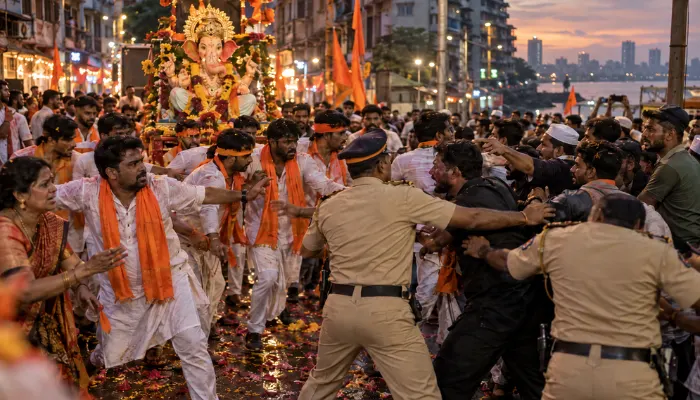
Case Summary
On September 25, 2026, in Malwani, Mumbai, a Hindu Ganpati procession was targeted after a crowd was called out from a nearby mosque through loudspeakers. Hindu devotees said the crowd that was mobilised attacked their members. The incident occurred at approximately 7:15 PM near the Ganpati pandal at Nirankar Nagar, NTC School Road, Gate No. 7. Following the confrontation, the devotees reached Malvani Police Station with the Ganpati idol and refused to proceed with the immersion until action was taken against those responsible. According to the police, a cold pyro device was placed near the entrance of the Ganpati pandal as part of the immersion celebrations. Some individuals objected to the artificial fire effect, stating that it could cause a fire at a shop opposite the pandal. Five men, identified as Adil, Sunil Sheikh, Gaus, Asgar, and Zakir, then argued with the Ganpati mandal's volunteers over the use of the device. The confrontation escalated when two other men, Zubair and Hussain, became involved in a physical scuffle with Hindu devotees Rohit Thakur and Sushil Mahto. Another individual, Ayan Sheikh, arrived carrying an earthen pot, verbally abused the volunteers in the presence of women and rushed towards them to assault them. The incident disrupted the immersion procession and created tension in the locality. Hindu protesters further stated that people inside a nearby mosque used loudspeakers to summon a crowd. The people who gathered assaulted the Hindu volunteers in the presence of senior police officers. The accused also issued death threats and brandished knives and swords to intimidate the Hindu participants. Following the violence, members of the Ganpati mandal and other Hindu devotees gathered at Malvani Police Station with the idol of Lord Ganesha, demanding the immediate arrest of the attackers. The protesters expressed dissatisfaction with the police response, saying they had waited about two hours without adequate assistance. They announced they would not proceed with the sacred Ganpati Visarjan until the police cooperated and took action against those responsible. Police personnel dispersed the assembled crowd and assured the devotees that appropriate action would be taken. On 26th September 2026, Malvani Police registered an FIR against seven individuals in connection with the dispute, physical assault, verbal abuse and obstruction of the Ganpati immersion procession. The accused were identified as Adil (24), Sunil Sheikh (25), Gaus (22), Asgar (23), Zakir (26), Zubair (25) and Hussain (24). Ayan Sheikh was separately identified in the complainant's account but was not among the seven individuals named in the FIR. Police subsequently began searching for the accused.
Why it is Hate Crime ?
The primary category for this case is "Attack not resulting in death". The subcategory for this case is "Attack on religious procession". The outward celebration and display of religious symbols is an intrinsic part of Hinduism. Religious processions on various festivals are age-old traditions and a way to manifest faith and form a part of the religious practices of Hindus. On several occasions, such religious processions come under attack by non-Hindu mobs, in a manifestation of their animosity towards Hinduism and its practices. The reasons cited for such violent attacks are many and range from crossing a non-Hindu resident-dominated area to playing loud music, crossing from an area where there is a religious structure of another faith, etc. The violent attacks are triggered by the outward display of religiosity by Hindus. The attacks are mainly a manifestation of religious supremacist doctrine which believes that idolatry, essentially the Hindu faith, deserves to be annihilated since the very tenets of Hinduism, its practices and traditions are considered a sin in those doctrines. Since these attacks emanate from intrinsic and doctrinal animosity towards Hindus and Hinduism, they are considered religiously motivated hate crimes under this category. The other subcategory for this case is "Attack against Hindu devotees". Hindu devotees are among the easiest targets of religiously motivated hate crimes because during the festival/procession/puja, etc., for non-Hindus it is easy to profile their victims based on religion. Hindu devotees come under attack on several occasions by individual non-Hindus or mobs of non-Hindus owing to their animosity against Hinduism, its symbols and tradition/practices. There are several instances of Hindu devotees being attacked while they worship in temples or temporary religious structures, during religious processions, doing bhajan/kirtan/puja in their own homes, in the residential society, etc. These attacks are perpetrated by non-Hindus primarily because of their animosity towards Hindus and their faith. In some cases, the trigger for the violence may be non-religious; however, two elements make these hate crimes. First, the Hindus who come under attack are attacked violently while indulging in religious activity. Whether they are in a place of worship or not is immaterial to the crime. When individuals are attacked while indulging in religious practices, the attack in itself is a hindrance to their freedom to practice religion and therefore constitutes a hate crime. Secondly, religious supremacist doctrines and ideologies deem religious practices of Hindus to be offensive ab initio since they are considered “sinful” by these ideologies, worthy of being annihilated by force or coercion. Driven by these religious supremacist ideologies and doctrines, the attacks against Hindu devotees stem from intrinsic animosity towards Hinduism. In some cases, the trigger for the violence may be non-religious; however, it develops into a religiously motivated crime during the course of the violence. Since these attacks stem from animosity towards Hindus and Hinduism, they are considered religiously motivated hate crimes under this category. The religious dimension of this incident was central because the confrontation arose during a Ganpati procession, a public Hindu religious celebration. Hindu devotees are particularly vulnerable to religiously motivated targeting because festivals, processions, pujas and other public observances make their religious identity immediately visible. In such settings, they can be easily identified and targeted precisely because they are openly practising their faith. Hindu devotees have repeatedly faced confrontation, intimidation and violence while participating in religious processions, worshipping at temples or temporary pandals, and conducting bhajans, kirtans and pujas. Such attacks directly interfere with their ability to practise and express their religion freely. Even where the original dispute may appear to be about a local or non-religious issue, the nature of the attack can make the religious dimension clear. Two elements are particularly relevant. First, when Hindus are subjected to violence while participating in a religious activity, the attack itself becomes an obstruction to their freedom of religious practice. Whether the devotees are inside a temple, at a pandal or on a public procession route does not alter this aspect. Secondly, where religious hostility or intolerance towards Hindu practices contributes to the confrontation, the violence takes on a distinctly religious character. In this case, a crowd was mobilised during the Ganpati procession through a mosque loudspeaker, directly linking the confrontation to the presence and public celebration of Hindu devotees. The attack was therefore directed at Hindus while they were participating in a Ganpati religious procession, rather than arising from an unrelated personal dispute. The mobilisation of a crowd in response to the procession and the subsequent targeting of devotees amounted to an attempt to intimidate Hindus while they were publicly observing their faith. Such conduct went beyond a routine neighbourhood disagreement because it interfered with the peaceful exercise of a Hindu religious practice. The religious context becomes even more significant because the confrontation arose specifically during a Hindu festival. The devotees were identifiable as participants in the Ganpati procession, making their Hindu identity both visible and directly connected to the circumstances of the attack. When violence is directed at people because they are participating in a Hindu religious observance, the assault cannot be separated from the religious activity that brought them together. It becomes a form of religious intimidation that restricts the community’s ability to celebrate and practise its faith without fear. Since the violence centred on a Hindu religious procession and involved the mobilisation of a crowd against devotees participating in that observance, the religious dimension was central to the incident. The case has therefore been classified under attack on religious procession and attacks against Hindu devotees, where violence or intimidation during the practice of Hinduism constitutes a religiously motivated hate crime.


Case Status
Complaint filed


Perpetrators Details
Perpetrators
Muslim Extremists
Perpetrators Range
From 5 to 10
Perpetrators Gender
male
 Sources




