Hindu girl lured away and converted to Islam by Muslim man; accused visited Hanuman Temple regularly to gain victim's trust
 Mathura, Uttar Pradesh, India
  17 September, 2026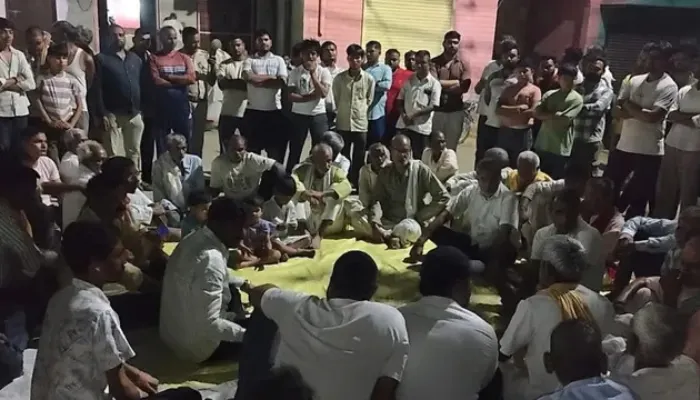
Case Summary
In Govardhan, Mathura, Uttar Pradesh, a Hindu woman was targeted by a Muslim man named Mustaq Khan, a resident of Mukhrai village, who lured her into a relationship, converted her, performed Nikah, and took her away on 18th September 2026. The woman's father accused Mustaq of converting his daughter to Islam and marrying her through Nikah. According to a relative of the Hindu woman's family, Mustaq regularly visited a local Hanuman temple, where he distributed prasad to devotees. During these visits, he contacted the woman and later developed a relationship with her. Following her disappearance, police began searching for Mustaq and conducted raids at locations associated with him and his relatives. On 24th September 2026, the woman's family, villagers and members of Hindu organisations, including the Karni Sena and cow protection groups, reached Mukhrai to protest against the delay in recovering her and arresting Mustaq. A delegation led by local representatives met Govardhan Circle Officer Anil Kumar Singh and demanded effective action within two days. The delegation included Karni Sena District President Kanha Thakur, Agra Division In-charge Dr Sitaram, Treasurer Thakur Laxminarayan and cow protection group representative Dheeraj Kaushik. As tensions escalated, personnel from several police stations and the Provincial Armed Constabulary (PAC) were deployed in the village. Following the father's complaint, Govardhan Police registered an FIR against the accused under Sections 3 and 5 of the Uttar Pradesh Prohibition of Unlawful Conversion of Religion Act and Section 87 of the Bharatiya Nyaya Sanhita. Later that evening, the police recovered the Hindu woman. Following her recovery, a large number of villagers assembled in Mukhrai and held a panchayat lasting approximately two hours. The panchayat decided to socially boycott Mustaq and his family, along with anyone who assisted them. Police also registered a case against individuals accused of helping Mustaq in the woman's religious conversion, following which the gathering dispersed. On 25th September 2026, Chitragupta Peethadhishwar Swami Sachchidanand Maharaj, accompanied by villagers from Basanti, members of Hindu organisations and the woman's family, staged a sit-in near Mustaq's residence demanding his immediate arrest. Swami Sachchidanand stated that Mustaq's brother had previously targeted another Hindu woman similarly. The protesters also accused the police of delaying action and demanded that those involved be brought to justice. Circle Officer Anil Kumar Singh reached the location and held discussions with the protesters to restore order. Additional police personnel were stationed outside the accused's residence. Rural Superintendent of Police Suresh Chandra Rawat stated that the investigation was proceeding following the woman's recovery and that the involvement of those who assisted in her conversion was also being examined. Further legal action would be taken based on the woman's statement and the investigation's findings. The Hinduphobia Tracker team contacted Govardhan Police to verify the victim’s age, but the police did not answer the call. Update (28th September, 2026): A joint team of the Govardhan Police and SOG in Mathura arrested accused Mustaq after an encounter in which he was shot and injured in the leg during retaliatory fire. Following his arrest and subsequent admission to a hospital for treatment, police seized a country-made pistol, four cartridges (three spent, one live), a Royal Enfield Bullet motorcycle, ₹2,750 in cash, and the victim's documents, including a high school mark sheet, driving license, and a fake Aadhaar card.
Why it is Hate Crime ?
The primary category selected for this case is: Crime against women in relationships and other sexual crimes. The subcategory selected for this case is: Man pretends to be Hindu. The tertiary categories selected are: Wears symbols of Hinduism. When a non-Hindu man pretends to be a Hindu to deceive a Hindu woman into a relationship, the act is seen as triggered by malafide intentions. In some cases, the woman eventually accepts the man’s original religious identity and converts after the man’s identity is revealed. These cases could be argued as cases of religious brainwashing and a result of the pressure a woman feels after getting into a relationship with a man. The woman, it can be argued, also changed her religious identity because of the stigma she believes she might face if she chooses to walk out of a deceptive relationship. However, for the purpose of documenting hate crimes, the cases in this subcategory are limited to those where there is explicit violence aimed at religious conversion against the wishes of the victim (force-feeding beef, blackmailing with intimate videos, rape on refusal to convert, etc), or if the woman herself complains of the man’s religious deception. In such cases, it is established that the deception of the non-Hindu man had a specific aim of religious conversion or targeting of the victim due to her Hindu religious identity, therefore, making it a religiously motivated hate crime. The other subcategory selected is- Brainwashed and/or groomed. In our database, we have not added incidents where women have converted to another religion of their free will and no allegations of forced/involuntary conversion have been made. However, there are certain cases of conversion where the consent itself is a result of the brainwashing or grooming of a minor by the non-Hindu perpetrator trying to victimise a woman for her Hindu religious identity. The phenomenon of grooming points to non-Hindu perpetrators identifying their Hindu victims’ vulnerabilities and exploiting them over months and sometimes years, to extract the supposed ‘consent’ in order to convert their religion. In most cases of grooming, the victims are minors or the grooming started when the victim was a minor. In other cases of grooming, the non-Hindu perpetrator brainwashes and grooms a minor victim to extract their trust and then proceeds to rape them repeatedly with the intent of converting them to their faith. It is pertinent to understand here that when the victim is a minor, the ‘consent’ to convert or enter into a romantic relationship with an adult itself is redundant – addressed by POCSO. While every case of conversion of a minor and incidents of establishing a physical relationship with a minor by an adult is a crime, for the purpose of this database, a case would be considered a hate crime only if there is a distinct religious angle to the grooming. For example, in the UK, if a Hindu minor is targeted by Pakistani grooming gangs, it would be considered a hate crime because the victims are specifically targeted owing to their non-Muslim religious identity, with the perpetrators being Muslim. In other cases, if a Hindu minor is brainwashed into entering a physical relationship with the non-Hindu adult perpetrator and the family alleges grooming/brainwashing of the minor to convert her religion, it would form a part of this database. If the victim is a Hindu adult, the case would form a part of this database only if the victim herself says that she was brainwashed/groomed to convert her religion. However, if the victim is deceased (murdered or otherwise), the case would form a part of this database if her family/friends provided testimony that the victim was brainwashed/groomed to convert her religion. Since these crimes have a distinct religious angle where the victim is being targeted owing to her Hindu religious identity, these cases are considered a hate crime. The religious dimension of this case was central to how Mustaq approached the Hindu woman. He regularly visited a Hanuman temple and distributed prasad, which helped him establish familiarity and trust with her. Using a Hindu religious setting to build that connection was significant because it made him appear comfortable with and familiar to her faith. This was not simply an ordinary relationship that later became religious. The initial contact itself developed through a Hindu religious environment, where Mustaq presented himself in a way that made him appear familiar with Hindu practices. Once that trust was established, the relationship was followed by her conversion to Islam and Nikah. Her Hindu identity was therefore central to how he gained access to her and developed the relationship. The sequence of events is particularly significant. The relationship began through familiarity created around a Hindu temple and its religious practices, but ultimately resulted in the victim being converted to Islam and married through Nikah. This progression shows that the religious element was not incidental or unrelated to the relationship. Rather, the victim’s Hindu identity formed an important part of the circumstances in which the relationship developed and was subsequently used to facilitate her movement away from her faith. The reported involvement of Mustaq’s brother in a similar case further strengthens the concern that this was not necessarily an isolated incident. It points to a recurring pattern in which Hindu women were approached through relationships that ultimately involved religious conversion. Where Hindu religious spaces and practices are used to establish trust before a relationship progresses towards conversion, the targeting is specifically shaped around the woman’s Hindu identity. Although the Hinduphobia Tracker could not independently establish the victim’s age, this does not affect the religious dimension of the case. The use of a Hanuman temple and prasad to build trust with a Hindu woman, followed by her conversion to Islam and Nikah, shows that her Hindu identity was not merely incidental but central to the relationship and its eventual outcome.
Victim Details
Total Victim
1
Deceased
0
Gender
- Male 0
- Female 1
- Third Gender 0
- Unknown 0
Caste
- SC/ST 0
- OBC 0
- General 0
- Unknown 1
Age Group
- Minor 0
- Adult 0
- Senior Citizen 0
- Unknown 1


Case Status
Arrested


Perpetrators Details
Perpetrators
Muslim Extremists
Perpetrators Range
One Person
Perpetrators Gender
male
 Sources




