Hindus targeted for religious conversion through inducements and 'healing' meetings by Christian conversion racket in Agra
 Agra, Uttar Pradesh, India
  22 September, 2026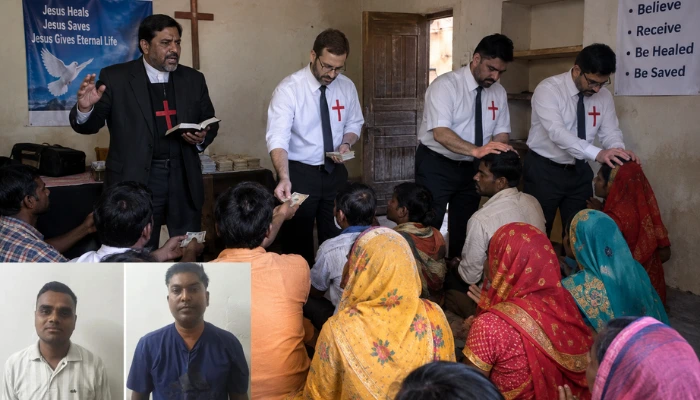
Case Summary
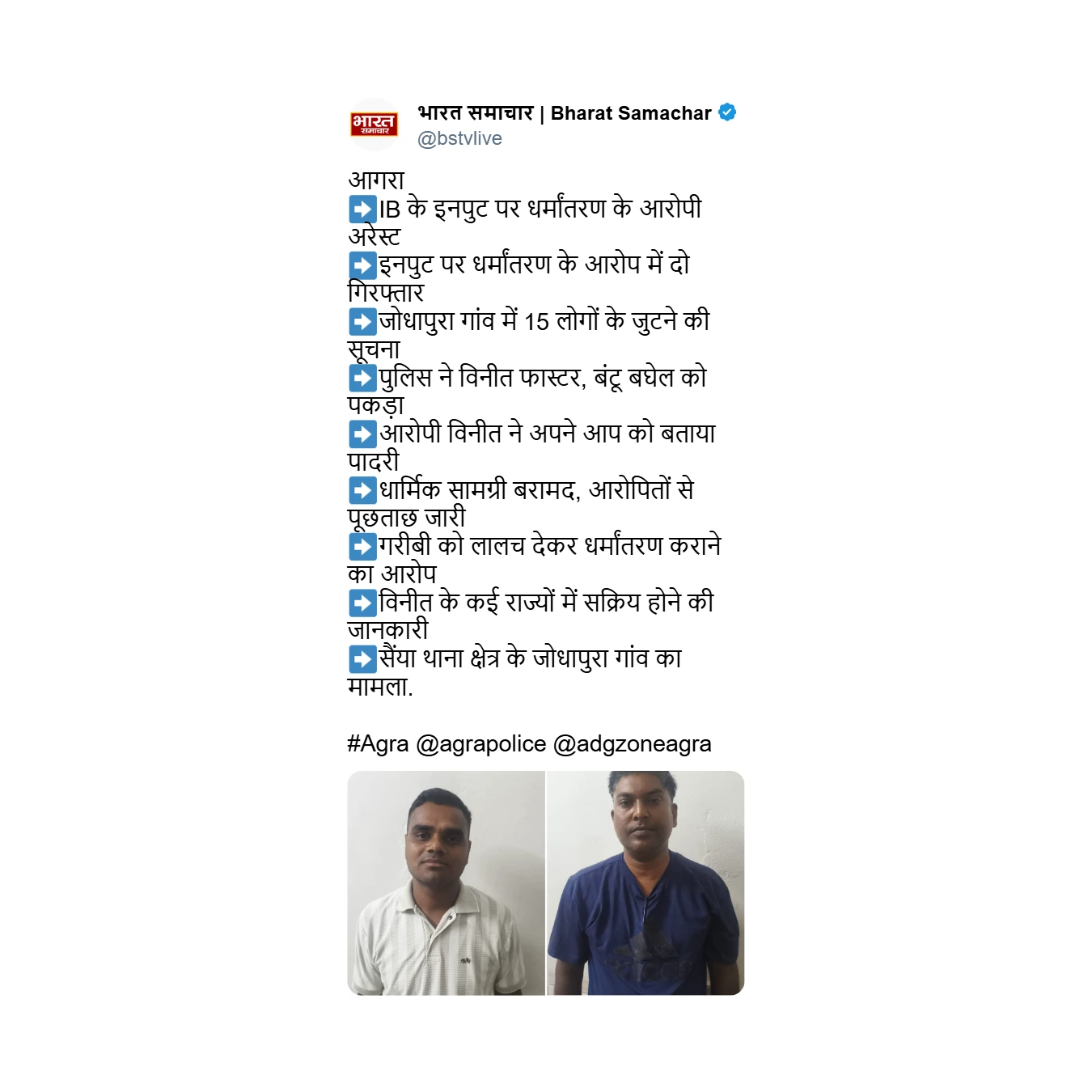
In Jodhapura village under the Saiya Police Station area of Agra district, Uttar Pradesh, Hindus were targeted for forced conversion to Christianity by four Christian individuals. The accused were identified as Vineet Vedi alias Vineet Pastor, Bantu Baghel, Mukhraj, and Pratap Kushwaha. As per the police investigation, the group targeted financially and emotionally vulnerable Hindus for conversion through inducements, prayer meetings, and miraculous 'healing'. According to reports, the accused invited Hindu men and women to birthday gatherings, which served as a pretext for conducting Christian religious meetings. Police said they first identified individuals facing financial hardship, family difficulties, personal distress, or health problems, gained their trust through prayers and small monetary assistance, and then encouraged them to embrace Christianity through a structured process of religious instruction. The incident came to light after the Intelligence Bureau alerted Agra Police about a gathering of around 15 Hindus at the residence of Pratap Kushwaha in Jodhapura village. Acting on the intelligence input, police reached the spot, questioned those present, and arrested the accused in connection with the conversion activity. During interrogation, Vineet Vedi identified himself as a pastor. Police recovered Christian religious material, mobile phones, cash, important documents, and Excel records that documented conversion-related activities. A First Information Report was registered against all four accused. The investigation revealed that the accused maintained contact through the Signal messaging application and operated through multiple social media groups. According to the police, they received recruitment targets and funding for bringing new people into the conversion network, while Vineet had remained active in several states for nearly a decade. Police further stated that the network consisted of more than 200 members, including around 50 in Agra, and operated across Uttar Pradesh, Madhya Pradesh, Rajasthan, Uttarakhand, Delhi, and other regions. Investigators also found that Chandravati, the mother of accused Pratap Kushwaha, had converted to Christianity about a year earlier, in 2025. At the time of writing this report, the investigation was underway to identify other members of the network and determine the full extent of the organised conversion racket.
Case Images
Why it is Hate Crime ?
This case is being added to the tracker under the primary category: Predatory Proselytisation. The subcategory selected is: Conversion/attempts to convert by inducement. Predatory Proselytisation is not just limited to threat, harassment, force and violence, but it also has contours of stealth. In several cases, the Hindu victim is exploited to convert, with non-Hindus taking advantage of their poverty. In such cases, the Hindu victim who is suffering financially is offered monetary benefits, including lucrative offers for jobs, health treatment, education, etc, to induce the victim into changing his/her religion. In such cases, the religious identity of the victim and the aim to disenfranchise him from his faith form the heart of the crime. Also, taking advantage of and exploiting an individual’s economic vulnerabilities is widely acknowledged as exploitation, forms of which are often penalised by law. Such cases therefore are considered religiously motivated hate crimes since the victim’s religious identity forms the very heart of the crime itself. The other subcategory selected is: Proselytisation by grooming, brainwashing, manipulation or subtle indoctrination. The tertiary category selected is: Pattern of targeting Hindus. Religious brainwashing essentially means the often subtle and forcible indoctrination to induce someone to give up their religious beliefs to accept contrasting regimented ideas. Religious grooming or brainwashing also involves propaganda and manipulation. It involves the systematic effort, driven by religious malice and indoctrination, to persuade “non-believers’ to accept allegiance, command, or doctrine to and of a contrasting faith. Cases of such grooming or brainwashing are far more nuanced than direct threats, coercion, inducement and violence. In such cases, it is often seen that there is repeated, subtle and continual manipulation of the victim to induce disaffection towards their own faith and acceptance of the contrasting faith of the perpetrator. While subtle indoctrination is widely acknowledged as predatory, an element which is often understated in such conversions or the attempts of such conversion is the role of loyalty and trust which might develop between the perpetrator and the victim. Fiduciary relationships are often abused to affect such religious conversion. For example, an educator transmitting religious doctrine of a competing faith to a Hindu student. The Hindu student is likely to accept what the teacher is transmitting owing to existence of the fiduciary relationship. The exploitation of the fiduciary relationship to religiously indoctrinate victims would also be included in this category. Since the underlying animosity towards the victim’s faith forms the basis of predatory proselytization, such cases are considered religiously motivated hate crimes. This case is a clear example of a religiously motivated hate crime because Hindus were specifically targeted for conversion to Christianity through predatory methods. These methods included inducements, prayer meetings, so-called miraculous 'healing', emotional manipulation, and systematic brainwashing designed to persuade vulnerable Hindus to abandon their faith. The nature of the conversion efforts and the wider impact on the Hindu community all indicate a targeted action against Hindus as a collectivity. When individuals or groups focus their efforts on converting members of a particular religion, in this case, Hindus, then it demonstrates a fundamental disregard for the Hindu faith. Conversion, especially when not based on personal conviction but rather on external persuasion or pressure, is not simply about sharing a different belief system. It is an attempt to undermine the values, traditions, and identity of the Hindu community. In this context, the Christian perpetrators specifically targeted Hindus, which suggests a lack of respect for Hinduism and its followers. Such actions are carried out to strip Hindu victims of their faith, making it a religiously motivated crime. The use of financial incentives, healing meetings, prayers, and other inducements clearly demonstrates that these actions were not motivated by kindness, charity, or genuine concern for the welfare of vulnerable people. Instead, they were calculated attempts to exploit Hindus specifically because of their religion. By offering money, financial assistance, promises of relief from hardship, and other material benefits in exchange for conversion, the Christian perpetrators emotionally manipulated individuals facing poverty, family difficulties, personal distress, and health problems. Such coercive tactics stripped Hindu victims of genuine religious choice and sought to replace personal conviction with dependency, making the conversion process inherently exploitative and religiously motivated. The use of prayer meetings and 'healing' meetings as a method of conversion further showcased a calculated and manipulative strategy disguised as a spiritual practice. These gatherings are presented as spaces for prayer, emotional support, and miraculous healing, creating the impression that they exist solely for religious worship and community care. In reality, they function as platforms through which Hindu attendees are gradually exposed to Christian teachings and pressured to embrace Christianity. The healing meetings, popularly known as 'Changai Sabha', promote the belief that conversion can cure illnesses, resolve financial and family problems, and transform lives. By exploiting hope, desperation, and faith in divine intervention, the perpetrators create an environment in which vulnerable Hindus are systematically brainwashed and coerced into abandoning their religion, revealing deep-seated hostility towards the Hindu faith. The fact that Vineet Vedi had remained involved in such conversion activities for nearly a decade highlighted the predatory, organised, and persistent nature of the conversion network. His long-term involvement demonstrated that these were not isolated or spontaneous incidents, but sustained efforts carried out over many years to identify, influence, and convert Hindus through well-established methods of inducement and religious persuasion. The continuity of these activities reflected a resilient evangelical campaign that repeatedly targeted Hindu communities, illustrating the malicious determination of the perpetrators to expand Christian conversions through systematic and coordinated means. The incident also highlighted a growing pattern within organised conversion networks in which individuals who embrace Christianity continue to retain Hindu names while practising Christianity. This enables such crypto Christians to blend seamlessly into Hindu communities, gain the confidence of unsuspecting families, and conduct conversion activities without immediately revealing their religious identity. In this case, the pastor and other Christian missionaries operated under Hindu names, illustrating how the continued use of a Hindu identity facilitates access to communities that might otherwise have been wary of conversion efforts. The manner in which the conversion network functioned demonstrated that this was not an isolated incident involving a few individuals. It operated through a systematic process of identifying vulnerable Hindus, establishing trust, conducting prayer and healing meetings, providing religious instruction, maintaining detailed records, and recruiting new converts across multiple states. Such organised functioning reflected a coordinated effort directed at converting Hindus to Christianity and revealed the broader targeting of the Hindu community as a collectivity, with the potential to alter the religious character of local communities. Such instances of predatory proselytisation activities stem from inherent hostility towards the victims' Hindu faith, since Abrahamic faiths like Christianity believe that any non-adherent to their faith is subject to being dehumanised till they convert, making it a religiously motivated crime against Hindus. Therefore, this case is being added to the hate crime database of the Hinduphobia Tracker. Disclaimer: The Hinduphobia Tracker records incident dates based on when the crime occurred rather than when it was reported by the media. In this case, the exact date on which the Christian conversion meetings took place has not been specified. The only confirmed date available is 24 September 2026, when the incident was reported in the media. Therefore, an indicative incident date of 24 September 2026 has been recorded for documentation purposes only. Media reports stated that around 15 Hindu villagers, including men and women, attended the Christian conversion gathering in Jodhapura village of Agra district, Uttar Pradesh, but no gender-wise breakdown was provided. For documentation clarity, the Hinduphobia Tracker has applied a proportional demographic estimate based on India's Census 2011 and National Family Health Survey-5 (2019–21) rural population data. Accordingly, the 15 participants are estimated as 8 men (53.3%) and 7 women (46.7%), reflecting the closest possible approximation to an equal gender distribution in a rural population.
Victim Details
Total Victim
15
Deceased
0
Gender
- Male 8
- Female 7
- Third Gender 0
- Unknown 0
Caste
- SC/ST 0
- OBC 0
- General 0
- Unknown 15
Age Group
- Minor 0
- Adult 0
- Senior Citizen 0
- Unknown 15


Case Status
Arrested


Perpetrators Details
Perpetrators
Christian Extremists
Perpetrators Range
From 2 To 5
Perpetrators Gender
male
 Sources




