700-year-old Hindu temple vandalised and robbed, sacred idol of Lord Hanuman desecrated in Vidisha, Madhya Pradesh
 Vidisha, Madhya Pradesh, India
  17 September, 2026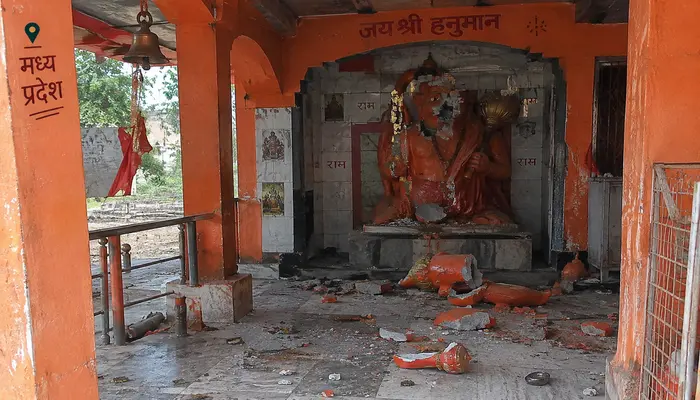
Case Summary
In Bandipur village of Lateri, Madhya Pradesh, a 700-year-old Hanuman temple was vandalised and robbed on 18 September 2026 at around 11 pm. The sacred idol of Lord Hanuman was desecrated, and multiple revered religious objects were stolen from the temple during the attack. According to Hindu villagers, the perpetrator entered the temple at night and damaged the Hanuman idol. He also stole several smaller Hindu idols, threw the sacred Ramayana onto the floor, and removed the silver eyes from the Hanuman idol. The incident sparked widespread outrage among the villagers, who said the desecration had deeply hurt Hindu religious sentiments. The attack also disrupted the temple's religious life, as regular worship remained suspended for four days and the traditional chola offering (a sacred ceremonial cloth draped over the Hanuman idol as an act of devotion) could not be performed. On 22 September 2026, a large number of villagers submitted a memorandum to the District Collector demanding strict legal action against the accused. They also sought an investigation into encroachment linked to his house, demolition action in accordance with the law, and his expulsion from the district. Villagers further stated that the accused, identified as Sanjeev Dhakad, had vandalised the temple on previous occasions as well. He was apprehended by local residents immediately after the incident, handed over to the police, and later remanded to judicial custody by the court.
Why it is Hate Crime ?
The primary category selected in this case is: Attack on Hindu religious representations. The subcategory selected is: Desecration of Hindu religious symbol. Icons and symbols or a religious representation of a spiritual ideal are widely revered in Hinduism. Iconography is of vital significance in the Hindu milieu. It helps connect people’s spiritual beliefs with the real world. Iconography within the Hindu faith takes several shapes and forms. Murtis are of most significance to Hindus, to which daily rituals, prayers and offerings are done. Besides the murtis, there are several other symbols which have deep significance in the Hindu faith – the Om and Swastika for example. Since these Hindu religious symbols hold paramount importance in Hinduism, any desecration of symbols, icons, murtis, religious representations and manifestations, is driven by animosity towards the faith itself which manifests itself through these murtis, icons and symbols. Therefore, any desecration of these Hindu religious symbols and representations is considered religiously motivated hate crimes under this category. The other subcategory selected is: Attack on Temples. In Hinduism, a temple is the abode of the Deity. The Deity in the Temple is consecrated, thereby, making it a real, breathing entity. Hindus believe that not just the Deity but the temple premises itself are sacred to Hindus since Hindus hold the faith that the entire Temple space is an amalgamation of the divine energy of the deity. Given the central significance of Temples in Hindu Dharma, any attack against a Hindu Temple or its peripheral premises is an attack on the faith itself and is born out of animosity towards the faith, of which, the Temple is a central tenet. Any manner of attack against a Temple and/or its premises would therefore be considered a religiously motivated hate crime. This incident was a clear example of a religiously motivated hate crime, as a 700-year-old Hindu temple was vandalised and robbed, the sacred idol of Lord Hanuman was desecrated, and multiple revered religious objects were looted. A Hindu temple is a deeply revered place of worship where devotees believe the divine presence resides. It is not merely a physical structure but a sacred space dedicated to prayer, ritual, and communion with the divine. Within Hindu tradition, consecrated idols (murtis) are sacred embodiments of the deity’s presence, serving as the focal point of worship and devotion rather than being regarded as ordinary objects. Lord Hanuman is one of Hinduism’s most venerated deities, worshipped as the embodiment of devotion, strength, courage, loyalty, and divine protection. The deliberate desecration of his idol, including the removal of its silver eyes, was therefore not simply an act of theft or property damage but an attack on a sacred religious symbol held in profound reverence by millions of Hindus. Such an act violates the sanctity of a consecrated place of worship, deeply wounds the religious sentiments of devotees, and reflects hostility towards Hindu beliefs and the sacred symbols through which the faith is expressed. The throwing of the sacred Ramayana onto the floor further constituted the desecration of a revered Hindu scripture. The Ramayana, one of Hinduism's most sacred epics, narrates the life and virtues of Lord Rama and occupies a central place in Hindu religious, cultural, and spiritual life. It is treated with profound reverence by devotees, who regard the scripture itself as sacred. Deliberately discarding it onto the floor was therefore not merely an act of disrespect towards a book, but an act of desecration directed at a cherished symbol of the Hindu faith. The theft of several smaller Hindu idols and other revered religious objects also reflected hostility towards Hindu religious symbols. These sacred objects form an integral part of temple worship and ritual practice, and their removal was not simply the loss of valuable property but the violation of items that hold deep spiritual significance for devotees. The combination of vandalism, desecration, and the robbery of consecrated religious objects disrupted the temple's religious life, preventing regular worship and the traditional Chola offering from being performed for four days. The fact that the perpetrator had vandalised the Hanuman temple on previous occasions as well demonstrated that this was not an isolated act, but a repeated pattern of targeting the same Hindu place of worship. The recurrence of such attacks reflected a sustained hostility towards Hinduism rather than a one-off act of vandalism. Repeatedly desecrating a sacred temple and its religious symbols showed a deliberate disregard for Hindu religious beliefs and the sentiments of the Hindu community. This pattern further reinforced the religiously motivated nature of the offence and its classification as a hate crime. Since this case meets the parameters of a religiously driven hate crime, it is being documented in the Hinduphobia Tracker's hate crime database.


Case Status
Arrested


Perpetrators Details
Perpetrators
Others
Perpetrators Range
One Person
Perpetrators Gender
male
 Sources




