Peaceful Ganpati visarjan disrupted as Ahilyanagar police lathi-charge Hindu devotees, activists say one devotee died in police excesses
 Ahmadnagar, Maharashtra, India
  22 September, 2026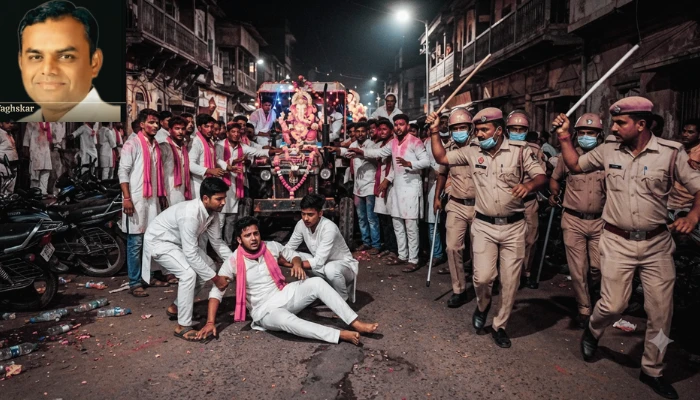
Case Summary
In Bhingar, Ahilyanagar/Ahmednagar, Maharashtra, Hindu devotees were lathi-charged by police without provocation while peacefully participating in a Ganpati Visarjan procession. Following the lathi charge, the participants stated that a 49-year-old devotee, Deepak Wagaskar, died because of the police excesses, while other devotees suffered injuries. According to the victims, Deepak Wagaskar, a 49-year-old resident of the Bhingar Camp police station area and a member of Shukleshwar Yuvak Mitra Mandal, was participating in the Ganpati Visarjan procession in Ahilyanagar city on Wednesday night, 23 September, 2026. The procession was passing through the area under Bhingar police station when the police confronted members of the Ganesh mandal over the throwing of gulal. A video of the incident subsequently went viral on social media. The video showed around 15 to 20 Hindu devotees peacefully dancing and celebrating during the Ganpati procession. A few devotees were on top of a tractor trolley in the procession. As the devotees danced and threw gulal on each other, the police suddenly lathi-charged the group without provocation. The devotees said that Wagaskar died following the lathi charge, while several other devotees suffered injuries. Members of the Ganesh mandal and local residents stated that the victim died after being subjected to police excesses. The incident led to protests in Bhingar, with Ganesh mandals demanding action against the police personnel involved. MLA Sangram Jagtap demanded strict action against the officials and called for a bandh in the Bhingar Camp area. “The residents and members of the Yuvak Mandal said that police lathi-charged people during the procession, following which Wagaskar fell and was taken to a hospital. He died there,” MLA Jagtap said. Meanwhile, Ahilyanagar Superintendent of Police R. Mummaka Sudarshan claimed that the victim was not present at the location where the police carried out the lathi charge, adding that the cause of death would be determined after the post-mortem examination and that the entire incident would be investigated. He further claimed that the police used a mild lathi charge on people near a moving tractor trolley to bring people down from it for their safety.
Why it is Hate Crime ?
The first primary category selected in this case is: Attack resulting in death. Within it, the sub-category selected is: Attack on religious procession. The outward celebration and display of religious symbols is an intrinsic part of Hinduism. Religious processions on various festivals are age-old traditions and a way to manifest faith and form a part of the religious practices of Hindus. On several occasions, such religious processions come under attack by non-Hindu mobs, in a manifestation of their animosity towards Hinduism and its practices. The reasons cited for such violent attacks are many and range from crossing a non-Hindu resident-dominated area to playing loud music, crossing from an area where there is a religious structure of another faith, etc. The violent attacks are triggered by the outward display of religiosity by Hindus. The attacks are mainly a manifestation of religious supremacist doctrine which believes that idolatry, essentially the Hindu faith, deserves to be annihilated since the very tenets of Hinduism, its practices, and traditions are considered a sin in those doctrines. Since these attacks and the deaths due to the attacks emanate from intrinsic and doctrinal animosity towards Hindus and Hinduism, it is considered a religiously motivated hate crime under this category. The second sub-category selected is: Attack against Hindu devotees. Hindu devotees are among the easiest targets of religiously motivated hate crimes because, during the festival/procession/puja, etc., for non-Hindus it is easy to profile their victims based on religion. Hindu devotees come under attack on several occasions by individual non-Hindus or mobs of non-Hindus owing to their animosity against Hinduism, its symbols, and traditions/practices. There are several instances of Hindu devotees being attacked while they worship in temples or temporary religious structures, during religious processions, doing bhajan/kirtan/puja in their own homes, in the residential society, etc. These attacks are perpetrated by non-Hindus primarily because of their animosity towards Hindus and their faith. In some cases, the trigger for the violence may be non-religious; however, two elements make these hate crimes. First, the Hindus who come under attack are attacked violently while indulging in religious activity. Whether they are in a place of worship or not is immaterial to the crime. When individuals are attacked while indulging in religious practices, the attack in itself is a hindrance to their freedom to practice religion and therefore constitutes a hate crime. Secondly, religious supremacist doctrines and ideologies deem the religious practices of Hindus to be offensive ab initio since they are considered “sinful” by these ideologies, worthy of being annihilated by force or coercion. Driven by these religious supremacist ideologies and doctrines, the attacks against Hindu devotees stem from intrinsic animosity towards Hinduism. In some cases, the trigger for the violence may be non-religious; however, it develops into a religiously motivated crime during the course of the violence. Since these attacks stem from animosity towards Hindus and Hinduism, they are considered religiously motivated hate crimes. Under this category, cases where the attack led to the death of the Hindu victim/s would be documented. The other primary category selected in this case is: Attack not resulting in death. Within it, the sub-category selected is: Attack on religious procession. The outward celebration and display of religious symbols is an intrinsic part of Hinduism. Religious processions on various festivals are age-old traditions and a way to manifest faith and form a part of the religious practices of Hindus. On several occasions, such religious processions come under attack by non-Hindu mobs, in a manifestation of their animosity towards Hinduism and its practices. The reasons cited for such violent attacks are many and range from crossing a non-Hindu resident-dominated area to playing loud music, crossing from an area where there is a religious structure of another faith etc. The violent attacks are triggered by the outward display of religiosity by Hindus. The attacks are mainly a manifestation of religious supremacist doctrine which believes that idolatry, essentially the Hindu faith, deserves to be annihilated since the very tenets of Hinduism, its practices and traditions are considered a sin in those doctrines. Since these attacks emanate from intrinsic and doctrinal animosity towards Hindus and Hinduism, it is considered a religiously motivated hate crime under this category. The second sub-category selected is: Attack against Hindu devotees. Hindu devotees are among the easiest targets of religiously motivated hate crimes because during the festival/procession/puja, etc., it is easy for non-Hindus to profile their victims based on religion. Hindu devotees come under attack on several occasions by individual non-Hindus or mobs of non-Hindus owing to their animosity against Hinduism, its symbols and tradition/practices. There are several instances of Hindu devotees being attacked while they worship in temples or temporary religious structures, during religious processions, doing bhajan/kirtan/puja in their own homes, in the residential society, etc. These attacks are perpetrated by non-Hindus primarily because of their animosity towards Hindus and their faith. In some cases, the trigger for the violence may be non-religious; however, two elements make these hate crimes. First, the Hindus who come under attack are attacked violently while indulging in religious activity. Whether they are in a place of worship or not is immaterial to the crime. When individuals are attacked while indulging in religious practices, the attack in itself is a hindrance to their freedom to practice religion and therefore constitutes a hate crime. Secondly, religious supremacist doctrines and ideologies deem religious practices of Hindus to be offensive ab initio since they are considered “sinful” by these ideologies, worthy of being annihilated by force or coercion. Driven by these religious supremacist ideologies and doctrines, the attacks against Hindu devotees stem from intrinsic animosity towards Hinduism. In some cases, the trigger for the violence may be non-religious; however, it develops into a religiously motivated crime during the course of the violence. Since these attacks stem from animosity towards Hindus and Hinduism, they are considered religiously motivated hate crimes under this category. The third primary category selected in the case is: Restriction/ban on Hindu practices. The selected subcategory is: Administration restricting religious practice In several cases, it is seen that the administration/state disallows a religious practice owing to prejudicial orders and concerns, targeted specifically against the Hindu community. Such restriction/prohibition would be considered documented as a hate crime because the orders are often a result of pressure by groups that harbour animosity towards Hinduism and Hindus. Often, the restriction by the authorities is driven by bias, hostility, or prejudice against the specific community being stopped from holding a religious practice, by pressure groups that harbour animosity towards Hindus, intrinsic to their faith. Since practices are intrinsic to the faith of the Hindus, such prejudicial restriction is considered a curtailing of the fundamental rights of the Hindu community. In several cases, for example, the authorities ban a Hindu religious practice due to pressure from groups opposed to the religion. In other instances the prohibition is selectively enforced against one religious group (Hindus) while others are allowed to proceed. There are still other cases where the authorities preemptively restrict a religious practice by Hindus because those who hold animosity towards Hindus may get “provoked”, leading to them being violent, thereby assuaging the sentiments of those who hold animosity towards Hindus by curtailing the religious rights of Hindus. Such acts and orders are prejudiced, indicating discriminatory motives owing to the capitulation to groups that harbour animosity towards Hindus and therefore, would be categorised as a religiously motivated hate crime since the original pressure leading to the order itself is a result of hatred/bias/prejudice/religious hate against Hindus. This case was included in the Hinduphobia Tracker because a peaceful Hindu religious observance was subjected to a violent and coercive interruption by the police. The attack occurred specifically in the course of Ganpati Visarjan, making the religious character of the gathering central to understanding the nature and impact of the violence. Ganpati Visarjan is not merely a public celebration but an integral Hindu religious practice through which devotees express their devotion to Lord Ganesha. The procession carries the faith of the devotees into the public sphere through music, dancing, gulal and collective participation. Such outward expressions are an important part of Hindu religious life. Violently disrupting such a procession struck directly at the community's freedom to practise and visibly express its faith. More significantly, the devotees were not engaged in an attack or confrontation with the police. They were participating in the customary celebrations of their faith, dancing to the music and sharing gulal among themselves. The sudden use of force against them therefore transformed a peaceful religious celebration into a scene of intimidation and physical violence. The fact that the violence was directed at devotees in the midst of religious observance made the attack particularly significant from the perspective of religious freedom. The incident's severity was further underscored by its consequences. Violence during a religious procession did not remain a momentary disruption of celebration but resulted in serious physical harm and the death of a devotee. This showed that using coercive force against a religious gathering had consequences that extended far beyond the immediate interruption of the practice itself. At the same time, the police justified the action by stating that only a mild lathi-charge was used and that the intervention was intended to bring devotees down from a moving tractor trolley for their safety. However, this explanation raises serious questions about the necessity and proportionality of using physical force during a peaceful religious celebration. The devotees were participating in the Ganpati Visarjan procession without any reported disturbance or provocation, and those standing on the trolley were grown adults capable of making their own decisions about their movement and safety. Even if the police considered their position on the moving trolley unsafe, the use of lathis against devotees was difficult to reconcile with the stated purpose of protecting them. A safety intervention could have involved stopping the vehicle, issuing instructions, or asking the devotees to come down rather than resorting to physical force. Using lathis against Hindu devotees in the midst of a peaceful religious celebration therefore reflected a blatant disregard for their safety, dignity and right to freely celebrate their faith. The fact that the intervention resulted in injuries and was followed by the death of a devotee made the action all the more serious, underscoring how the religious observance was treated with disregard rather than respect. The case therefore represented a serious interference with the peaceful practice and public expression of Hinduism. The combination of a religious procession, the targeting of its participating devotees with physical force, the resulting injuries and the death of one participant made the incident relevant to the Tracker's parameters concerning attacks on Hindu religious processions and devotees. Disclaimer: The number of victims recorded in the Tracker was taken as 20(twenty), since the video showed around 15 to 20 Hindu devotees participating in the procession, all of whom were subjected to the lathi charge. The higher figure of 20 was therefore used for documentation purposes.
Victim Details
Total Victim
20
Deceased
1
Gender
- Male 20
- Female 0
- Third Gender 0
- Unknown 0
Caste
- SC/ST 0
- OBC 0
- General 0
- Unknown 20
Age Group
- Minor 0
- Adult 20
- Senior Citizen 0
- Unknown 0


Case Status
Unknown


Perpetrators Details
Perpetrators
State and Establishment
Perpetrators Range
Unknown
Perpetrators Gender
unknown
 Sources




