Over 100-year-old Hindu Temple in Bangladesh targeted, idols of goddess Durga and Saraswati vandalised
 Rajbari District, Bangladesh
  21 September, 2026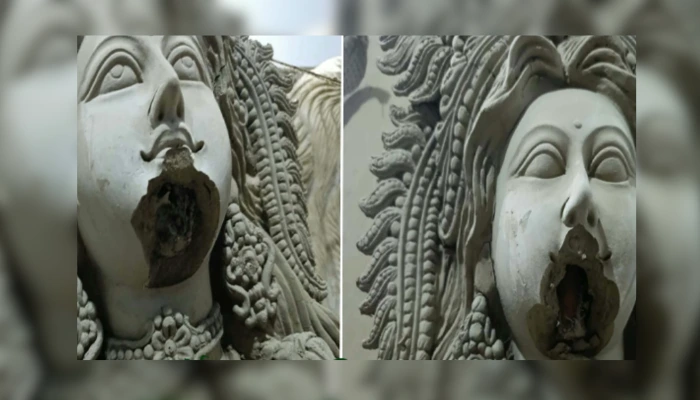
Case Summary
In Banibaha Union of Rajbari Sadar Upazila, Bangladesh, vandals vandalised the under-construction idols of revered Hindu deities Goddess Durga and Goddess Saraswati at the Banibaha Bazar Sarbajanin Durga Temple. The faces of both idols were damaged, reportedly with sticks, in an incident believed to have occurred on the night of 21 September 2026. Arun Kundu, president of the temple committee, said that Durga Puja has been celebrated at the temple for more than a century, and preparations for this year’s festival were underway. Artisans had begun sculpting the idols around two weeks earlier, completed the clay work several days before the incident, and then left the site. Kundu said the temple's front was secured with an iron grille. At around 10 PM on Monday, his son and nephew entered the temple to retrieve a spade. After switching on the lights, they found that the faces of the Durga and Saraswati idols had been broken. Kundu suspected that someone had used a stick to strike the idols from outside the iron grille. After discovering the vandalism, leaders of the Banibaha Bazar committee verbally informed the Rajbari Sadar Police Station. Officer-in-Charge Uttam Kumar Ghosh said the temple was reasonably secure, with iron grilles around it, while the idols were also covered with cloth to keep them out of public view. He confirmed that the artisans had completed the clay structuring several days earlier, before leaving. Police have launched an investigation into how the idols were damaged despite the security arrangements. The motive for the vandalism and the identities of those responsible are yet to be established and will be determined through the investigation.
Why it is Hate Crime ?
This case is being added to the tracker under the primary category- Attack on Hindu religious representations. The subcategory selected is- Desecration of Hindu religious symbol. Icons and symbols or a religious representation of a spiritual ideal are widely revered in Hinduism. Iconography is of vital significance in the Hindu milieu. It helps connect people’s spiritual beliefs with the real world. Iconography within the Hindu faith takes several shapes and forms. Murtis are of most significance to Hindus, to which daily rituals, prayers and offerings are done. Besides the murtis, there are several other symbols which have deep significance in the Hindu faith – the Om and Swastika for example. Since these Hindu religious symbols hold paramount importance in Hinduism, any desecration of symbols, icons, murtis, religious representations and manifestations, is driven by animosity towards the faith itself which manifests itself through these murtis, icons and symbols. Therefore, any desecration of these Hindu religious symbols and representations is considered religiously motivated hate crimes under this category. The other subcategory selected is- Attack on Temples. In Hinduism, a temple is the abode of the Deity. The Deity in the Temple is consecrated, thereby, making it a real, breathing entity. Hindus believe that not just the Deity but the temple premises itself are sacred to Hindus since Hindus hold the faith that the entire Temple space is an amalgamation of the divine energy of the deity. Given the central significance of Temples in Hindu Dharma, any attack against a Hindu Temple or its peripheral premises is an attack on the faith itself and is born out of animosity towards the faith, of which, the Temple is a central tenet. Any manner of attack against a Temple and/or its premises would therefore be considered a religiously motivated hate crime. This case exemplifies a clear instance of an anti-Hindu hate crime, as the perpetrators deliberately targeted a Hindu temple and idols of revered Hindu deities, Goddess Durga and Goddess Saraswati. Hindu temples hold profound significance as the divine abodes of Hindu deities, places where the sacred presence of gods manifests for devotees. These institutions stand as deeply revered centres of worship, community gathering, and spiritual solace for all Hindus, embodying centuries of faith and cultural heritage. By choosing to desecrate such a holy site, the attackers revealed their religiously motivated intent to humiliate and terrorise the Hindu community, stripping away any doubt that this was a hate-driven assault aimed squarely at targeting Hindus and their beliefs. The perpetrators' deliberate desecration of the temple idols further cemented the religious hatred fuelling this crime. These idols were far more than physical objects; they served as living manifestations of the divine, invoked through ancient rituals and revered in daily worship by countless devotees who poured their hearts into prayers and offerings. The attackers, fully aware of the sacred role these idols played, including the Kali idol, Shiva, a snake, and the faces of the Dakini-Yogini, desecrated them with brutal intent, shattering what the Hindu community held most dear. This calculated violation of such potent sacred symbols of the Hindu faith exposed raw animosity towards Hinduism itself, its rituals, and its people, marking the act as a textbook example of a religiously motivated hate crime. This temple attack gains even greater significance when viewed alongside recent assaults on Hindus in Bangladesh, particularly after the ouster of Sheikh Hasina in August 2024. These back-to-back incidents reveal not isolated outbursts but a chilling pattern of selective, impunity-laced violence against Bangladesh's Hindu minority. Such escalation underscores a pervasive climate of religiously motivated hate crimes targeting Hindus, demanding urgent recognition and action. Even without the perpetrators' religious identity being confirmed in this case, their fixation on desecrating a Hindu temple and its idols demonstrated deep-seated anti-Hindu animosity as the driving force behind the crime. This was no random act but a premeditated strike rooted in hatred for the Hindu faith and identity. Accordingly, this case has been added to the hate crime database of the Hinduphobia Tracker.


Case Status
Unknown


Perpetrators Details
Perpetrators
Unknown
Perpetrators Range
Unknown
Perpetrators Gender
unknown
 Sources




