Hindu family threatened with eviction by Muslim woman over celebrating Ganesh Chaturthi; accused had repeatedly objected to Hindu pujas and reciting Hanuman Chalisa
 Nala Sopara, Maharashtra, India
  24 September, 2026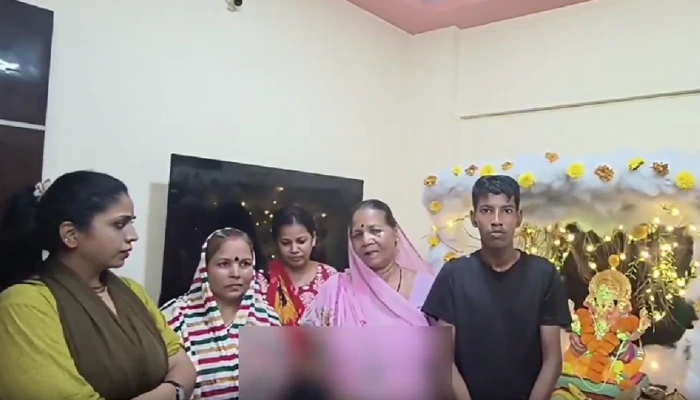
Case Summary
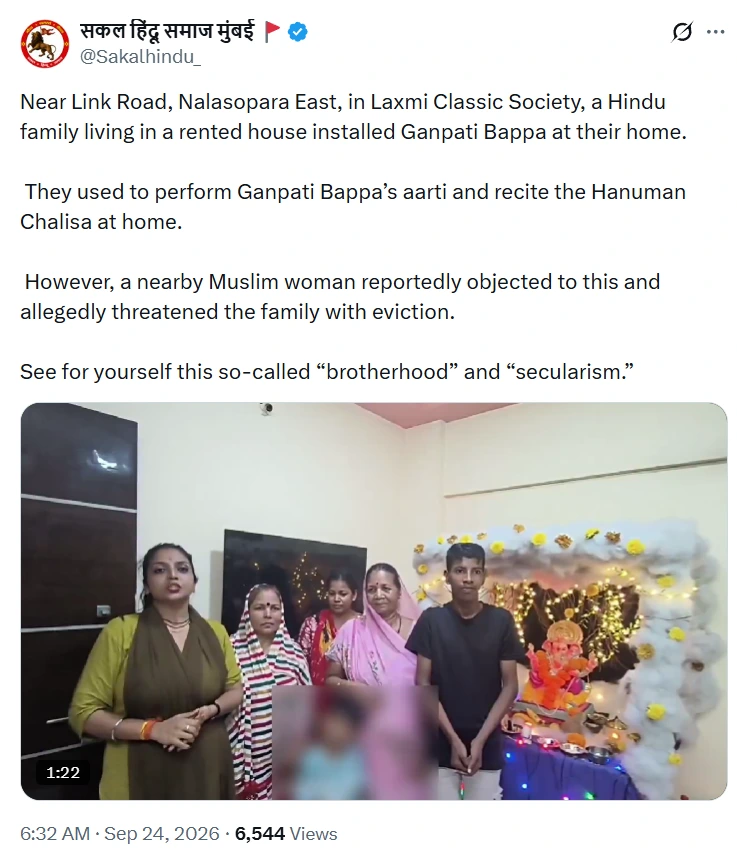
In Nalasopara East, Maharashtra, a Hindu family was threatened with eviction from their residence by a Muslim woman while they were celebrating Ganesh Chaturthi. The woman objected to the family's worship of Lord Ganesha and disrupted their aarti. The Hindu family said she had repeatedly harassed and threatened them in the past for performing puja and reciting the Hanuman Chalisa. As per available information, the victim family lived in Rashmi Classic Society on Link Road in Nalasopara. The incident came to public attention on 24 September 2026, when Sakal Hindu Samaj, a Hindu organisation based in Maharashtra, posted a video testimony of the family's ordeal on X. In the video, a female Hindu activist from Sakal Hindu Samaj stated that the Muslim woman disrupted the family's aarti during the Ganesh Chaturthi celebrations. She added that the woman had repeatedly targeted the family for observing Hindu religious practices, including performing aarti, conducting pujas and reciting the Hanuman Chalisa. The video showed the Hindu family together, comprising three adult women, one Hindu youth and a minor child. One of the women said that the Muslim resident repeatedly harassed them over their religious practices, instructed them not to perform puja, and demanded that they keep the windows of their house closed, saying the Hindu rituals disturbed her. She further stated that the family had been subjected to repeated threats and harassment, and that such incidents had occurred more than four or five times. The video also revealed that the Muslim woman harassed the Hindu youth whenever he recited the Hanuman Chalisa, saying that his chanting disturbed her. The family further stated that she threatened to have them evicted from the society, saying that other Hindu families had previously been expelled and that they too would be expelled. The video subsequently went viral on social media, with Hindu users demanding legal action from the local police against the Muslim woman.
Case Images
Why it is Hate Crime ?
This case is being added to the tracker under the primary category: Attack not resulting in death. The subcategory selected is: Attacked for Hindu identity. In several cases, Hindus are attacked merely for their Hindu identity without any perceived provocation. A classic example of this category of religiously motivated hate crime is a murder in 2016. 7 ISIS terrorists were convicted for shooting a school principal in Kanpur because they got ‘triggered’ seeing the Kalava on his wrist and tilak that he had put. In this, the Hindu victim had offered no provocation except for his Hindu religious identity. The motivation for the murder was purely religious, driven by religious supremacy. Such cases where Hindus are targeted merely for their religious identity would be documented as a hate crime under this category. Another primary category selected is: Attack on Hindu religious representations. The subcategory selected is: Defiling customs. Sanatan Dharma is not a religion of one book, which is to say that while it has religious scriptures that form the central tenets of the faith, there are several traditions followed through thousands of years, mostly passed from generation to generation orally. There are several such customs and traditions that are followed by various Hindus and Hindu sects. Defiling of these traditions and customs is a breach of an individual or group’s religious practices. Such practices can range from dietary restrictions like not eating non-vegetarian food for a certain period of the year, not eating non-vegetarian food at all, not eating beef since the cow is considered holy in Hinduism, the sanctity of religious customs followed in the house (like many ISCKON devotees), etc. Any malicious action leading to the breach of such traditions or defilement of these traditions owing to animosity towards the faith or for the sake of activism stems not only from the lack of faith in the religion itself but also from disregard for the faith of the devotees who follow the customs/traditions and implicit bias against the faith, the tradition itself. Since these specific traditions are central to the faith of the devotees of that specific sect of Hindus, any non-compliance with these traditional rules would be considered a religiously motivated hate crime. This case is an example of a hate crime because the Hindu family's faith and religious identity were targeted while they were celebrating Ganesh Chaturthi. The Muslim woman objected to their worship of Lord Ganesha, disrupted their aarti, and had repeatedly harassed and threatened them with eviction for performing puja and reciting the Hanuman Chalisa. The hostility described by the family was directed not at a personal dispute, but at their public expression of Hindu faith. Ganesh Chaturthi is one of the most revered festivals in Hinduism, commemorating the birth of Lord Ganesha, the deity worshipped as the remover of obstacles, the patron of wisdom, and the harbinger of auspicious beginnings. During the festival, Hindu families install the idol of Lord Ganesha in their homes, perform daily puja and aarti, offer prayers, sing devotional hymns, and seek divine blessings. These rituals constitute an integral expression of Hindu religious life and hold profound spiritual significance for Hindu devotees. The disruption of the family's Ganesh Chaturthi celebrations, particularly their sacred aarti, and the threats of eviction demonstrated clear hostility towards their Hindu faith. Ganesh Chaturthi is one of Hinduism's most revered festivals and is celebrated only once a year; in residential neighbourhoods where people of different religions coexist, mutual accommodation of each other's religious observances is a normal part of community life. Aarti is an indispensable ritual of Ganesh worship, during which devotees offer light before Lord Ganesha while singing devotional hymns as an expression of reverence, surrender, and divine communion. By interrupting this sacred act of worship and targeting the family simply for celebrating Ganesh Chaturthi, the Muslim woman not only displayed religious intolerance towards the public expression of Hinduism but also desecrated a deeply sacred Hindu religious observance. The harassment extended beyond the Ganesh Chaturthi celebrations to the family's everyday Hindu worship, revealing a sustained pattern of religious intolerance. The Muslim woman repeatedly prevented the family from performing puja and insisted that they shut the windows of their home whenever Hindu prayers or rituals were taking place, saying that they disturbed her. This intimidation occurred on more than four or five occasions and was accompanied by repeated threats. Such conduct demonstrated a fundamental objection to Hindu religious practices being carried out in her vicinity, treating the very presence of Hindu worship as unacceptable. The repeated attempts to suppress ordinary Hindu rituals within the family's own home therefore reflected deep-seated religious animosity towards the public expression of Hinduism. The religious hostility in this incident was further evident from the Muslim woman's repeated harassment of the family's Hindu youth whenever he recited the Hanuman Chalisa. The Hanuman Chalisa is one of Hinduism's most sacred devotional hymns, composed by the 16th-century saint Tulsidas in praise of Lord Hanuman, and is recited daily by millions of devotees as an act of worship, spiritual protection, and devotion. By objecting to and attempting to prevent its recitation, the Muslim woman demonstrated hostility even towards the audible expression of Hindu faith within the family's own home. Her repeated efforts to stop the chanting, coupled with threats to have the family expelled from the housing society, reflected a clear pattern of religious intolerance directed specifically at Hindu identity and its visible expression. Such actions of Muslim perpetrators are rooted in doctrinal hostility towards Hinduism. Notably, in Islamic theology, idol worship, referred to as Shirk, is regarded as the gravest sin. The Qur'an strictly condemns it, and Islamic teachings emphasise the complete rejection of any practice associated with idol worship. Muslims are taught from a young age that idolatry is an unforgivable sin. While this belief is central to the Islamic faith, it has also led, historically and in contemporary times, to intolerance and hostility towards idol-worshipping religions, especially Hinduism. When a Hindu family is harassed, their Ganesh Chaturthi celebrations are disrupted, and they are threatened with eviction merely for worshipping Lord Ganesha, it reflects more than a neighbourhood dispute. It is a manifestation of deep-seated theological contempt towards Hindu practices, rooted in the Islamic doctrinal view that idol worship is impure and offensive. Overall, since this incident meets the parameters of a hate-driven offence, it is being added to the hate crime database of the Hinduphobia Tracker. Disclaimer: The Hinduphobia Tracker records incident dates based on when the crime occurs rather than when it is reported. In this case, the exact date of the incident was not disclosed in the available information. Therefore, 24 September 2026, the date on which Sakal Hindu Samaj first published the victim family's video testimony on X, has been selected as the indicative incident date for documentation purposes only.
Victim Details
Total Victim
5
Deceased
0
Gender
- Male 1
- Female 3
- Third Gender 0
- Unknown 1
Caste
- SC/ST 0
- OBC 0
- General 0
- Unknown 5
Age Group
- Minor 1
- Adult 3
- Senior Citizen 0
- Unknown 1


Case Status
Unknown


Perpetrators Details
Perpetrators
Muslim Extremists
Perpetrators Range
One Person
Perpetrators Gender
female
 Sources




