Hindu bank offical targeted with false ‘blasphemy’ accusations by former Muslim employee in Pirojpur, Bangladesh
 Pirojpur District, Bangladesh
  21 September, 2026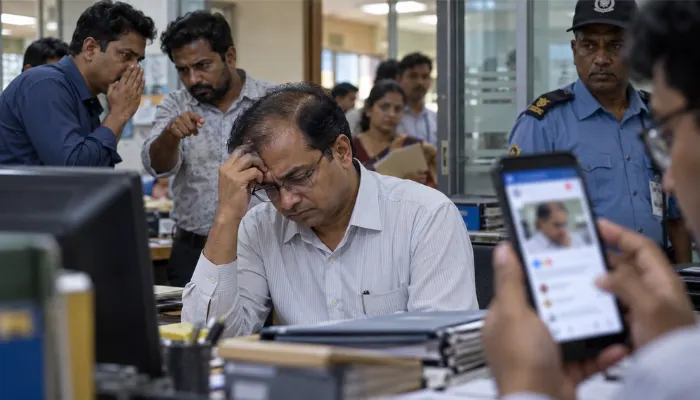
Case Summary
In Pirojpur, Bangladesh, a Hindu bank officer working at Dutch-Bangla Bank was targeted by a former Muslim employee, who accused him of insulting Islam. The officer said the allegations were false and were deliberately circulated on Facebook to humiliate him, damage his professional reputation and put his job at risk. The dispute began after a security guard at the officer’s branch left his job on the 27th of an unspecified month. About two months later, after security guard salaries were increased, the former employee sought to return to the bank. He pressured the Hindu officer to remove the existing guard and arrange his reappointment. As the officer did not have the authority to make such staffing decisions, he directed the former employee to approach his supervisor. After his attempt to regain employment failed, the former security guard began accusing the Hindu officer of insulting Islam. The officer said the former employee deliberately invoked his religious identity to give the allegations a communal character and circulate them among the public, with the intention of damaging his reputation. The former employee also photographed the existing security guard sleeping during night duty and repeatedly sent the photographs to the branch and head office. As the harassment continued, the Hindu officer brought the matter to the attention of his senior authorities. They later tried to settle the dispute in the presence of Masud, owner of Green Hospital and a respected local figure. The officer, however, said the former security guard continued with the campaign despite the intervention. The situation escalated when the former employee sent another person to the officer’s workplace between around 6 PM and 7 PM, two evenings before the officer made his public statement. The individual secretly photographed the Hindu officer as well as official documents and materials at the workplace. A Facebook post was subsequently circulated in the officer’s name, accusing him of insulting Islam. The officer denied making any derogatory remarks about Islam or any other religion. He said there was no audio recording, written statement or other evidence to substantiate the accusations. According to him, the campaign stemmed from the former security guard’s resentment after he could not secure re-employment following the salary revision. The Hindu officer further said the allegations had harmed both his personal reputation and the image of Dutch-Bangla Bank. He called for an impartial investigation and appropriate action against those responsible for circulating the accusations and spreading false information.
Why it is Hate Crime ?
This case has been added to the tracker under the primary category of: Attack not resulting in death. Within it, the sub-category selected is: Attacked over 'Blasphemy'. Blasphemy essentially refers to the desecration of anything which is held sacred/holy to a group of people. However, for religious supremacist groups, the elements of ‘blasphemy’ are ever-changing, shifting and expanding – leading to infringement on the rights of other religious groups, freedom of speech and expression, threats and even physical violence. There are instances where blasphemy is also used as a dog whistle to target Hindus owing to intrinsic animosity towards Hinduism. There are several instances where stating truths as mentioned in the non-Hindu doctrine itself has led to unmitigated violence against Hindus. There have also been instances where non-Hindus have themselves created a ‘blasphemous’ situation, like placing a Quran in a temple, to use it as an excuse to attack Hindus. Essentially, Blasphemy charges are often made up and/or are used to shut down any form of criticism of non-Hindu faiths and as a tool to target Hindus. Any physical violence over Blasphemy charges against Hindus is foundationally based on animosity toward Hindus and their faith owing to religious supremacist ideologies; therefore, such attacks would be documented as religiously motivated hate crimes under this category. This case has been documented because it demonstrates how an unproven accusation of insulting Islam can be weaponised against a Hindu individual, exposing him to humiliation, intimidation and professional harm. The religious charge was not merely defamatory in nature; it attached a serious allegation of religious offence to the Hindu victim and thereby turned his identity into the basis of the attack. As the victim stated, his Hindu identity was deliberately brought into the framing of the accusation, making the episode a form of religiously targeted harassment rather than an ordinary personal dispute. The case's significance lies in how a blasphemy-style allegation can transform an otherwise limited dispute into a wider communal and institutional threat. Once a Hindu is portrayed as having insulted Islam, the allegation can carry consequences far beyond the original conflict. It can damage social standing, create hostility, jeopardise employment and expose the victim to further intimidation. The religious charge therefore becomes a tool through which pressure is amplified, and the victim is placed in a vulnerable position because of his faith. The absence of credible evidence supporting the allegation further strengthens this interpretation. An unverified charge of insulting Islam can itself become the instrument of persecution, regardless of whether the alleged offence ever took place. When such an accusation is publicly circulated against a Hindu individual, it can stigmatise him as an offender against another faith and generate pressure for punishment without established proof. The harm therefore arises not only from the allegation itself, but from the religious stigma attached to it. The case also reflects how blasphemy allegations can be used to exert pressure through professional and institutional channels. By circulating a religious accusation against a Hindu employee, those targeting him could create an environment in which his livelihood and standing were placed at risk. This gives the accusation a coercive function: it can isolate the victim, undermine his credibility, and create pressure for adverse action without requiring any physical attack. This pattern is particularly significant in Bangladesh, where the Hinduphobia Tracker has documented nearly 44 cases between 1 January 2023 and 15 September 2026 in which Hindus were targeted by Muslim mobs or state institutions over alleged blasphemy. In these cases, the allegations were not established, yet victims faced violence, threats, death, arrest or institutional pressure. The recurrence of such incidents shows how accusations of insulting Islam can become a mechanism for targeting members of the Hindu minority and exposing them to consequences vastly disproportionate to the allegation itself. The victim's religious identity, the nature of the accusation, and the social and professional consequences attached to it therefore make the religious dimension central to this case. It has consequently been classified under attacks over ‘blasphemy’ in the Hinduphobia Tracker. Disclaimer: The Hinduphobia Tracker records incident dates based on when the crime occurred, not when the media reported it. However, in this case, available reports did not establish the exact date of the incident. Therefore, 22nd September 2026 has been selected as the indicative incident date for documentation purposes.
Victim Details
Total Victim
1
Deceased
0
Gender
- Male 1
- Female 0
- Third Gender 0
- Unknown 0
Caste
- SC/ST 0
- OBC 0
- General 0
- Unknown 1
Age Group
- Minor 0
- Adult 1
- Senior Citizen 0
- Unknown 0


Case Status
Unknown


Perpetrators Details
Perpetrators
Muslim Extremists
Perpetrators Range
One Person
Perpetrators Gender
male
 Sources




