Hindu temple targeted, Kali idol damaged during attempted removal, religious artefacts and ornaments stolen in Faridpur, Bangladesh
 Faridpur District, Bangladesh
  18 September, 2026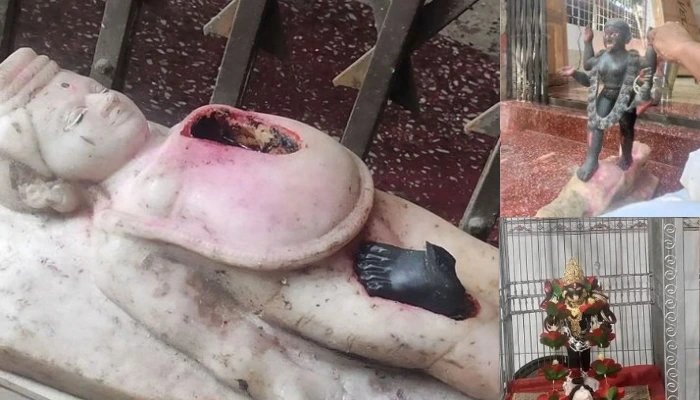
Case Summary
In Faridpur city, Bangladesh, the idol of Goddess Kali at the Uttar Kalibari Temple was damaged while unknown miscreants attempted to remove it during a nighttime break-in. The black-stone Kali idol, depicted standing over a white-marble figure of Lord Shiva, had one of its legs broken during the attempt to remove it from the temple. The perpetrators then fled with the damaged Kali idol along with its gold ornaments and several other Hindu religious artefacts. The incident took place between around 10:30 pm on 19 September 2026 and 5:45 am on 20 September 2026 at Uttar Kalibari Temple in Faridpur city. When the temple was opened in the morning, items were found scattered inside, and an inspection revealed that the Kali idol and several other religious artefacts were missing. According to temple priest Debi Prasad Chakraborty, the black-stone Kali idol was placed above a white-marble figure of Lord Shiva. The unknown miscreants forcibly attempted to remove the Kali idol, breaking one of its legs in the process. They eventually managed to take the damaged Kali idol, while the Shiva figure was left behind. The stolen Kali idol weighed at least 20 kilograms, while the complete structure weighed around 40 kilograms. The perpetrators also stole around 7–8 tolas of gold ornaments worn by the Kali idol. Other stolen religious artefacts included small brass idols of Lord Vishnu, Radha-Krishna and Goddess Manasa, as well as a silver snake weighing around 8–10 tolas that was wrapped around a Shivalinga. The idols and other artefacts were kept inside a room accessible through a wooden door and a collapsible gate on the eastern side of the temple. The perpetrators first broke a padlock securing the wooden door before breaking open an iron shutter gate secured with four locks. They entered the room and removed the Kali idol before fleeing with the stolen religious artefacts and ornaments. Temple management committee president 41-year-old Kushal Chakraborty stated that the temple's CCTV cameras were out of order at the time of the incident. After the theft was discovered, the temple committee called Bangladesh's national emergency service 999 at around 5:45 am. Police personnel from Faridpur Kotwali Police Station arrived at the temple shortly afterwards. None of the stolen idols, ornaments or other religious artefacts had been recovered. Kushal Chakraborty subsequently filed a general diary at the police station around noon. Faridpur Superintendent of Police Shahriar Mohammad Miazi and Officer-in-Charge Mahmudul Hasan visited the temple, while a Criminal Investigation Department crime scene team examined the site, collected evidence and cordoned off the area. Police stated that several teams had begun working to identify and arrest those involved in the theft. This incident occurred against the broader backdrop of the historical persecution faced by Hindus in Bangladesh. While the Hindu minority has endured discrimination, targeted violence, and religious hostility over decades, such persecution has intensified in distinct spurts during periods of political and social instability. The latest major escalation began and continued after the ouster of Sheikh Hasina’s government in August 2024, followed by another surge after the death of Sharif Osman Bin Hadi in December 2025, and subsequently in the immediate aftermath of the 13th National Parliamentary Election in 2026. Following the ouster of Sheikh Hasina, multiple incidents involving attacks on Hindu homes, temples and religious institutions were documented, alongside intimidation, arson and mob violence targeting Hindu localities. The Hinduphobia Tracker recorded 336 incidents involving the Hindu minority during this period, reflecting the scale of the escalation and the continuing vulnerability of Hindus in Bangladesh. A further spurt of violence followed the death of Sharif Osman Bin Hadi, a Muslim political activist and student leader known for his anti-Hindu and anti-India rhetoric, in December 2025. In the aftermath, Hindu communities were subjected to retaliatory violence, with Hindu homes and properties selectively attacked and several families forced to flee. Among the victims was Dipu Chandra Das, who was lynched and whose body was subsequently set ablaze by a Muslim mob over false blasphemy allegations. The Hinduphobia Tracker documented 51 incidents of anti-Hindu violence in the period following Hadi’s death alone, further illustrating how existing hostility towards the Hindu minority intensified during moments of communal mobilisation. During the same period, posters and written material calling for the extermination of Hindus were also displayed in public spaces. Such rhetoric, when viewed alongside incidents of arson, vandalism, assault and targeted intimidation, reflected an environment in which hostility towards Hindus was not merely episodic but repeatedly resurfaced in more intense forms during periods of unrest. The most recent escalation followed the 13th National Parliamentary Election in 2026. In the immediate aftermath of the election results, Hindu families in districts including Noakhali, Rangpur, Nilphamari, Sylhet, Thakurgaon and Dinajpur faced attacks involving arson, looting, assault and vandalism of Hindu homes and temples. In several instances, Hindu properties were selectively targeted, and families were threatened with displacement. The present incident therefore occurred within a much longer history of persecution of Hindus in Bangladesh, where hostility towards the community has persisted over time and intensified in repeated spurts. The latest cycle began after the ouster of Sheikh Hasina and continued through subsequent periods of political and communal upheaval, leaving the Hindu minority increasingly vulnerable to targeted violence, intimidation and religious hostility.
Why it is Hate Crime ?
This case has been added to the tracker under the primary category: Attack on Hindu religious representations. The sub-category selected is: Desecration of Hindu religious symbol. Icons and symbols, or a religious representation of a spiritual ideal, are widely revered in Hinduism. Iconography is of vital significance in the Hindu milieu. It helps connect people’s spiritual beliefs with the real world. Iconography within the Hindu faith takes several shapes and forms. Murtis are of great significance to Hindus, to which daily rituals, prayers and offerings are made. Besides the murtis, there are several other symbols which have deep significance in the Hindu faith – the Om and Swastika, for example. Since these Hindu religious symbols hold paramount importance in Hinduism, any desecration of symbols, icons, murtis, religious representations and manifestations is driven by animosity towards the faith itself, which manifests itself through these murtis, icons and symbols. Therefore, any desecration of these Hindu religious symbols and representations is considered religiously motivated hate crimes under this category. The other sub- category selected is: Attack on Temples. In Hinduism, a temple is the abode of the Deity. The Deity in the Temple is consecrated, thereby making it a real, breathing entity. Hindus believe that not just the Deity but the temple premises themselves are sacred to Hindus since Hindus hold the faith that the entire Temple space is an amalgamation of the divine energy of the deity. Given the central significance of Temples in Hindu Dharma, any attack against a Hindu Temple or its peripheral premises is an attack on the faith itself and is born out of animosity towards the faith, of which the Temple is a central tenet. Any manner of attack against a Temple and/or its premises would therefore be considered a religiously motivated hate crime. This case was included in the Hinduphobia Tracker as a hate crime because an ancient Hindu temple was targeted, the sacred Kali idol was physically damaged during its forcible removal, and the idol and other religious artefacts were subsequently stolen. At first glance, the incident appeared to involve the theft of valuable ornaments and other religious artefacts. However, if the sole objective had been to obtain valuables, the perpetrators could have removed the ornaments without forcibly removing the Kali idol itself. Instead, they broke one of the idol’s legs while attempting to remove it from the temple and then carried the damaged idol away, leaving the Shiva figure beneath it behind. Their actions therefore went beyond the mere theft of material valuables and involved the physical violation of a sacred Hindu murti that is deeply revered by Hindus. In Hinduism, a consecrated murti is not regarded as an ordinary object or merely as a piece of property. It represents the sacred presence of the deity within the temple and serves as the focus of prayers, offerings, rituals and daily worship. Goddess Kali is a revered Hindu deity worshipped as a manifestation of the Divine Mother, and her murti holds profound religious significance for the devotees who worship before her. Her placement upon the Shiva murti is also part of the established iconographic and religious setting in which she is worshipped. The forcible removal and physical breaking of the Kali murti therefore disrupted this sacred setting and violated the sanctity associated with the consecrated deity. The physical damage to and removal of the sacred murti from its place of worship thus amounted to the desecration of a sacred Hindu symbol and directly hurt the religious sentiments of the devotees for whom the deity and murti form an integral part of their religious practice. The fact that the incident occurred within the temple premises further heightened its religious significance. A Hindu temple is not merely a physical structure but a sacred institution regarded as the abode of a deity and a dedicated space for worship, prayer, rituals and religious practice. Temples consequently hold deep reverence within the Hindu community. Objects kept within the temple and associated with the deity, including murtis, ornaments offered to and worn by the deity, and other articles used in worship, likewise form part of this sacred religious setting and cannot be viewed solely in terms of their monetary value. By breaking into the temple, damaging the Kali murti and removing sacred objects from their place of worship, the perpetrators violated a space dedicated to Hindu worship and disrupted its devotional and religious environment. The wider context is also significant. Following the ouster of Sheikh Hasina on 5 August 2024, Hindus in Bangladesh faced repeated attacks on their religious institutions. The Hinduphobia Tracker has documented 145 attacks on Hindu temples in Bangladesh between 5 August 2024 and 23 September 2026. The repeated targeting of Hindu places of worship and sacred religious symbols indicates that the attack on Uttar Kalibari Temple occurred within a broader pattern of hostility towards Hindu religious institutions, rather than in complete isolation. It further reflects the continuing vulnerability of Hindu temples and places of worship in Bangladesh. It is important to mention here that, although the perpetrators remain unidentified at the time of writing this report, the forcible entry into the Hindu temple, physical damage to the sacred Kali idol and removal of Hindu religious artefacts, when viewed in the context of the wider pattern of attacks on Hindu religious institutions, amounted to an act of hostility towards Hinduism and resulted in the desecration of a sacred Hindu space and religious symbol. The incident is therefore considered a religiously motivated hate crime and is being recorded in the hate crime database of the Hinduphobia Tracker. Disclaimer: The Hinduphobia Tracker records the incident date based on when a crime occurs, rather than when it is reported by the media. As the incident occurred between 19 September 2026 and 20 September 2026, 19 September 2026 has been selected as the indicative incident date for documentation purposes only.


Case Status
Complaint filed


Perpetrators Details
Perpetrators
Unknown
Perpetrators Range
Unknown
Perpetrators Gender
unknown
 Sources




