Hindu Ganpati pandal targeted in Mumbai: Two Muslim men wave Islamic flags after dispute over devotional songs played near mosque
 Mumbai, Maharashtra, India
  21 September, 2026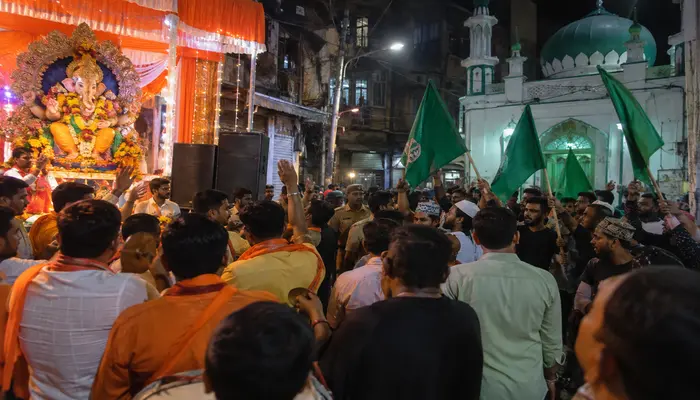
Case Summary
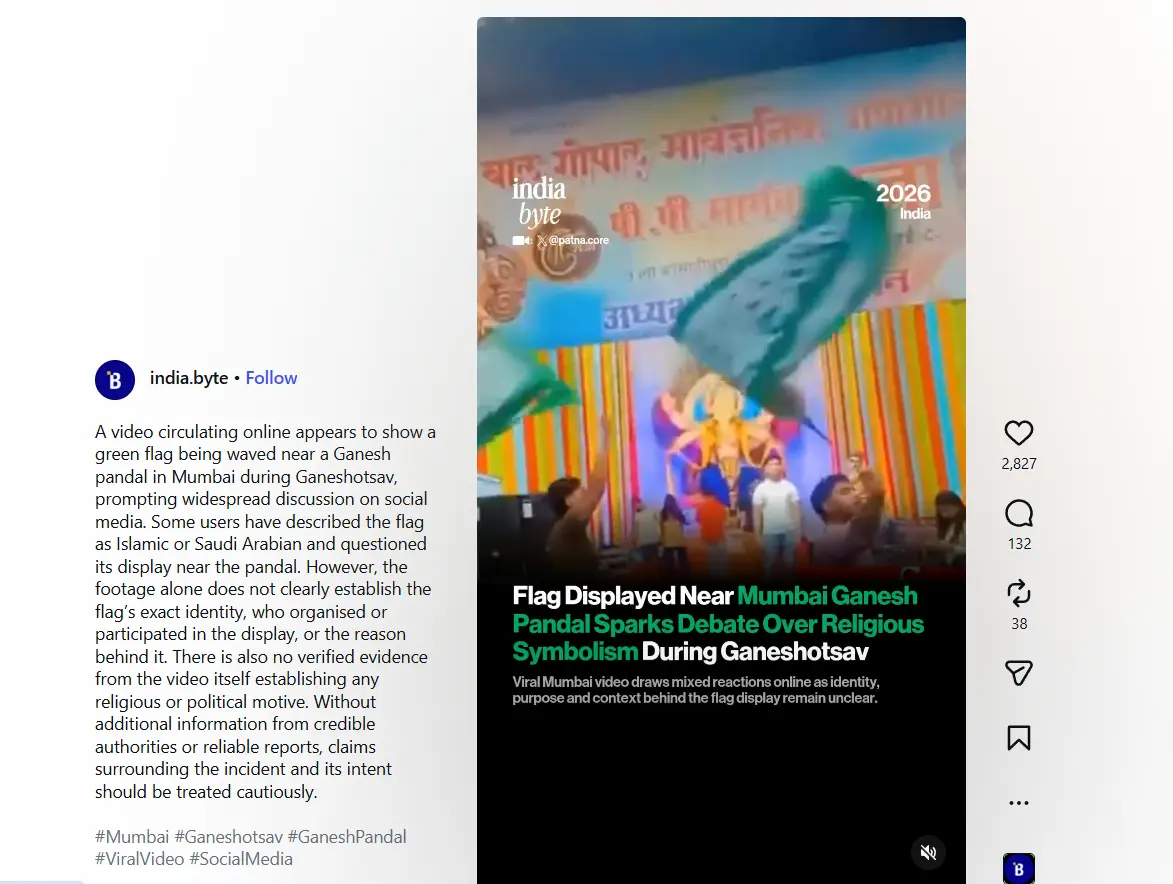
A video circulating on social media showed two Muslim youths waving green flags bearing Islamic inscriptions in front of the P.P. Margcha Raja Ganesh Mandal pandal in Kamathipura, Mumbai, during the Ganesh Chaturthi celebrations. The incident reportedly followed a dispute over the playing of Hindu devotional songs near a local mosque. The sight of Islamic flags being waved immediately outside a Ganpati pandal, during a festival dedicated to Lord Ganesha, drew criticism as an act of religious provocation and interference with a Hindu religious celebration. The location was particularly significant because the P.P. Margcha Raja is one of Kamathipura’s well-known Ganesh mandals, and Ganeshotsav has been celebrated here since 1963. This year’s P.P. Margcha Raja featured a 27-foot Ganesh idol. The P.P. Margcha Raja pandal is a sacred space where devotees gather for darshan, prayer and other Ganesh Chaturthi rituals. The reported display of Islamic flags outside the pandal, particularly after a dispute over playing Hindu devotional songs near a mosque, therefore carried religious significance beyond an ordinary neighbourhood disagreement. However, the Hinduphobia Tracker could not independently verify the video or establish the circumstances in which it was recorded. Nevertheless, the act raises concerns about deliberate religious provocation. The significance lies in the reported Islamic inscriptions on the flags, their display directly outside a Hindu religious venue, and the timing amid a dispute over Hindu devotional expression.
Case Images
Why it is Hate Crime ?
This case has been added to the tracker under the primary category of - Attack on Hindu religious representations. Within it, the sub-category selected is Defiling religious customs. Sanatan Dharma is not a religion of one book, which is to say that while it has religious scriptures that form the central tenets of the faith, there are several traditions followed through thousands of years, mostly passed from generation to generation orally. There are several such customs and traditions that are followed by various Hindus and Hindu sects. Defiling of these traditions and customs is a breach of an individual or group’s religious practices. Such practices can range from dietary restrictions like not eating non-vegetarian food for a certain period of the year, not eating non-vegetarian food at all, not eating beef since the cow is considered holy in Hinduism, the sanctity of religious customs followed in the house (like many ISCKON devotees), etc. Any malicious action leading to the breach of such traditions or defilement of these traditions owing to animosity towards the faith or for the sake of activism stems not only from the lack of faith in the religion itself but also from disregard for the faith of the devotees who follow the customs/traditions and implicit bias against the faith, the tradition itself. Since these specific traditions are central to the faith of the devotees of that specific sect of Hindus, any non-compliance with these traditional rules would be considered a religiously motivated hate crime. The Ganpati pandal served as a highly sacred space where the local community observed traditional public worship. Targeting this consecrated area transformed a neighbourhood disagreement into a direct attack on a Hindu religious representation. The perpetrators deliberately brought the confrontation to a site dedicated to Hindu deities, demonstrating a profound disregard for the sanctity of the festival's customs. The playing of bhajans constituted a vital oral and musical tradition central to Hindu devotional practice. The friction arose specifically from this public expression of faith. Retaliating against the singing of devotional songs by targeting the worshippers directly evidenced a clear bias against Hindu religious practices and a deep intolerance for their peaceful observance. It may be argued that Hindu religious processions also pass in front of mosques and other places of worship, and that the mere presence of one community’s religious activity near another faith’s place of worship is not, by itself, evidence of hostility. The distinction here, however, lies in the context and the nature of the conduct. A Hindu procession passing a mosque is ordinarily part of a planned religious route and does not, merely by passing the site, amount to an attempt to provoke those worshipping there. In this case, however, the waving of Islamic flags was reportedly not part of any religious event or procession. It occurred suddenly at the Hindu Ganpati gathering, after a dispute over the playing of devotional songs, and was intended as retaliation. The deliberate introduction of religious symbols in this manner, outside any corresponding religious occasion, reflected a clear disregard for the Hindu celebration and amounted to deliberate provocation of the devotees. In fact, it functioned as a calculated act of religious intimidation. Rather than seeking a civic resolution to their grievances, the youths weaponised their own religious symbols to mock and dominate a Hindu space. This action defiled the traditional customs of the Ganesh festival by forcibly introducing antagonistic religious imagery into an environment reserved strictly for Hindu rituals. The malicious disruption stemmed from animosity towards the Hindu faith and a complete disregard for the devotees. By breaching the peaceful conduct of the celebrations, the perpetrators violated the community’s right to follow its ancient traditions without harassment. The aggressive display of rival religious markers at a sacred site elevated the confrontation from a local dispute into a religiously motivated hate crime, warranting inclusion in the tracker. Disclaimer: The exact date of the incident could not be established from the available material. The available sources and video documented the reported dispute during Ganesh celebrations in Kamathipura, Mumbai, but did not specify the exact date. Therefore, the date has been recorded as 22nd September 2026, the day when the video went viral on social media, as an indicative date for documentation purposes only.


Case Status
Unknown


Perpetrators Details
Perpetrators
Muslim Extremists
Perpetrators Range
From 2 To 5
Perpetrators Gender
male
 Sources




