Hindu devotees carrying Ganesha idol for immersion subjected to stone-pelting in Muslim-dominated area of Jalgaon, Maharashtra
 Jalgaon, Maharashtra, India
  19 September, 2026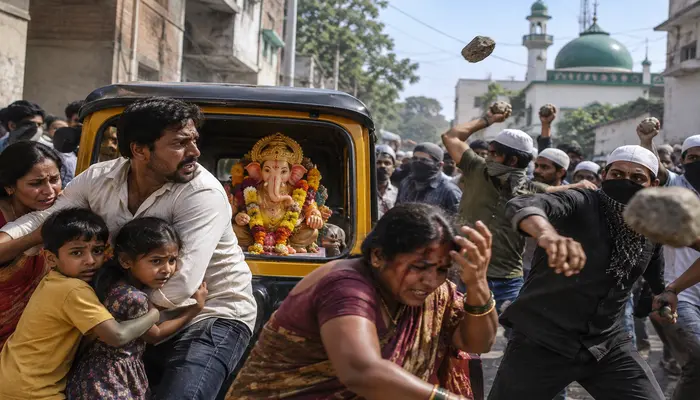
Case Summary
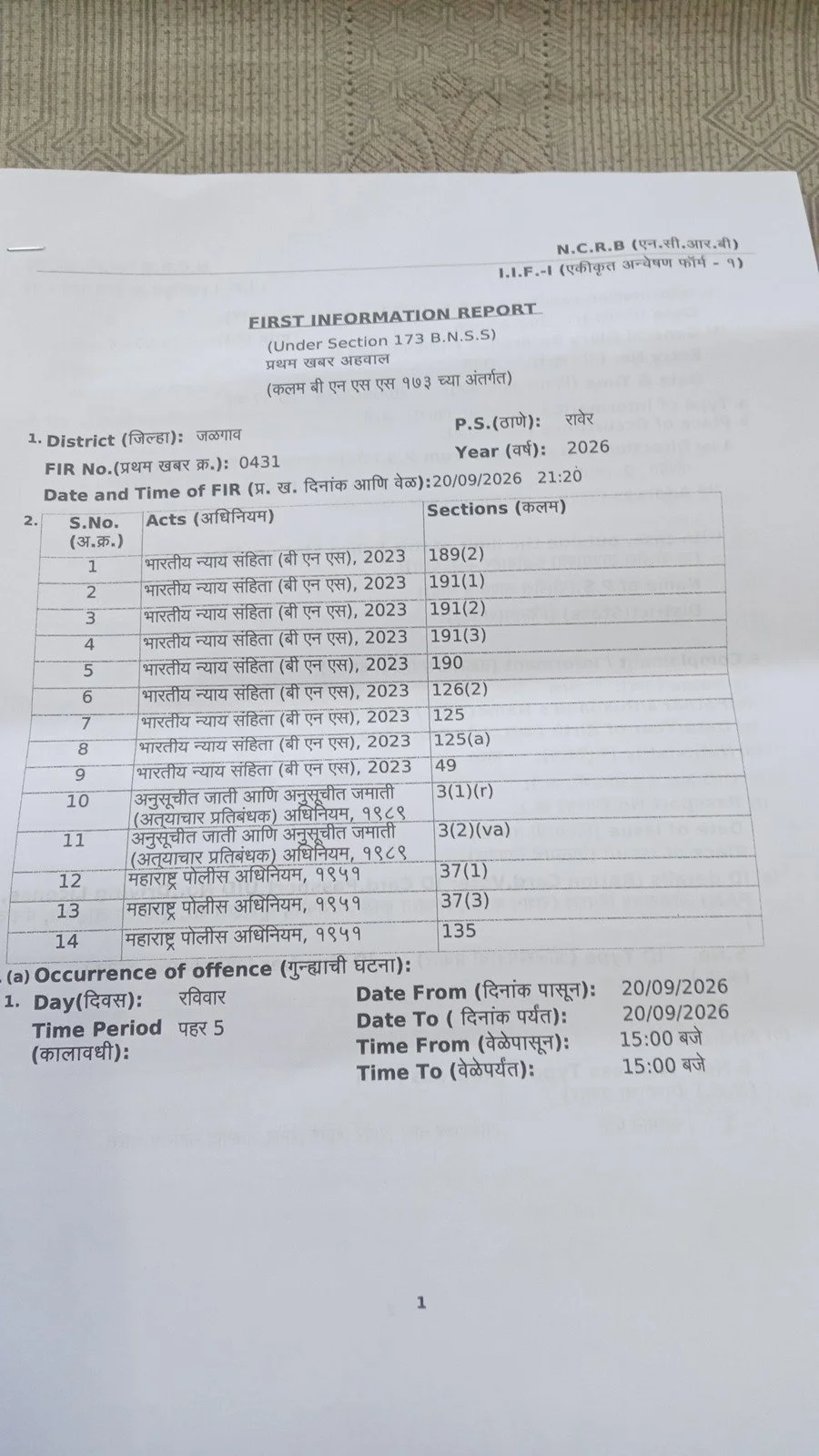
In a Muslim-dominated area of Raver city in Jalgaon district, Maharashtra, Hindu devotees carrying a Ganesh idol for immersion rites were obstructed and subsequently attacked by Muslims. At around 3 pm on 20 September 2026, the devotees were stopped while passing through Raza Colony and told not to take the idol through the area for immersion. The confrontation subsequently escalated into stone-pelting, resulting in severe injuries to several Hindu devotees. According to media reports, Vishal Dashrath Ghete was travelling in an auto-rickshaw with some young children while carrying a household Ganesh idol towards the Punkheda riverbank for immersion. As the auto-rickshaw passed through Raza Colony, some local Muslim residents, including Muslim women, stopped it and told Ghete that the Ganesh idol should not be taken through the route for immersion. After receiving information about the incident, Lata Ghete and other witnesses reached the spot, following which the dispute between the two groups escalated. A group of Muslims subsequently gathered and began pelting stones at the Hindu devotees. Four Hindu women, identified as Dipali Vishal Ghete, Sarla Kailas Ghete, Rupali Shubham Ghete and Sandhya Dnyaneshwar Ghete, sustained injuries to their hands, faces, chests and legs in the stone-pelting. Another report stated that a total of eight Hindu devotees were injured in the incident. Upon receiving information about the violence, District Superintendent of Police Shrikant Dhiware, Additional Superintendent of Police Sandeep Gavit and Divisional Police Officer Anil Badgujar reached the spot along with additional police forces. The police brought the situation under control and increased security deployment in the area to prevent further escalation. The police also appealed to residents not to believe or spread rumours. The Ganesh idol immersion was subsequently completed peacefully in the presence of police personnel. Raver Police Station registered a First Information Report against Sheikh Jameel Sheikh Usman, Ibrahim Irfan Sheikh, Umar Sheikh, Rais Manda Hotelwala, Irfan, Moin Rais Manda Hotelwala, Sheikh Saeed alias Langda alias Sagar, Sheikh Bilal Khan Yusuf Khan, Kamil Shakil Kirana Dukandaar, Sheikh Sameel Sheikh Saeed, Azam Arif Mohammad, Sayyad Jabeel Ali, Sheikh Shafik, Sheikh Qasim Sheikh Jameel and Saira Bi, along with two to three unidentified women and four to five unidentified persons. Legal action was initiated under relevant provisions of the Bharatiya Nyaya Sanhita, Sections 3(1)(r) and 3(2)(va) of the Scheduled Castes and the Scheduled Tribes (Prevention of Atrocities) Act, and relevant provisions of the Maharashtra Police Act. The investigation was being conducted by Police Inspector Sandeep Patil under the guidance of the Faizpur Sub-Divisional Police Officer. The Hinduphobia Tracker team attempted to obtain a copy of the First Information Report through the online portals of the Maharashtra Police, but the First Information Report was not publicly available online. The team also attempted to contact Raver Police Station, where the case was registered, but the call was not answered at the time of writing this report.
Case Images
Why it is Hate Crime ?
The primary category for this case is "Attack not resulting in death". The sub-category for this case is "Attack on religious procession". The outward celebration and display of religious symbols in an intrinsic part of Hinduism. Religious processions on various festivals are age-old traditions and a way to manifest faith and form a part of the religious practices of Hindus. On several occasions, such religious processions come under attack by non-Hindu mobs, in a manifestation of their animosity towards Hinduism and their practices. The reasons cited for such violent attacks are many and range from crossing a non-Hindu resident-dominated area to playing loud music, crossing from an area where there is a religious structure of another faith etc. The violent attacks are triggered by the outward display of religiosity by Hindus. The attacks are mainly a manifestation of religious supremacist doctrine which believes that idolatry, essentially the Hindu faith, is one that deserves to be annihilated since the very tenets of Hinduism, its practices and traditions are considered a sin in those doctrines. Since these attacks emanate from intrinsic and doctrinal animosity towards Hindus and Hinduism, it is considered a religiously motivated hate crime under this category. The other sub-category for this case is "Attack against Hindu devotees". Hindu devotees are a few of the easiest targets of religiously motivated hate crimes because during the festival/procession/puja etc, for non-Hindus it is easy to profile their victims on the basis of religion. Hindu devotees come under attack on several occasions by individual non-Hindus or mobs of non-Hindus owing to their animosity against Hinduism, its symbols and tradition/practices. There are several instances of Hindu devotees being attacked while they worship in temples or temporary religious structures, during religious processions, doing bhajan/kirtan/puja in their own homes, in the residential society etc. These attacks are perpetrated by non-Hindus primarily because of their animosity towards Hindus and their faith. In some cases, the trigger for the violence may be non-religious, however, there are two elements that make these hate crimes. First, the Hindus who come under attack are attacked violently while indulging in religious activity. Whether they are in a place of worship or not is immaterial to the crime. When individuals are attacked while indulging in religious practices, the attack in itself is a hindrance to their freedom to practice religion and therefore constitutes a hate crime. Secondly, religious supremacist doctrines and ideologies deem religious practices of Hindus to be offensive ab initio since they are considered “sinful” by these ideologies, worthy to be annihilated by force or coercion. Driven by these religious supremacist ideologies and doctrines, the attacks against Hindu devotees stem from intrinsic animosity towards Hinduism. In some cases, the trigger for the violence may be non-religious, however, it develops into a religiously motivated crime during the course of the violence. Since these attacks stem from animosity towards Hindus and Hinduism, they are considered religiously motivated hate crimes under this category. The other sub-category here is "Attacked for crossing 'Muslim area'". One of the reasons that Hindus get attacked unprovoked specifically by Islamists is for crossing ‘Muslim areas’. Essentially, Muslim mobs often attack Hindus crossing or present in certain areas which have a majority Muslim population. It has often been cited as one of the reasons to blame Hindus for attacks against themselves, signalling that Hindus displaying religious symbols, taking our religious processions or crossing any area which is dominated by Muslim residents is a provocation in and of itself. These areas are mostly ghettoized areas where mobs mobilize quickly to attack Hindus for a variety of reasons like playing music during a religious procession, crossing a mosque, wearing a tilak or any other religious symbol in a Muslim-dominated area, praying at a local temple in that area etc. There have been cases where the few local Hindus of that area have been attacked on their way to the Temple for prayers as well, simply because the area is considered a Muslim-dominated area. Several times, it is entirely possible that the immediate trigger for the violence against Hindus was non-religious in nature, however, the violence became religiously motivated in nature because the area was Muslim dominated and the residents on the whole harboured animosity towards Hindus, evidenced from the actions of the mob, the slogans, and the nature of the attack. Such crimes are motivated by the religious identity of the victims and are therefore classified as hate crimes under this category. This case was a clear example of a religiously driven hate crime, as a Hindu immersion procession carrying a household Ganesha idol was obstructed while passing through a Muslim-dominated area. The Hindu devotees accompanying the procession were subsequently assaulted and subjected to stone-pelting, demonstrating hostility towards the Hindu community and its religious practices. It is important to note that the incident took place shortly after the Ganesh Chaturthi celebrations and during the religious rites associated with the festival. Ganesh Chaturthi is a major Hindu festival dedicated to Lord Ganesha, who is worshipped as the remover of obstacles and the deity of wisdom and auspicious beginnings. During the festival, devotees install Ganesha idols in their homes and public pandals and worship them through prayers and offerings. The festival traditionally ends with the immersion (visarjana) of the idol in a water body. Carrying the idol to the immersion site in a procession is therefore an important part of the religious observance, making the Ganesha idol involved in this incident a sacred object of worship for the devotees. Therefore, attacking a Hindu procession by pelting it with stones and obstructing its passage demonstrates a deep-seated level of religious hostility. The fact that a peaceful procession carrying a Ganesha idol for immersion was treated as a provocation indicates that the mere public expression of Hindu faith was perceived as unacceptable by the Muslim perpetrators. The devotees were engaged in a lawful religious observance and were not causing any harm or disruption, yet they were met with obstruction and violence. Such conduct reflects deep disdain towards Hinduism and an intolerance of Hindus peacefully expressing and practising their faith in public. The hostility subsequently escalated into direct violence when the Hindu devotees were subjected to stone-pelting, resulting in injuries to several participants, including women who sustained injuries to their hands, faces, chests and legs. Attacking Hindu devotees while they were participating in a sacred religious immersion procession demonstrates that the hostility extended beyond an objection to the movement of the procession and was directed towards the people practising their faith. The use of violence against devotees engaged in a peaceful Hindu religious observance reflects clear intolerance towards Hinduism and the Hindu community's right to practise and express its faith openly. The deliberate targeting of devotees in this context therefore constitutes a religiously driven hate crime, as the victims were attacked in the course of publicly exercising their Hindu faith. The fact that the Hindu devotees were obstructed while passing through a Muslim-dominated area adds another significant dimension to the incident. The devotees were carrying the Ganesha idol towards the riverbank for immersion when they were stopped and told not to take it through the area, making the objection specifically directed at the passage of a Hindu religious procession through a locality described as Muslim-dominated. In this context, areas around mosques, dargahs, or places where Muslims form a majority are often perceived by the Muslim community as ‘Muslim areas’, and the incident reflects a disturbing sense of religious entitlement in which the attackers treated such a space as one where non-Muslims, particularly Hindus, were unwelcome. The Muslim community's violent reaction to the presence of a Hindu religious procession indicates that Hindus practising their faith in what was perceived as ‘their’ area was itself treated as a provocation, with an attempt made to halt the procession and assert control over who could move through the space. This reflects a form of territorial religious supremacy in which Hindu presence and public religious expression are deemed unacceptable, effectively transforming a shared public space into one where Hindu religious practice is not tolerated. The resulting assault, therefore, was rooted in exclusion, intolerance and religious animosity, with the violence aimed at disrupting a Hindu religious procession and asserting dominance over the public expression of Hindu devotion. Notably, in Islamic theology, idol worship, referred to as Shirk, is regarded as the gravest sin. The Qur'an strictly condemns it, and Islamic teachings emphasise the complete rejection of any practice associated with idol worship. Muslims are taught from a young age that idolatry is an unforgivable sin. While this belief is central to the Islamic faith, it has also led, historically and in contemporary times, to intolerance and hostility towards idol-worshipping religions, especially Hinduism. When Muslims pelt stones at the Ganesh idol immersion procession, it reflects more than personal disrespect. It is a manifestation of deep-seated theological contempt against Hindu practices, stemming from the Islamic doctrinal view that idol worship is impure and offensive. Since this case met the parameters of a hate crime, it was added to the hate crime database of the Hinduphobia Tracker.
Victim Details
Total Victim
8
Deceased
0
Gender
- Male 0
- Female 4
- Third Gender 0
- Unknown 4
Caste
- SC/ST 8
- OBC 0
- General 0
- Unknown 0
Age Group
- Minor 0
- Adult 0
- Senior Citizen 0
- Unknown 8


Case Status
Complaint registered


Perpetrators Details
Perpetrators
Muslim Extremists
Perpetrators Range
From 10 to 100
Perpetrators Gender
both
 Sources




