Hindu religious poster torn down by Muslim man during Ganesh Chaturthi celebrations in Gwalior; Hindu devotees assaulted for opposing it
 Gwalior, Madhya Pradesh, India
  18 September, 2026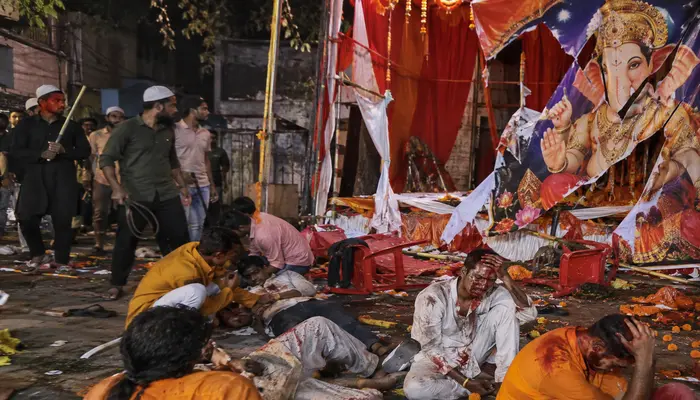
Case Summary
In Sevanagar, Ramtapura, Gwalior, Madhya Pradesh, during Ganesh Chaturthi celebrations, a Hindu religious poster depicting Lord Ganesha was torn down by a Muslim gym owner, Irfan Khan. When Hindu devotees opposed the tearing of the religious poster, they were assaulted by Irfan Khan and his associates, leading to a violent clash between the two groups in which several Hindu youths were injured. According to media reports, local Hindu youths had erected a Ganesh pandal in Ramtapura and installed an idol of Lord Ganesha for the festival. As part of the celebrations, a Ganesh Utsav poster depicting Lord Ganesha was put up outside a gym owned by Irfan Khan, also identified as Irfan Pathan. On the night of 19 September 2026, the poster was torn down and removed by Irfan. When members of the Ganesh festival committee and Hindu devotees involved in the pandal learned about the incident, they went to the gym owner and questioned him about the poster. An argument subsequently broke out between the two sides over the tearing of the religious poster. As the dispute escalated, the Muslim man called his associates to the spot, after which the confrontation turned violent. Reports stated that Irfan called associates including Pawan, Prince, Islam and others, who then attacked the Hindu youths near the Ganesh pandal. The attackers used sticks and rods during the assault, while witnesses also described kicks, punches and belts being used to harm the Hindu devotees. The Hindu victims injured in the assault were identified as Raju Shrivas, Vedant Upadhyay, Arpan, Deepak Manjhi and Sanju. They sustained injuries to their heads, hands and legs and were subsequently sent for medical examination. A video of the assault also surfaced and was taken up by the police for verification as part of the investigation. As news of the incident spread, a large number of people gathered in the area and tension prevailed. Members of the injured party and local Hindu residents subsequently went to the police station, where they created a ruckus while demanding strict action against those responsible. Hindu organisation workers also reached the police station and stated that the tearing of the Ganesh Utsav poster had hurt Hindu religious sentiments. Police reached the area after receiving information about the clash and brought the situation under control by pacifying the people. Given the tension, the police administration deployed forces from six police stations as a precautionary measure and increased patrolling and vigilance in the area. Police officers also appealed to people to maintain peace and prevent the situation from escalating further. Police subsequently registered a case based on the complaint of the injured Hindu youths against seven accused, including Irfan Khan, Pawan, Saurabh Tomar, Rajat Bhadoria, Prince Saxena, Vicky Chauhan and Kartik. The accused had not been arrested at the time of reporting, and police teams were formed to trace them. Gwalior police station in-charge Prashant Sharma stated that the case had been registered in connection with the assault on the injured Hindu youths. Police said that CCTV footage and videos circulating on social media would be verified to establish the sequence of events and identify everyone involved. The police also appealed to the public not to circulate unverified claims and warned that strict action would be taken against anyone attempting to disturb communal harmony. The investigation was ongoing to establish the complete sequence of events and the role of each person involved.
Why it is Hate Crime ?
This case is added to the tracker under the first primary category: Attack on Hindu religious representations. The subcategory selected is: Desecration of Hindu religious symbol. Icons and symbols or a religious representation of a spiritual ideal are widely revered in Hinduism. Iconography is of vital significance in the Hindu milieu. It helps connect people’s spiritual beliefs with the real world. Iconography within the Hindu faith takes several shapes and forms. Murtis are of most significance to Hindus, to which daily rituals, prayers and offerings are done. Besides the murtis, there are several other symbols which have deep significance in the Hindu faith – the Om and Swastika for example. Since these Hindu religious symbols hold paramount importance in Hinduism, any desecration of symbols, icons, murtis, religious representations and manifestations, is driven by animosity towards the faith itself which manifests itself through these murtis, icons and symbols. Therefore, any desecration of these Hindu religious symbols and representations is considered religiously motivated hate crimes under this category. The second primary category selected in this case is: Attack not resulting in death. The subcategory selected is: Attacked for opposing radicals or trying to save victim. In several cases, Hindus are attacked for opposing religiously motivated crimes being committed against a fellow Hindu or simply for voicing an opinion opposing radical elements, who either have in the past or continue to persecute Hindus. In such cases, the initial attack against the victim, against which the Hindu was trying to defend the victim, would also need to be classified as a religiously motivated hate crime. Since the initial crime itself was religiously motivated and the subsequent crime of attempting to save the victim or speaking against the radical elements ends up inviting a violent attack, it would also be classified as a religiously motivated hate crime under this category. The other subcategory selected is: Attack against Hindu devotees. Hindu devotees are a few of the easiest targets of religiously motivated hate crimes because during the festival/procession/puja etc, for non-Hindus it is easy to profile their victims on the basis of religion. Hindu devotees come under attack on several occasions by individual non-Hindus or mobs of non-Hindus owing to their animosity against Hinduism, its symbols and tradition/practices. There are several instances of Hindu devotees being attacked while they worship in temples or temporary religious structures, during religious processions, doing bhajan/kirtan/puja in their own homes, in the residential society etc. These attacks are perpetrated by non-Hindus primarily because of their animosity towards Hindus and their faith. In some cases, the trigger for the violence may be non-religious, however, there are two elements that make these hate crimes. First, the Hindus who come under attack are attacked violently while indulging in religious activity. Whether they are in a place of worship or not is immaterial to the crime. When individuals are attacked while indulging in religious practices, the attack in itself is a hindrance to their freedom to practice religion and therefore constitutes a hate crime. Secondly, religious supremacist doctrines and ideologies deem religious practices of Hindus to be offensive ab initio since they are considered “sinful” by these ideologies, worthy to be annihilated by force or coercion. Driven by these religious supremacist ideologies and doctrines, the attacks against Hindu devotees stem from intrinsic animosity towards Hinduism. In some cases, the trigger for the violence may be non-religious, however, it develops into a religiously motivated crime during the course of the violence. Since these attacks stem from animosity towards Hindus and Hinduism, they are considered religiously motivated hate crimes under this category. This case was a clear example of a religiously driven hate crime. A Muslim man tore down a Hindu religious poster depicting Lord Ganesha during Ganesh Chaturthi celebrations and, when Hindu devotees confronted him over the desecration, called his associates, who joined him in launching a violent assault on them. The sequence of events demonstrated the religious hostility underlying the incident. Ganesh Chaturthi is a major Hindu religious festival dedicated to Lord Ganesha, the revered Hindu deity associated with wisdom, prosperity, auspiciousness and the removal of obstacles. The festival involves the installation and worship of Ganesha idols, religious ceremonies, devotional gatherings and the decoration of homes, temples and public spaces with images, posters and other representations of the deity. It is a period of religious devotion in which Hindus offer prayers, perform rituals and participate in community celebrations centred on Lord Ganesha, making such devotional displays an important part of the public expression of the festival. In this case, a poster depicting Lord Ganesha had been placed outside the gym in a public space as part of the Ganesh Utsav celebrations. The poster was therefore a devotional representation of a Hindu deity and a visible expression of Hindu religious observance during the festival, rather than an ordinary piece of material unrelated to the celebrations. Therefore, the deliberate act of tearing down the poster amounted to the desecration of a sacred Hindu religious representation. It was not an ordinary advertisement or unrelated piece of material; it depicted Lord Ganesha and had been displayed specifically in connection with a Hindu religious festival. The fact that the Muslim man took offence to its presence in a public space and deliberately tore it down demonstrated hostility towards the public expression of Hindu religious practices, symbols and celebrations. By directly targeting a representation of a Hindu deity during a major Hindu festival, the act demonstrated deep-seated religious intolerance towards Hindu religious symbols and traditions. The violence that followed further established the hostile nature of the incident and its religiously driven character. When the Hindu devotees confronted the Muslim man over the tearing down of the poster, he did not acknowledge the desecration or apologise. Instead, he called his associates to the spot, after which the devotees were assaulted by him and his associates. This constituted an instance of communal intimidation in which Hindus who objected to the desecration of their religious symbol were themselves subjected to violence. The Hindu devotees were not the primary aggressors: they did not initiate violence, assault the man or his associates, or direct religious abuse at them. Their confrontation arose from the destruction of a Hindu religious representation. Despite this, the response was a violent assault, demonstrating hostility towards Hindus for merely opposing the desecration of their sacred religious symbol. The fact that the victims were Hindu devotees participating in the celebration of a Hindu religious festival further intensified the religious nature of the incident. Assaulting devotees over their objection to the destruction of a representation of Lord Ganesha directly disrupted their religious observance and undermined the sense of safety surrounding the festival. Such violence creates fear and intimidation among Hindus by conveying that even peacefully celebrating a Hindu festival and protecting its religious representations can result in violence. The assault therefore affected not only the individual victims but also the broader religious atmosphere of the celebration, undermining the sanctity of the festival and creating fear among Hindus seeking to observe their religious traditions. Overall, since the incident involved the desecration of a Hindu religious representation followed by violence against Hindu devotees who opposed it, it met the parameters of a hate crime and was added to the Hinduphobia Tracker's hate crime database. Disclaimer: The perpetrators identified in connection with the assault were Irfan Khan, Pawan, Prince, Islam, Saurabh Tomar, Rajat Bhadoria, Prince Saxena, Vicky Chauhan and Kartik. Since these individuals were identified as perpetrators in connection with the assault, a perpetrator count of 8 is being recorded for documentation purposes only. Since five Hindu youths were specifically identified as having sustained injuries in the assault, a victim count of 5 is being recorded. No additional individuals have been included in the victim count unless they were specifically identified as victims in the available reports. While this tracker acknowledges that eight individuals were identified as having participated in the assault, the religion of the perpetrators has been recorded as Muslim for documentation purposes since the primary perpetrator, Irfan Khan, was identified as Muslim. The religious identities of the other seven individuals have not been independently verified at the time of documentation. However, given that Irfan Khan was the primary perpetrator who tore down the Hindu religious poster and subsequently called his associates, who joined him in assaulting the Hindu devotees, the case has been recorded under a single perpetrator religion for consistency in categorisation. This approach ensures clarity in data representation while acknowledging the involvement of all eight identified perpetrators.
Victim Details
Total Victim
5
Deceased
0
Gender
- Male 5
- Female 0
- Third Gender 0
- Unknown 0
Caste
- SC/ST 0
- OBC 0
- General 1
- Unknown 4
Age Group
- Minor 0
- Adult 0
- Senior Citizen 0
- Unknown 5


Case Status
Complaint registered


Perpetrators Details
Perpetrators
Muslim Extremists
Perpetrators Range
From 5 to 10
Perpetrators Gender
male
 Sources




