Hindu teenager beaten, his Tulsi mala torn off by Muslim men for mistakenly entering Muslim-owned shop in Bangladesh
 Moulvibazar District, Bangladesh
  18 September, 2026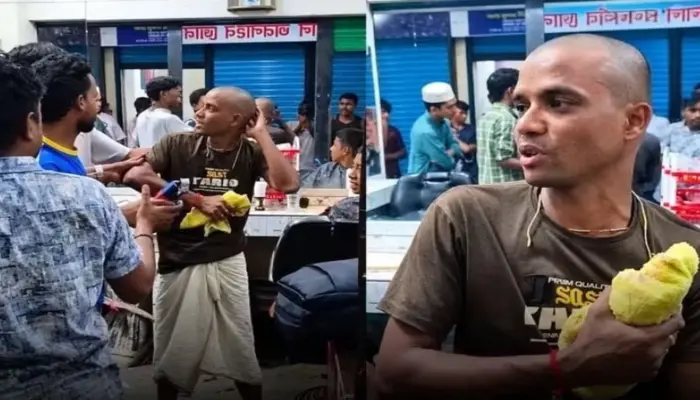
Case Summary
In Moulvibazar, Bangladesh, a Hindu youth was brutally beaten, and his Tulsi mala was desecrated by a group of Muslim men after he mistakenly entered a Muslim-owned shop. The incident came to light on 18 September 2026 after a video of the incident went viral on social media, prompting condemnation and demands for an impartial investigation from members of the Sanatani community. During the incident, the Hindu youth, who was identified as a devotee associated with the International Society for Krishna Consciousness (ISKCON), was brutally beaten by the Muslim men, who also tore the Tulsi mala worn around his neck. He was further warned not to return to the area. Another Hindu teenager intervened and attempted to protect him. In the video, the Muslim men were heard threatening the Hindu youth, saying, “How dare you enter our market? What is your worth?” As of the date of writing, no official statement from the local administration, law enforcement authorities, or the victim’s family had been reported regarding the incident.
Why it is Hate Crime ?
This case has been added to the tracker under the primary category of - Attack not resulting in death. Within it, the sub-category selected here is - Attack for Hindu identity. In several cases, Hindus are attacked merely for their Hindu identity without any perceived provocation. A classic example of this category of religiously motivated hate crime is a murder in 2016. 7 ISIS terrorists were convicted for shooting a school principal in Kanpur because they got ‘triggered’ seeing the Kalava on his wrist and tilak that he had put. In this, the Hindu victim had offered no provocation except for his Hindu religious identity. The motivation for the murder was purely religious, driven by religious supremacy. Such cases where Hindus are targeted merely for their religious identity would be documented as a hate crime under this category. The other sub-category selected here is - Attacked for crossing 'Muslim area'. One of the reasons that Hindus get attacked unprovoked specifically by Islamists is for crossing ‘Muslim areas’. Essentially, Muslim mobs often attack Hindus crossing or present in certain areas which have a majority Muslim population. It has often been cited as one of the reasons to blame Hindus for attacks against themselves, signalling that Hindus displaying religious symbols, taking our religious processions or crossing any area which is dominated by Muslim residents is a provocation in and of itself. These areas are mostly ghettoized areas where mobs mobilize quickly to attack Hindus for a variety of reasons like playing music during a religious procession, crossing a mosque, wearing a tilak or any other religious symbol in a Muslim-dominated area, praying at a local temple in that area etc. There have been cases where the few local Hindus of that area have been attacked on their way to the Temple for prayers as well, simply because the area is considered a Muslim-dominated area. Several times, it is entirely possible that the immediate trigger for the violence against Hindus was non-religious in nature, however, the violence became religiously motivated in nature because the area was Muslim dominated and the residents on the whole harboured animosity towards Hindus, evidenced from the actions of the mob, the slogans, and the nature of the attack. Such crimes are motivated by the religious identity of the victims and are therefore classified as hate crimes under this category. The second primary category selected here is - Attack on Hindu religious representations. Within it, the sub-category selected here is - Desecration of Hindu religious symbols. Icons and symbols or a religious representation of a spiritual ideal are widely revered in Hinduism. Iconography is of vital significance in the Hindu milieu. It helps connect people’s spiritual beliefs with the real world. Iconography within the Hindu faith takes several shapes and forms. Murtis are of most significance to Hindus, to which daily rituals, prayers and offerings are done. Besides the murtis, there are several other symbols which have deep significance in the Hindu faith – the Om and Swastika for example. Since these Hindu religious symbols hold paramount importance in Hinduism, any desecration of symbols, icons, murtis, religious representations and manifestations, is driven by animosity towards the faith itself which manifests itself through these murtis, icons and symbols. Therefore, any desecration of these Hindu religious symbols and representations is considered religiously motivated hate crimes under this category. The conduct had a clear religious dimension because the physical assault by Muslims on the Hindu youth was accompanied by the deliberate tearing of the teenager’s Tulsi mala, a visible and sacred marker of his Hindu devotional identity. The Hindu teenager was a Krishna devotee and was wearing the Tulsi mala when he was confronted and beaten after mistakenly entering a Muslim-owned shop. The significance of the Tulsi mala was central to understanding why its removal could not be treated merely as the destruction of an ordinary personal possession. Tulasi holds particular importance in Vaishnava traditions and is closely associated with the worship of Krishna. Krishna devotees customarily wear neck beads made from Tulsi wood as an expression of their devotional commitment, and Tulsi is itself regarded as especially dear to Krishna. The mala therefore functioned as an outward expression of the teenager’s Hindu religious identity. Its deliberate removal during an assault was consequently significant because the conduct was directed not simply at an object belonging to the victim, but at an article through which he visibly expressed his faith. The tearing of the Tulsi mala therefore constituted a desecration of a Hindu religious symbol. The religious significance arose from the context in which the mala was worn and the manner in which it was removed. Where an individual forcibly tears a sacred religious article from a devotee’s body during an assault, the conduct can reasonably be understood as an attack on the victim's religious expression in addition to the physical violence itself. The fact that the teenager was specifically identified as a Krishna devotee further strengthened the connection between the object targeted and his religious identity. This was materially different from an ordinary altercation in which an unrelated item of clothing or personal property was damaged. It is important to note that this incident occurred in a Muslim-majority country of Bangladesh, which shaped how the Muslim perpetrators understood the space. Muslims often treat areas around mosques, dargahs, or zones where their community is in the majority as “Muslim areas” where non‑Muslims, particularly Hindus, are expected to be unobtrusive or even unwelcome. The physical location of the attack revealed a clear attempt to enforce territorial dominance over the Hindu youth. This mindset reflects a disturbing sense of Islamic supremacy in which public space is treated as belonging to one religious community, and any assertion or even presence of Hindu religious identity is framed as an intrusion. Thus, the assault on the Hindu youth, combined with the explicit threat How dare you enter our market? What is your worth?, was motivated by this supremacist ideology, under which Muslims in the neighbourhood looked down upon Hindus and believed they had the right to control who could move freely and express their faith in “their area”. This transforms the space into one where Hindu faith is not tolerated, and the act of crossing such a space becomes a trigger for communal violence. The assault therefore represented an infringement not only of the victims' physical safety but also of their ability to move through a locality without being subjected to hostility or violence because of their faith. Religious identity functioned as a marker that exposed the victims to differential treatment and violence. Such an attitude is rooted in exclusion, intolerance, and religious animosity, making this case a clear illustration of a crime motivated by religious hatred. This incident should also had to be viewed in the context of the wider persecution of Hindus in Bangladesh, particularly following the ouster of Sheikh Hasina’s government in August 2024. Multiple incidents involving attacks, intimidation and other forms of violence against Hindus were documented during this period. Against this broader backdrop, the assault of a Hindu youth, the forcible tearing of his sacred Tulsi mala and the warning that he should not return to the area carried particular significance. The targeting of a visible Hindu religious symbol during the assault represented hostility towards an expression of Hindu religious identity and, contributed to an atmosphere in which members of the minority community were intimidated from openly practising or displaying their faith. Accordingly, the religious significance of the conduct lay principally in the combination of physical assault, targeting of a Hindu religious symbol, desecration of the Tulsi mala, and intimidation of a Hindu youth. The Tulsi mala was an outward manifestation of Krishna devotion, and its forcible tearing from the teenager's neck during the assault transformed the incident from a simple confrontation over mistaken entry into conduct with a distinct religious dimension. Therefore, this case has been added to the Hinduphobia Tracker.
Victim Details
Total Victim
1
Deceased
0
Gender
- Male 1
- Female 0
- Third Gender 0
- Unknown 0
Caste
- SC/ST 0
- OBC 0
- General 0
- Unknown 1
Age Group
- Minor 0
- Adult 0
- Senior Citizen 0
- Unknown 1


Case Status
Unknown


Perpetrators Details
Perpetrators
Muslim Extremists
Perpetrators Range
Unknown
Perpetrators Gender
male
 Sources




