Hindu religious procession blocked by Muslims and forced to take an alternate route in Hadagalli, Karnataka
 Hadagalli, Karnataka, India
  17 September, 2026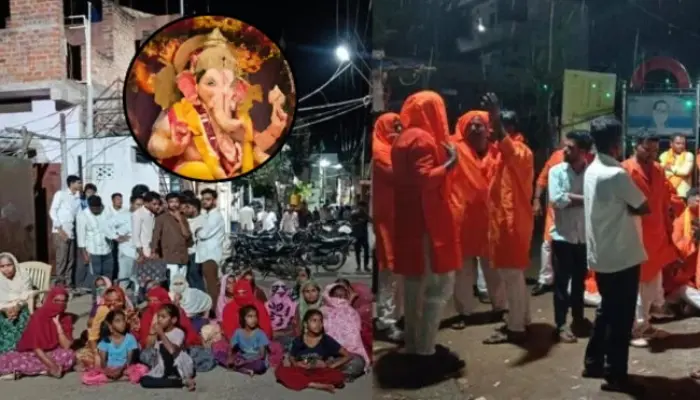
Case Summary
On September 18, 2026, a Ganesh idol immersion procession from Koravara Oni in Huvinahadagali town, Hadagalli, Karnataka, was obstructed by the Muslim community while passing through the Islampet area. According to reports, a group of Muslims sat across the public road while the Hindu religious procession was passing through the Islampet area and objected to the procession proceeding through the locality, insisting that it should follow the route used the previous year. The Hindu youths accompanying the procession maintained that the procession had followed the same route for several years and that the route had only been changed the previous year because it coincided with Eid-e-Milad. The disagreement escalated into a verbal confrontation before police personnel intervened and dispersed both sides. BJP MLA Krishna Nayak subsequently reached the spot and held discussions with the youths accompanying the Ganesh procession in the presence of police officials. He asked them to follow the route used the previous year and stated that a specific route would be finalised for future processions. The youths then agreed to the arrangement and left the spot. District Superintendent of Police S. Jahnavi also visited the location and reviewed the situation, while DySPs Santosh Chavan and Mallesh Doddamani, CPI Mallappa Hoogar and PSI Manikantha were involved in bringing the situation under control. As a result of the confrontation and the subsequent intervention by the authorities, the Ganesh immersion procession did not proceed along the traditional route that the Hindu youths had sought to use.
Why it is Hate Crime ?
This case has been added to the tracker under the primary category of - Restriction/ban on Hindu practices. Within it, the sub-category selected here is - Restriction of expression of Hindu identity. An example of the state-affected prejudicial and targeted orders against the Hindu community would be a government denying the right of a Hindu or a group of Hindus to hold a religious procession owing to the animosity of non-Hindu groups. Denial of the religious right of the Hindus to assuage the non-Hindu group which harbours animosity to a point where it could lead to violence against Hindus is not only a failure of law and order but is a prejudicial order against Hindus, denying them their fundamental rights to express their religious identity. An example of a hate crime against Hindus by a non-Hindu would be a non-Hindu institution forcing its Hindu employees to abandon religious symbols that a Hindu would wear as an expression of faith owing to inherent prejudice against the faith professed by the victim or a non-Hindu group of people restricting a Hindu group from constructing a place of worship simply because the demography of the area in which the temple is being built is dominated by non-Hindus. Such actions are driven by religious animosity and/or prejudice against Hindus and their faith and would therefore be categorized as a hate crime. The second primary category selected here is - Attack not resulting in death. Within it, the sub-category selected here is - Attack for Hindu identity. In several cases, Hindus are attacked merely for their Hindu identity without any perceived provocation. A classic example of this category of religiously motivated hate crime is a murder in 2016. 7 ISIS terrorists were convicted for shooting a school principal in Kanpur because they got ‘triggered’ seeing the Kalava on his wrist and tilak that he had put. In this, the Hindu victim had offered no provocation except for his Hindu religious identity. The motivation for the murder was purely religious, driven by religious supremacy. Such cases where Hindus are targeted merely for their religious identity would be documented as a hate crime under this category. The other sub-category selected here is - Attack on religious procession. The outward celebration and display of religious symbols in an intrinsic part of Hinduism. Religious processions on various festivals are age-old traditions and a way to manifest faith and form a part of the religious practices of Hindus. On several occasions, such religious processions come under attack by non-Hindu mobs, in a manifestation of their animosity towards Hinduism and their practices. The reasons cited for such violent attacks are many and range from crossing a non-Hindu resident-dominated area to playing loud music, crossing from an area where there is a religious structure of another faith etc. The violent attacks are triggered by the outward display of religiosity by Hindus. The attacks are mainly a manifestation of religious supremacist doctrine which believes that idolatry, essentially the Hindu faith, is one that deserves to be annihilated since the very tenets of Hinduism, its practices and traditions are considered a sin in those doctrines. Since these attacks emanate from intrinsic and doctrinal animosity towards Hindus and Hinduism, it is considered a religiously motivated hate crime under this category. The religious dimension of the incident was established by the fact that the obstruction directly concerned a Ganesh immersion procession, an important Hindu religious observance, rather than an ordinary public gathering. The procession was carrying a consecrated Ganesh idol for immersion, making its movement part of the religious ritual itself. The intervention and disruption by Muslims was therefore not simply a disagreement over traffic or road usage, but a confrontation over the conduct and route of a Hindu religious procession through a particular locality. The conduct became particularly significant from a hate-crime perspective because it directly disrupted an ongoing Hindu religious procession and religious observance. The Ganesh immersion procession was not merely a public gathering or cultural event, but an integral part of the Hindu religious observance associated with the immersion of the Ganesh idol. By physically occupying the road and preventing the procession from proceeding along its established route, Muslims directly disrupted the Hindu religious ceremony and interfered with the devotees' ability to carry out their religious observance in the manner intended. The obstruction therefore had a direct impact on the practice and exercise of Hindu religious faith, as the procession was stopped and ultimately required to proceed through a different route following intervention by the authorities. The incident also constituted an attack on a Hindu religious procession, even though no physical assault was reported against the devotees. An attack on a religious procession need not necessarily involve physical violence against its participants; deliberate obstruction that prevents the procession from continuing can itself constitute a direct interference with the religious observance. In this case, the Muslim protesters physically blocked the public road and did not allow the Ganesh immersion procession to continue along its designated route. As a result, the devotees were compelled to abandon the intended route and proceed through an alternative route following intervention by the authorities. The conduct therefore directly disrupted the movement of the sacred procession and interfered with the Hindus' ability to carry out the religious observance as intended. Furthermore, if the Muslim protesters had genuine grievances regarding the procession route, they could have approached the police, district administration or other competent authorities. Instead, the immediate method adopted was to sit across the public road and stop the religious procession from proceeding. This distinction was important: the issue was not the mere expression of an objection, but the use of physical obstruction to prevent a Hindu religious procession from following its intended route. The impact on the Hindu community was therefore concrete. The obstruction caused the religious procession to be diverted from the route its organisers had sought to follow, meaning that the conduct of the Ganesh immersion ceremony was altered following opposition at the location. Contemporary reports stated that the authorities ultimately persuaded the organisers to accept an alternative route, while subsequent administrative discussions were held to establish clearer arrangements for future processions. The incident was thus relevant to the attack on Hindu religious practices dimension of a hate-crime framework because the conduct interfered directly with a Hindu religious ceremony and restricted its movement on account of a dispute involving the religious character of the procession and the locality through which it was passing. This deliberate physical obstruction of a sacred Hindu procession, followed by its diversion from the disputed route, constituted a concrete interference with the community's exercise of its religious practice. Therefore, this case has been added to the tracker.


Case Status
Unknown


Perpetrators Details
Perpetrators
Muslim Extremists
Perpetrators Range
Unknown
Perpetrators Gender
unknown
 Sources




