Multiple Hindu women religious profiled, sexually harassed and pressured to convert to Islam by Muslim man
 Rewa, Madhya Pradesh, India
  14 September, 2026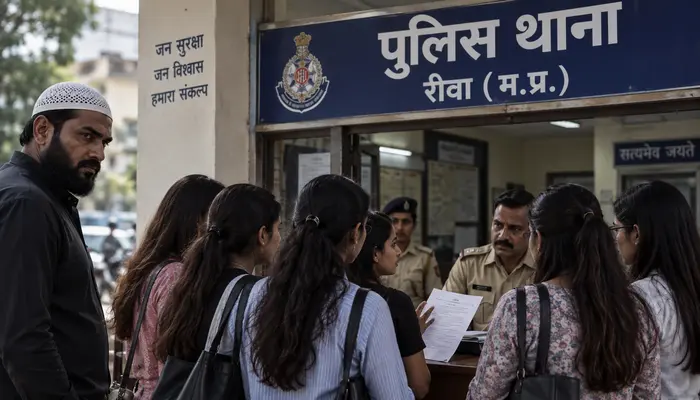
Case Summary
In Rewa, Madhya Pradesh, six Hindu women working in a private company were harassed, sexually harassed and pressured to convert to Islam by a Muslim man identified as Saif Pathan. The Hindu women, who were engaged in telecalling work at a private company in the Samdariya area, filed a complaint at the Amahiya police station.They stated that the Muslim accused, Saif Pathan, operated an office near their workplace and had been following them, stalking them and harassing them within and around the office premises, including while they went to the washroom, parking area, lift and other parts of the building. They stated that he repeatedly made inappropriate comments and asked them to accompany him, including telling one of the women, “I will keep you as a queen,” and pressuring her to convert to Islam. The Hindu women said that they had repeatedly warned him to stop, but the harassment continued. One of the women stated that the harassment had been continuing for around 10–15 days and intensified on 15 September 2026, when Pathan followed her to another office where she was working alone. Thereafter, he entered the office, forced her inside, damaged the gate and then attempted to physically force himself upon her. She stated that she subsequently approached Amahiya police station seeking protection and action against those responsible. The victim submitted a written complaint to the police and requested protection, stating that they feared for their safety. They identified Saif Pathan as the primary person involved, while stating that other individuals associated with him were also present but that they did not know their identities. Police officials informed the complainants that action would be taken following their complaint.
Why it is Hate Crime ?
This case has been added to the tracker under the primary category: Predatory Proselytisation. The subcategory selected is: Harassment, threats, coercion for conversion. Harassment covers a wide range of behaviours of an offensive nature. It is commonly understood as behaviour that demeans, humiliates, and intimidates a person, including threats and coercion. Harassment and threats, in this case, find their root on discriminatory grounds which has the effect of nullifying a person’s rights or infringing upon his freedom to exercise his right specifically owing to the victim’s religious identity. Verbal and physical threats and psychological or physical harassment are often used against Hindu victims because they choose to practice their professed religion. Religious harassment also includes forced and involuntary conversions by harassment, threats or coercion. Coercion includes intimidatory tactics like force-feeding a Hindu victim beef to convert to another religion, forceful circumcision etc. In several cases documented, non-Hindu perpetrators or those who harbour specific animosity towards Hinduism, harass victims simply based on their religious identity. Such cases often also include harassment to ensure the Hindu victim abandons his/her professed religion and adopts the religion of the perpetrator. Such cases where Hindu victims are harassed to convert to the perpetrator’s religion are rooted in animosity towards the victim’s religious identity and are therefore documented as religiously motivated hate crimes. The other primary category selected here is - Attack not resulting in death. Within it, the sub-category selected here is - Attack for Hindu identity. In several cases, Hindus are attacked merely for their Hindu identity without any perceived provocation. A classic example of this category of religiously motivated hate crime is a murder in 2016. 7 ISIS terrorists were convicted for shooting a school principal in Kanpur because they got ‘triggered’ seeing the Kalava on his wrist and tilak that he had put. In this, the Hindu victim had offered no provocation except for his Hindu religious identity. The motivation for the murder was purely religious, driven by religious supremacy. Such cases where Hindus are targeted merely for their religious identity would be documented as a hate crime under this category. The hate-crime dimension in this case centred on the religious profiling of the Hindu women and the use of their religious identity as part of the harassment and intimidation directed towards them. The conduct was not limited to stalking, following or sexually inappropriate behaviour. The accused repeatedly made inappropriate remarks and, in the course of targeting Hindu women, pressured them to convert to Islam. By specifically pressuring a Hindu woman to abandon her faith and adopt Islam, the accused singled her out on the basis of her religious identity and introduced a clear religious dimension into the harassment. The demand to change religion therefore indicated that the victim’s Hindu identity was not incidental to the conduct, but was directly brought into the harassment and coercive behaviour directed towards her. The pressure to abandon her existing faith and adopt Islam was particularly significant because it transformed the interaction from ordinary workplace harassment into conduct involving religious coercion. Pressuring a Hindu individual to discard her religious faith and embrace another was a direct attack on her religious identity and dignity. It was not a matter of personal choice; it was coercion rooted in hostility towards the victim's Hindu identity. Such an attempt reflects religious animosity because the act was not simply about personal differences but about erasing the victim’s Hindu faith, making it a religiously motivated crime. The stalking, harassment and sexual misconduct were significant in the context of the religious pressure directed towards the victim. The harassment was accompanied by repeated efforts to convert to Islam In such cases, sexual molestation and harassment serves a dual purpose: physical subjugation and religious humiliation. The intention was to break the victims down, emotionally, physically, and spiritually, so that they could be converted. This was not random violence; it was systematic, targeted, and rooted in religious animosity. The fact that multiple Hindu women were targeted and subjected to the same pattern of stalking and harassment, with pressured for religious conversion, further reinforced the religious dimension of the case. The repeated targeting of Hindu women, combined with explicit demands that they abandon their faith, demonstrated that their religious identity was directly relevant to the conduct directed against them. This pattern reflected religiously motivated coercion in which harassment and intimidation were used to pressure the victims towards conversion. Taken together, the targeting of multiple Hindu women, the religious profiling, and the explicit pressure to adopt Islam provided the basis for treating the case as a hate crime involving religiously targeted harassment and coercive pressure for conversion.
Victim Details
Total Victim
6
Deceased
0
Gender
- Male 0
- Female 6
- Third Gender 0
- Unknown 0
Caste
- SC/ST 0
- OBC 0
- General 0
- Unknown 6
Age Group
- Minor 0
- Adult 6
- Senior Citizen 0
- Unknown 0


Case Status
Complaint filed


Perpetrators Details
Perpetrators
Muslim Extremists
Perpetrators Range
One Person
Perpetrators Gender
male
 Sources




