Hindus, including minors, targeted for conversion through inducements and brainwashing at a Christian prayer meeting in Sidhi, Madhya Pradesh
 Sidhi, Madhya Pradesh, India
  19 September, 2026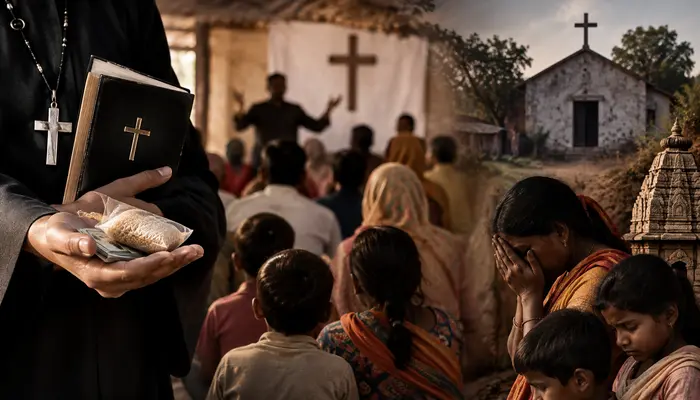
Case Summary
In Sidhi district, Madhya Pradesh, Hindus, including minor schoolchildren, were targeted for religious conversion through prayer meetings organised by Christian missionaries. The Hindu attendees were offered financial assistance, 'healing' from illnesses and other benefits, while Christian religious teachings and materials were used to influence and indoctrinate them towards conversion. The incident came to light in the Bahri police station area of Sidhi district, where a Christian prayer meeting was being conducted inside a rented house in the bypass area. The meeting was being held in a closed room and had continued for around a week. Bajrang Dal activists reached the spot after receiving information about the gathering and objected to the activities taking place there before informing the police. Hindus, including members of tribal communities, from several nearby villages were being brought to the prayer meetings, where a number of schoolchildren were also present. The attendees were being encouraged to embrace Christianity through promises of financial assistance, treatment or healing of illnesses and other facilities. Some of those attending had previously followed Hinduism but had subsequently converted to Christianity. A video of the incident subsequently went viral on social media, showing Bajrang Dal activists confronting a Christian man who was organising the prayer meeting. During the confrontation, the activists stated that he and other Christian missionaries were brainwashing young Hindu children with the objective of converting them to Christianity. The video showed several minor Hindu children along with a large number of men and women attending the prayer meeting. The activists also objected to the manner in which the meeting was being conducted and said that those attending were being influenced towards Christianity. Reports also stated that the Christian priests had arrived directly from Bhopal and were wearing coats, trousers and ties. Bajrang Dal workers subsequently demanded the arrest of those involved and their prosecution under the anti-conversion law. Following this, the Bahri police reached the premises and detained three people conducting the prayer meeting. The accused were identified as Rajendra Bahadur Singh, Rajpati Singh and Gibson Thomas. Police recovered more than a dozen Christian prayer books, envelopes and other Christian religious and promotional material from the spot. Bahri police station in-charge Rajesh Pandey said that the three men were arrested and a case was registered against them under the Madhya Pradesh Religious Freedom Act. The case was registered on the basis of the questioning of the accused and the material recovered from the premises. The three were subsequently produced before a court, which sent them to jail.
Why it is Hate Crime ?
The primary category selected in this case is: Predatory Proselytisation. The subcategory selected is: Conversion/attempts to convert by inducement. Predatory Proselytisation is not just limited to threat, harassment, force and violence, but it also has contours of stealth. In several cases, the Hindu victim is exploited to convert, with non-Hindus taking advantage of their poverty. In such cases, the Hindu victim who is suffering financially is offered monetary benefits, including lucrative offers for jobs, health treatment, education, etc, to induce the victim into changing his/her religion. In such cases, the religious identity of the victim and the aim to disenfranchise him from his faith form the heart of the crime. Also, taking advantage of and exploiting an individual’s economic vulnerabilities is widely acknowledged as exploitation, forms of which are often penalised by law. Such cases therefore are considered religiously motivated hate crimes since the victim’s religious identity forms the very heart of the crime itself. The other subcategory selected is: Proselytisation by grooming, brainwashing, manipulation or subtle indoctrination. The tertiary categories selected are: Pattern of targeting Hindus, Conversion of Minor. Religious brainwashing essentially means the often subtle and forcible indoctrination to induce someone to give up their religious beliefs to accept contrasting regimented ideas. Religious grooming or brainwashing also involves propaganda and manipulation. It involves the systematic effort, driven by religious malice and indoctrination, to persuade “non-believers’ to accept allegiance, command, or doctrine to and of a contrasting faith. Cases of such grooming or brainwashing are far more nuanced than direct threats, coercion, inducement and violence. In such cases, it is often seen that there is repeated, subtle and continual manipulation of the victim to induce disaffection towards their own faith and acceptance of the contrasting faith of the perpetrator. While subtle indoctrination is widely acknowledged as predatory, an element which is often understated in such conversions or the attempts of such conversion is the role of loyalty and trust which might develop between the perpetrator and the victim. Fiduciary relationships are often abused to affect such religious conversion. For example, an educator transmitting religious doctrine of a competing faith to a Hindu student. The Hindu student is likely to accept what the teacher is transmitting owing to existence of the fiduciary relationship. The exploitation of the fiduciary relationship to religiously indoctrinate victims would also be included in this category. Since the underlying animosity towards the victim’s faith forms the basis of predatory proselytization, such cases are considered religiously motivated hate crimes. This case was a clear example of a religiously driven hate crime, as Christian missionaries targeted Hindus, including minor children, for conversion through inducements and brainwashing techniques. The involvement of Hindu minors further demonstrated the extent to which the conversion efforts targeted vulnerable members of the Hindu community. The nature of the conversion efforts and the wider impact on the Hindu community all indicate a targeted action against Hindus as a collectivity. When individuals or groups focus their efforts on converting members of a particular religion, in this case, Hindus, then it demonstrates a fundamental disregard for the Hindu faith. Conversion, especially when not based on personal conviction but rather on external persuasion or pressure, is not simply about sharing a different belief system. It is an attempt to undermine the values, traditions, and identity of the Hindu community. In this context, the Christian perpetrators specifically targeted Hindus, which suggests a lack of respect for Hinduism and its followers. Such actions are carried out to strip Hindu victims of their faith, making it a religiously motivated crime. The use of inducements to encourage Christian conversion demonstrated that these efforts were intended to exploit the socio-economic vulnerabilities of Hindus rather than provide assistance without conditions. By offering financial assistance, facilities and other benefits in connection with conversion, the Christian missionaries sought to influence the victims’ religious choices through material incentives rather than free and informed consent, effectively placing pressure on vulnerable Hindus to abandon their faith in return for promised benefits. Such inducements undermined the victims’ religious autonomy, agency and dignity and amounted to a coercive method of conversion. Targeting vulnerable Hindus with inducements to persuade them to discard their faith and embrace Christianity demonstrated hostility towards their religious identity, making the act religiously motivated. The promise of healing from illnesses served as both an inducement and a manipulative means of influencing Hindus towards Christian conversion. By linking participation in Christian prayer meetings and acceptance of Christian teachings with claims of healing, the missionaries exploited people facing illness and hardship, creating the impression that embracing Christianity could cure their ailments or improve their lives. This tactic used personal vulnerability as leverage over religious choice, undermining the victims’ ability to make a genuinely free and informed decision about their faith. Conducting such conversion efforts under the guise of prayer meetings further demonstrated how religious gatherings were being used to create trust and facilitate conversion through promised healing and other benefits. The deliberate use of personal vulnerability and purported spiritual healing to influence Hindus into abandoning their faith reflected hostility towards their religious identity and established the religious motivation underlying the crime. The recovery of Christian prayer books, religious literature, promotional material and other related material from the premises further indicated the use of organised religious material in the conversion process. Such material is used to systematically expose Hindu attendees to Christian teachings, influence and manipulate their religious beliefs and facilitate their indoctrination towards Christianity. Its presence alongside the inducements and other methods used during the prayer meetings demonstrated that religious instruction and persuasion formed part of the broader effort to influence the attendees’ faith and facilitate conversion. It's also important to note that the victims included Hindu minors. This means the element of consent and genuine change of conscience was missing ab initio. Minors, due to their young age and lack of maturity, are particularly vulnerable to manipulation and coercion. They do not have the ability to fully understand the implications of converting to another religion, and the Christian perpetrators purposely targeted and exploited this vulnerability of the minor victims. Since this case exemplifies the use of coercion and manipulation to achieve religious conversion, it is a blatant act of a religiously motivated hate crime against Hindus. Such instances of predatory proselytisation are manifestations of doctrinal hostility embedded within Abrahamic religions like Christianity that regard non-adherents as inferior and encourage their conversion. This leads to the dehumanisation of those who do not share the faith and creates an environment in which coercion becomes an instrument for stripping Hindu individuals of their religious identity. In this case, the entire sequence of events showcases that Hindus were being induced and indoctrinated to convert to Christianity, showcasing the religious hostility driving the crime. Therefore, this case is being added to the hate crime database of the Hinduphobia Tracker. Disclaimer: Hinduphobia Tracker records incident dates based on when the crime occurs rather than when it is reported by the media. However, in this case, media reports did not specify the exact date on which the crime occurred. Therefore, 20 September 2026, the date when the incident was first published in the media, has been selected as the indicative incident date for documentation purposes only.


Case Status
Arrested


Perpetrators Details
Perpetrators
Christian Extremists
Perpetrators Range
From 2 To 5
Perpetrators Gender
male
 Sources




