500-800 Hindus, including minors, targeted for Christian conversion under pretext of prayer meeting and ‘healing’ in Delhi
 West Delhi, Delhi, India
  19 September, 2026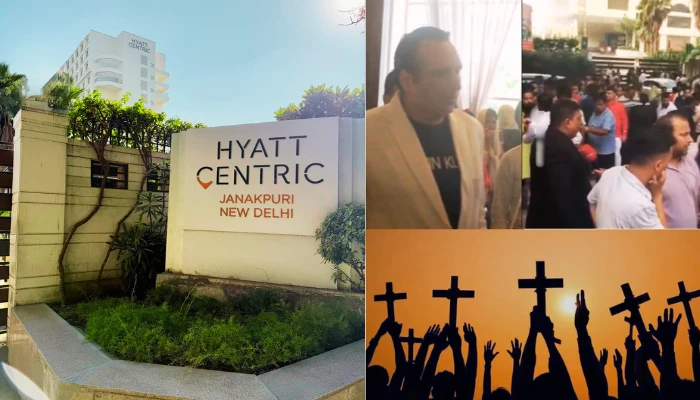
Case Summary
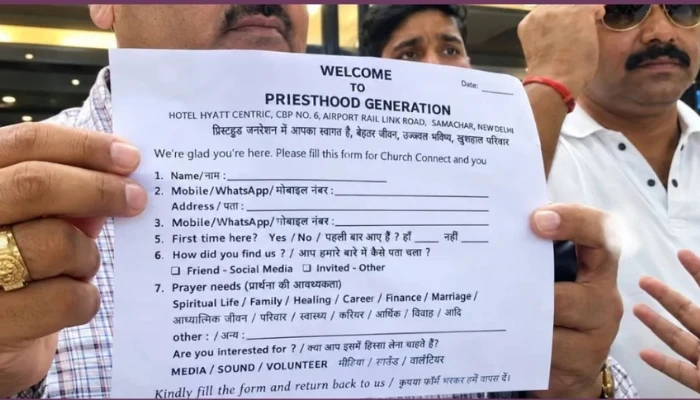
In Janakpuri, Delhi, at the Hyatt Centric Hotel, around 500 to 800 Hindus, including minors, were lured towards conversion to Christianity by Christian missionaries. The conversion activities were being carried out under the guise of prayer meetings and supposed healing. The matter came to light after Hindu activist Preet Sirohi (@BhaiPreetSingh) posted a video about the incident on his official X handle at 2:28 pm on 20 September 2026. In the video, Hindu activists stated that vulnerable Hindus were being subjected to illegal religious conversion at the Hyatt Hotel by Christian evangelists. The post stated that around 500 poor and vulnerable Hindus, including minors, had gathered at the Hyatt Hotel and were being made to fill out forms in connection with prayer, healing and conversion activities. The form that the Hindus were made to fill out also subsequently went viral on social media. The form asked attendees whether they were attending the prayer meeting for the first time and whether they had come for healing or prayer-related activities. At the time, members of the Hindu organisation Bajrang Dal were present at the Hyatt Hotel for a separate meeting on the second floor. After becoming aware of the gathering, the Bajrang Dal members reached the prayer meeting and recorded the proceedings. They also confronted the Christian organisers and opposed the forced conversion activities taking place there. Following this, the Bajrang Dal members were assaulted and forced to leave the hotel. A protest was subsequently held outside the hotel's main entrance, while those attending the prayer gathering were taken out through another exit of the hotel. At around 3:37 pm, the Delhi Police West, through its official X handle (@DCPWestDelhi), responded to Preet Sirohi’s post and claimed that members of the local Christian community had gathered at the Hyatt Hotel for a regular Sunday prayer. Despite the healing-related forms having gone viral on social media, the police claimed that the complaint regarding the conversion of around 500 people was untrue. The police statement was strongly disputed by Preet Sirohi, who wrote on X, "SHOCKING: Is the police enquiry meant to uncover the truth—or bury it? Instead of investigating the alleged conversion activity, the police appear to have conducted a superficial enquiry and cooked up a report without establishing the identities of those involved. We have independently verified concerns regarding attendees allegedly claiming Christian faith while also availing SC/ST reservation benefits. Why were their names, addresses and identity details not properly verified and recorded? If there is nothing to hide, why avoid a proper investigation?" Several others raised questions about the nature of the gathering and the activities taking place there. Videos from the venue showed Hindu women, men and minors among those present. Members of the Hindu organisation also displayed a form that had been filled out by attendees, which asked whether they were attending for the first time and whether they had come for healing or prayer. Complaints seeking a proper investigation into the gathering and the conversion activities were subsequently raised before National Human Rights Commission member Priyank Kanoongo. He stated on his official X handle that the matter would be properly investigated and that the Delhi Police would be requested to provide the list of persons concerned so that the doubts and concerns surrounding the gathering could be examined. He further stated that if any unauthorised access to constitutionally protected reservation benefits was found, the matter would be taken up with the competent authorities for appropriate legal action.
Case Images
Why it is Hate Crime ?
This case has been added to the tracker under the primary category of: Predatory Proselytisation. Within this, the sub-category selected is: Proselytisation by grooming, brainwashing, manipulation or subtle indoctrination. The tertiary category selected is: Conversion of Minor. Religious brainwashing essentially means the often subtle and forcible indoctrination to induce someone to give up their religious beliefs to accept contrasting regimented ideas. Religious grooming or brainwashing also involves propaganda and manipulation. It involves the systematic effort, driven by religious malice and indoctrination, to persuade “non-believers’ to accept allegiance, command, or doctrine to and of a contrasting faith. Cases of such grooming or brainwashing are far more nuanced than direct threats, coercion, inducement and violence. In such cases, repeated, subtle, and continual manipulation often induces disaffection toward the victim's own faith and acceptance of the perpetrator's contrasting faith. While subtle indoctrination is widely acknowledged as predatory, an element which is often understated in such conversions or in the attempts at such conversion is the role of loyalty and trust which might develop between the perpetrator and the victim. Fiduciary relationships are often abused to affect such religious conversion—for example, an educator transmitting religious doctrine of a competing faith to a Hindu student. The Hindu student is likely to accept what the teacher is transmitting owing to the existence of the fiduciary relationship. The exploitation of the fiduciary relationship to religiously indoctrinate victims would also be included in this category. Since the underlying animosity towards the victim’s faith forms the basis of predatory proselytisation, such cases are considered religiously motivated hate crimes. The other subcategory selected is: Conversion/attempts to convert by inducement. Predatory Proselytisation is not just limited to threat, harassment, force and violence, but it also has contours of stealth. In several cases, the Hindu victim is exploited to convert, with non-Hindus taking advantage of their poverty. In such cases, the Hindu victim who is suffering financially is offered monetary benefits, including lucrative offers for jobs, health treatment, education, etc, to induce the victim to change his/her religion. In such cases, the religious identity of the victim and the aim to disenfranchise him from his faith form the heart of the crime. Also, taking advantage of and exploiting an individual’s economic vulnerabilities is widely acknowledged as exploitation, forms of which are often penalised by law. Such cases therefore are considered religiously motivated hate crimes since the victim’s religious identity forms the very heart of the crime itself. Another primary category selected is: Attack not resulting in death. The subcategory selected is: Attacked for opposing radicals or trying to save victim. In several cases, Hindus are attacked for opposing religiously motivated crimes being committed against a fellow Hindu or simply for voicing an opinion opposing radical elements, who either have in the past or continue to persecute Hindus. In such cases, the initial attack against the victim, against which the Hindu was trying to defend the victim, would also need to be classified as a religiously motivated hate crime. Since the initial crime itself was religiously motivated and the subsequent crime of attempting to save the victim or speaking against the radical elements ends up inviting a violent attack, it would also be classified as a religiously motivated hate crime under this category. This case was included in the Hinduphobia Tracker because it involved an organised effort to influence Hindus towards converting to Christianity through prayer meetings and purported healing activities. The religious setting was used to bring Hindu attendees into sustained contact with Christian religious practices and teachings, making the activity distinct from ordinary private Christian worship. The use of prayer and healing as the means through which vulnerable Hindus were engaged indicated that religious interaction was being used as a pathway towards conversion rather than merely as an expression of Christian belief. The process therefore targeted the religious identity of Hindus and sought to influence their adherence to their existing faith. The method also involved elements of religious indoctrination, as prayer and purported healing created a seemingly benign and reassuring environment in which Christian beliefs were being introduced to Hindu attendees. By associating Christianity with healing, spiritual relief and assistance, the organisers made the competing Christian faith appear increasingly familiar and attractive to Hindu individuals facing personal or economic difficulties. Such methods influence religious choice through familiarity, trust and inducement rather than through an open and informed decision to change one’s faith. The use of religious engagement in this manner therefore went beyond ordinary religious propagation and became a means of influencing vulnerable Hindus towards conversion. More importantly, the organisers specifically targeted poor and vulnerable Hindus, whose economic circumstances made them particularly susceptible to promises of assistance and healing. The purported healing therefore also functioned as an inducement, offering vulnerable individuals a perceived source of relief while simultaneously exposing them to Christian religious influence. Using material or perceived personal benefits in this manner becomes a manipulative tool when they are tied to religious conversion, particularly where the individuals being approached are already economically and socially vulnerable. Such methods undermine genuine religious autonomy by exploiting circumstances that impair a person’s ability to make a free and informed decision about their faith. Conversion pursued through manipulation, coercion or exploitation of vulnerability therefore interferes with the individual’s freedom of conscience and their right to freely practise and profess their religion. It's also important to note that the victims also included Hindu children. This means the element of consent and genuine change of conscience was missing ab initio. Minors, due to their young age and lack of maturity, are particularly vulnerable to manipulation and coercion. They may not have the ability to fully understand the implications of converting to another religion, and the Christian perpetrators purposely targeted and exploited this vulnerability of the minor victims. Since this case exemplifies the use of coercion and manipulation to achieve religious conversion, it is a blatant act of a religiously motivated hate crime against Hindus. The organised nature of the activity further distinguished it from ordinary private worship. The use of forms asking attendees whether they were participating for the first time and whether they had come for healing or prayer indicated a structured process for engaging with participants and identifying the nature of their participation. Combined with the presence of large numbers of Hindu attendees, including minors, and the use of healing as an inducement and manipulative tool, this demonstrated an organised effort to draw vulnerable Hindus into a Christian religious environment and influence their religious choices. The assault on the Hindu activists also demonstrated religious hostility because they were attacked specifically after they intervened to oppose the conversion activities and protect fellow Hindus. By assaulting and forcing them out of the venue, the perpetrators signalled that those who challenged the conversion drive or attempted to prevent Hindus from being targeted would themselves face violence. This created a clear message of intimidation against Hindu activists defending their community and demonstrated hostility towards those who sought to protect Hindus from religious conversion. In this case, the police denied the conversion angle despite the availability of multiple pieces of evidence, including the healing forms circulated from the gathering that showed attendees were being engaged specifically in relation to prayer and healing. The police characterised the gathering as a regular Sunday prayer meeting and rejected the conversion angle at an early stage. The police, in many such cases where forced conversion takes place, deny it by calling it just prayer meetings. Even in other cases of religiously driven hate crimes against Hindus, where the motive behind the crime is obvious but not explicitly mentioned, they deny that the crime committed was in any way motivated by a religious bias or say that there was ‘no communal angle’ to the crime. Several factors are generally at play here that need strict evaluation. Many a time the police downplay incidents of low-level communal crime because it is their jurisdiction that comes under question. The police also often say that there was ‘no communal angle’ to a crime when there was one because they wish to ensure that, owing to the crime already committed, there is no further flare-up in the area. However, a mere police statement cannot be enough to determine whether there is a communal angle present in the crime that has been committed. In fact, to determine whether the crime is communal in nature or not, we need to give emphasis to the ground realities. For example, in the case of Rinku Sharma, the Bajrang Dal activist who was mercilessly stabbed in his house in front of his family members in Delhi’s Mangolpuri area in the year 2021, the leftist media and the leftist ecosystem had tried to peddle that there was no communal angle to the crime. Even the police denied that the crime was communal in nature. However, Opindia, a news portal, spoke to several people who are on the ground with the family of Rinku Sharma, and they were told that the communal tension in the area is palpable. The family of Rinku Sharma has said that the Muslims of the area held a grudge against Rinku ever since he celebrated the Ram Mandir verdict Like the case of Rinku Sharma, those cases where even if the police have denied a communal or religious angle, but the ground reality, including the victim’s family or relatives’ testimonies and other evidence emerging from the incident, makes it clear that there was an obvious religious bias that led to the crime, will be documented in this Tracker. In this case, despite the Delhi Police claiming that the gathering at the Hyatt Hotel was merely a regular Sunday prayer meeting and denying that Hindus were being targeted for conversion, the videos from the venue, statements by Hindu activists and the form circulated on social media established the religious nature and purpose of the gathering. The presence of a large number of Hindu men, women and minors, along with forms referring to prayer and healing, clearly contradicted the attempt to characterise the gathering as an ordinary prayer meeting. The available evidence established that Hindus were being deliberately targeted through a Christian religious gathering conducted under the guise of prayer and healing. Therefore, despite the police denying the conversion angle, the religious targeting evident from the circumstances of the incident makes this a case of religiously motivated hostility against Hindus. Such instances of predatory proselytisation are manifestations of doctrinal hostility embedded within Abrahamic religions like Christianity that regard non-adherents as inferior and encourage their conversion. This leads to the dehumanisation of those who do not share the faith and creates an environment in which coercion becomes an instrument for stripping Hindu individuals of their religious identity. In this case, the entire sequence of events showcases that Hindus were being induced and indoctrinated to convert to Christianity, showcasing the religious hostility driving the crime. Therefore, this case is being added to the hate crime database of the Hinduphobia Tracker. Disclaimer: Media reports state that between 500 and 800 Hindus, including men, women and minors, were targeted for conversion in Delhi. However, the reports do not provide a gender-wise or age-wise breakdown. For documentation purposes, the Hinduphobia Tracker has recorded the upper-limit figure of 800 victims, as some reports indicated that the number of Hindus targeted may have been as high as 800. In the absence of a verified exact figure, the Tracker has used 800 as the victim count for documentation and calculation purposes. In the absence of specific demographic data, a proportional estimate has been applied based on India’s Census 2011 and NFHS-5 (2019–21) rural population patterns. Accordingly, the 800 participants are estimated as 400 men (50%) and 400 women (50%), reflecting an equal gender distribution consistent with typical rural family demographics. As age-wise segregation was also not specified in the media reports, the same data sources have been used to derive a proportional age estimate. On this basis, the 800 participants are estimated as 560 adults (70%) and 240 children (30%). These figures are approximate and intended solely for consistency in documentation; they do not represent verified individual counts.
Victim Details
Total Victim
800
Deceased
0
Gender
- Male 400
- Female 400
- Third Gender 0
- Unknown 0
Caste
- SC/ST 0
- OBC 0
- General 0
- Unknown 800
Age Group
- Minor 240
- Adult 560
- Senior Citizen 0
- Unknown 0


Case Status
Unknown


Perpetrators Details
Perpetrators
Christian Extremists
Perpetrators Range
Unknown
Perpetrators Gender
unknown
 Sources




