Hindu woman pressured to convert to Christianity on pretext of curing ‘black magic’, her brother pressured to break his kalava by Christian pastor
 Ahmednagar, Maharashtra, India
  28 August, 2026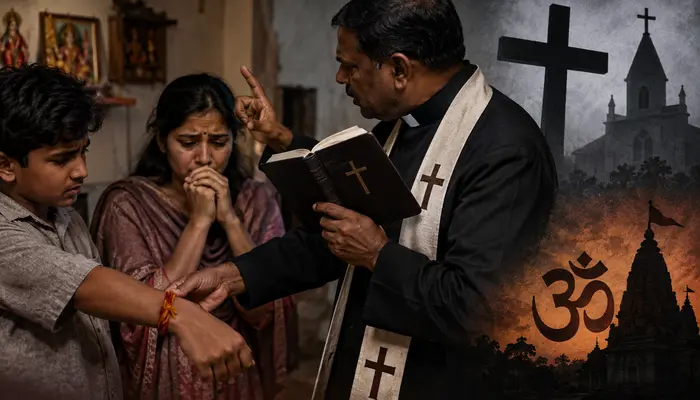
Case Summary
In Astagaon, Rahata taluka, Ahilyanagar (Ahmednagar), Maharashtra, a 21-year-old married Hindu woman, Vaishnavi Gorakshnath Gaikwad, and her younger brother, Prashant, were pressured to convert to Christianity by a Christian pastor. The accused told Vaishnavi that she was suffering from karni badha (black magic affliction) and said that she would have to accept Christianity to remove it. He also attempted to make her younger brother break the kalava (sacred Hindu thread) worn on his hand and placed pressure on both siblings to convert. Vaishnavi had been eight months pregnant in January 2026 when her baby died in the womb. Following the death, her health continued to deteriorate. During Raksha Bandhan in August 2026, her aunt, who resided in Padhegaon, told her that a Christian “Father” from Padhegaon would pray for her and that the prayers would improve her health. From 29 August 2026, the accused repeatedly contacted Vaishnavi on her mobile phone and conducted prayers and chanting over the telephone. On 15 September 2026, he told her that someone had done something to her father’s house, referring to karni (black magic), and said that he would have to visit the house. On 16 September 2026, at around 11:00 am, the pastor arrived at Vaishnavi’s parental home in Astagaon. He took out a Bible and began loudly conducting prayers and chanting. He then attempted to make Prashant break the religious thread worn on his hand, but Prashant refused. The man subsequently told Vaishnavi that she had karni badha and that she would have to accept Christianity to remove it. He placed pressure on Vaishnavi and her brother to convert and also offered inducements in connection with the proposed conversion. The loud prayers and chanting attracted neighbours, villagers and other local residents to the house. When questioned, the initially frightened family members told them that the prayers were being conducted because of Vaishnavi’s illness. The residents then checked the Aadhaar card of the man presenting himself as a “Father”, following which he was identified as Narayan Bhausaheb Chavan, with his residence listed as Padhegaon/Shrirampur. Reports stated that Chavan belonged to the Hindu Maratha community, had left Hinduism and adopted Christianity, and was presenting himself as a “Father” while approaching people for conversion. Local youths, villagers and police subsequently reached the scene. Following the incident, local activists and police assisted in bringing Vaishnavi to the police station, where she submitted a written complaint at Rahata Police Station. Based on her complaint, police registered an FIR against Narayan Bhausaheb Chavan under Sections 9(1) and 9(2) of the Maharashtra Freedom of Religion Act, 2026, and Sections 3(1) and 3(2) of the Maharashtra Prevention and Eradication of Human Sacrifice and Other Inhuman, Evil and Aghori Practices and Black Magic Act, 2013. The investigation was assigned to Police Sub-Inspector Komal Kumawat. Shubham Murtadak, President of the Bajrang Dal, North District, stated that exploiting people's innocence or poverty to force or induce religious conversion was harmful to society. He said that the Bajrang Dal was conducting an awareness campaign throughout the district to identify such activities and pursue legal action against those involved.
Why it is Hate Crime ?
The primary category selected in this case is: Predatory Proselytisation. Within this, the selected subcategory is: Proselytisation by grooming, brainwashing, manipulation or subtle indoctrination. Religious brainwashing essentially means the often subtle and forcible indoctrination to induce someone to give up their religious beliefs to accept contrasting regimented ideas. Religious grooming or brainwashing also involves propaganda and manipulation. It involves the systematic effort, driven by religious malice and indoctrination, to persuade “non-believers’ to accept allegiance, command, or doctrine to and of a contrasting faith. Cases of such grooming or brainwashing are far more nuanced than direct threats, coercion, inducement and violence. In such cases, it is often seen that there is repeated, subtle and continual manipulation of the victim to induce disaffection towards their own faith and acceptance of the contrasting faith of the perpetrator. While subtle indoctrination is widely acknowledged as predatory, an element which is often understated in such conversions or the attempts of such conversion is the role of loyalty and trust which might develop between the perpetrator and the victim. Fiduciary relationships are often abused to affect such religious conversion. For example, an educator transmitting religious doctrine of a competing faith to a Hindu student. The Hindu student is likely to accept what the teacher is transmitting owing to existence of the fiduciary relationship. The exploitation of the fiduciary relationship to religiously indoctrinate victims would also be included in this category. Since the underlying animosity towards the victim’s faith forms the basis of predatory proselytization, such cases are considered religiously motivated hate crimes. The other subcategory selected is: Conversion/attempts to convert by inducement. Predatory Proselytisation is not just limited to threats, harassment, force and violence, but it also has contours of stealth. In several cases, the Hindu victim is exploited to convert, with non-Hindus taking advantage of their poverty. In such cases, the Hindu victim who is suffering financially is offered monetary benefits, including lucrative offers for jobs, health treatment, education, etc., to induce the victim to change his/her religion. In such cases, the religious identity of the victim and the aim to disenfranchise him from his faith form the heart of the crime. Also, taking advantage of and exploiting an individual’s economic vulnerabilities is widely acknowledged as exploitation, forms of which are often penalised by law. Such cases therefore are considered religiously motivated hate crimes since the victim’s religious identity forms the very heart of the crime itself. This case constituted a clear example of a religiously driven hate crime, as the conduct was specifically directed at the Hindu religious identity, beliefs, and practices of the victims. The Christian pastor used claims of “karni badha” (black magic affliction), offered Christian conversion as the supposed means of removing the affliction, pressured the victims to abandon a Hindu religious symbol, and conducted Christian prayers and chanting while attempting to persuade them to convert. These actions were not confined to the expression of a different religious belief, but involved the deliberate use of fear, superstition, religious pressure, and manipulation to undermine the victims’ existing faith and facilitate their conversion to Christianity. The combination of these acts demonstrated hostility directed towards their Hindu religious identity, placing the incident within the parameters of a religiously driven hate crime. The assertion that accepting Christianity would cure or remove “karni badha” functioned as a manipulative proselytisation tactic. By attributing Vaishnavi’s suffering and deteriorating health to black magic and then presenting conversion to Christianity as the necessary solution, the perpetrator exploited an existing fear and vulnerability to influence her religious decision-making. The act also carried an implicit religious message that Christianity was capable of providing the spiritual remedy that her existing Hindu faith supposedly could not provide, thereby portraying Hindu religious beliefs and practices as inadequate or incapable of protecting her from or relieving her suffering. Christianity was thus positioned as the superior or necessary source of spiritual relief, while Hinduism was implicitly presented as insufficient in addressing her perceived affliction. Such messaging, conveyed through the circumstances of the proposed conversion rather than through an explicit theological argument, sought to undermine confidence in the victim’s existing faith while elevating Christianity as the prescribed alternative. Proselytisation achieved through fear, superstition, manipulation and exploitation of personal vulnerability undermined the victims’ religious autonomy and transformed the proposed conversion into a coercive act rather than a freely exercised change of faith. The attempt to influence the victims by exploiting their fear of supernatural harm and presenting abandonment of Hinduism as necessary for their well-being therefore demonstrated a distinctly religiously driven form of manipulation and hostility towards their Hindu faith and identity. The promise that Christian intervention and conversion could provide relief from the perceived affliction also functioned as an inducement. The perpetrator linked the proposed conversion to the removal of black magic and the improvement of Vaishnavi’s condition, thereby exploiting her personal circumstances and vulnerability following the death of her unborn child and her continuing health problems. By presenting a religious conversion as a means of obtaining relief from suffering, the inducement made the conversion attempt predatory in nature, as the victim’s distress was used as an opportunity to advance a particular religious objective. Such exploitation of personal hardship to facilitate religious conversion further demonstrated that the attempt was not merely an instance of religious persuasion, but involved the use of vulnerability and promised spiritual relief to pressure a Hindu individual towards abandoning her faith. Of particular religious significance was the pressure placed upon Prashant to break the kalava worn on his hand. The kalava is a sacred thread traditionally worn by Hindus as part of religious and ritual observance and is associated with protection and adherence to Hindu customs. The deliberate attempt to make a Hindu victim break such a religiously significant symbol therefore carried significance beyond the physical act itself. Despite the reverence attached to the kalava, the perpetrator sought to make Prashant discard or break it while simultaneously pressuring the siblings to accept Christianity. This effectively sought to make a Hindu victim desecrate or renounce a visible symbol of his own faith. Such conduct formed part of a broader attempt to gradually separate the victims from their Hindu religious identity, practices, symbols, and cultural traditions. The interference with the kalava therefore reinforced the religious nature of the conversion attempt and demonstrated hostility towards an established expression of Hindu religious identity. The use of the Bible and Christian prayers and chanting further reinforced this pattern. The perpetrator introduced distinct Christian religious practices into the Hindu family’s home while simultaneously applying pressure for conversion. These practices were presented in the context of providing spiritual intervention for Vaishnavi’s perceived affliction, thereby reinforcing Christianity as the supposed source of healing and spiritual relief. The conduct consequently went beyond the peaceful expression of Christian belief and formed part of an attempt to familiarise the Hindu victims with Christian religious practices while weakening their attachment to their existing Hindu religious framework. In conjunction with the demand that the victims accept Christianity, the prayers, chanting and use of the Bible formed part of a broader process through which the victims were being pressured to move away from Hindu religious observance and towards Christianity. The incident also highlights a growing pattern in organised conversion networks, where individuals who have embraced Christianity continue to retain their Hindu names while practising Christianity. This allows these crypto Christians to seamlessly integrate into Hindu communities, gain the confidence of unsuspecting families, and carry out conversion activities without immediately revealing their religious identity. In this case too, the pastor operated under the Hindu name Narayan Bhausaheb Chavan, illustrating how the continued use of a Hindu identity can facilitate access to communities that might otherwise be wary of conversion efforts. Such instances of predatory proselytisation are manifestations of doctrinal hostility embedded within Abrahamic religions like Christianity that regard non-adherents as inferior and encourage their conversion. This leads to the dehumanisation of those who do not share the faith and creates an environment in which coercion and manipulation become an instrument for stripping Hindu individuals of their religious identity. In this case, the entire sequence of events showcases that Hindus were being induced and indoctrinated to convert to Christianity, showcasing the religious hostility driving the crime. Therefore, this case is being added to the hate crime database of the Hinduphobia Tracker. Disclaimer: The Hinduphobia Tracker records the date of an incident based on when the victim’s ordeal began, rather than the date on which the incident was reported by the media. In the present case, media reports stated that the victim’s ordeal began on 29 August 2026, when the perpetrator first began contacting her and conducting Christian prayers and chanting over the telephone. As this was the earliest documented date marking the commencement of the victim’s ordeal, 29 August 2026 has been selected as the indicative incident date for documentation purposes.
Victim Details
Total Victim
2
Deceased
0
Gender
- Male 1
- Female 1
- Third Gender 0
- Unknown 0
Caste
- SC/ST 0
- OBC 0
- General 0
- Unknown 2
Age Group
- Minor 0
- Adult 1
- Senior Citizen 0
- Unknown 1


Case Status
Complaint registered


Perpetrators Details
Perpetrators
Christian Extremists
Perpetrators Range
One Person
Perpetrators Gender
male
 Sources




