Ganpati puja disrupted after mutton water poured into sacred fire; Hindu woman assaulted and mangalsutra forcibly removed for opposing
 Powai, Maharashtra, India
  16 September, 2026
Case Summary
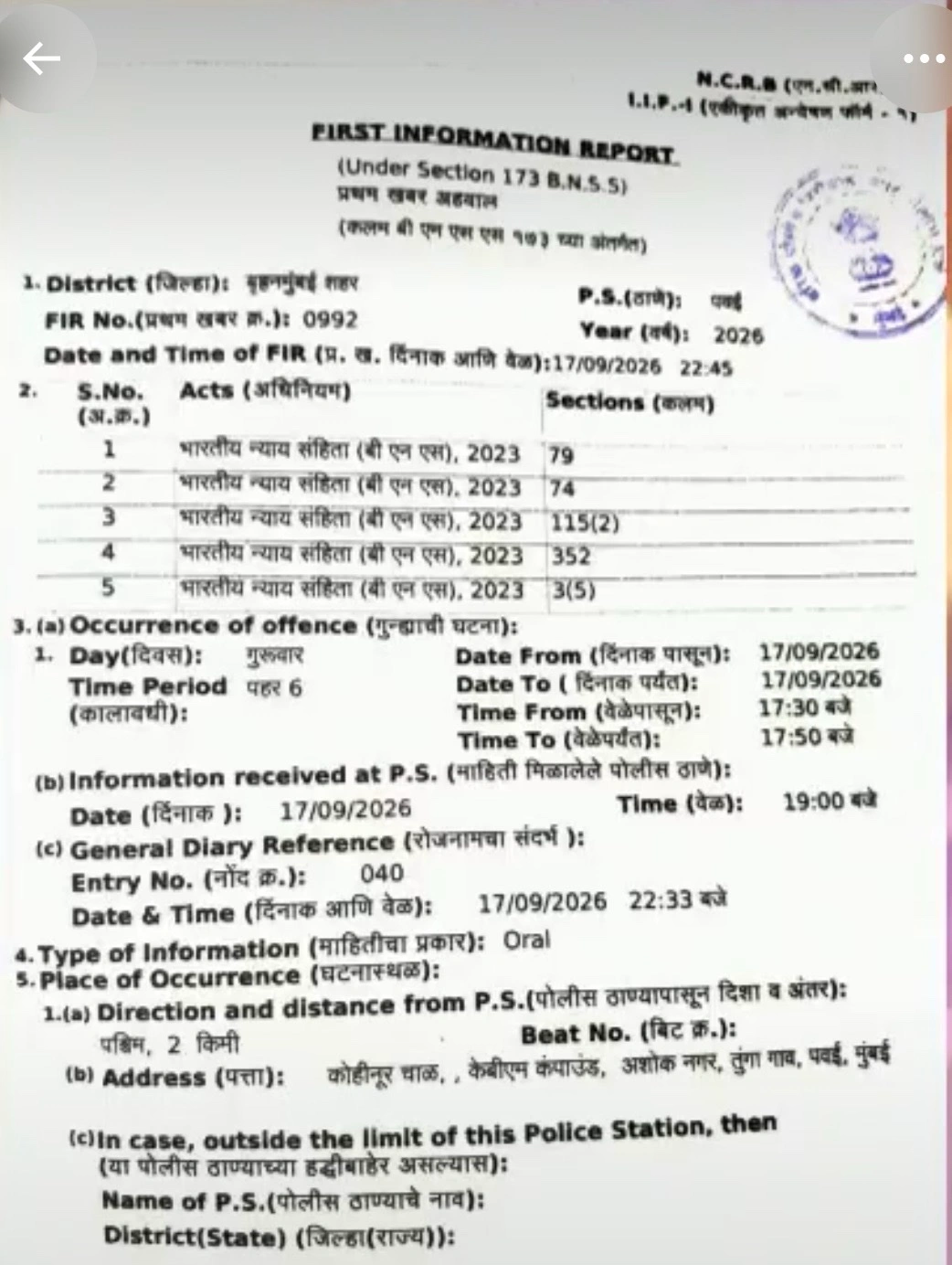
In Ashok Nagar, Powai, Mumbai, Maharashtra, a Hindu family’s Ganpati puja was disrupted and defiled after miscreants poured mutton water (mutton broth) into the hawan, a sacred Hindu fire ritual. Furthermore, a Hindu woman who objected to the interference was assaulted, and her mangalsutra (sacred Hindu marital necklace) was snatched during the confrontation. The incident occurred on 17 September 2026, when the Hindu family was conducting the Ganpati installation at their home, with the hawan and a community feast organised as part of the religious observances. During this time, between 5:30 pm and 5:50 pm, while the family members and organisers were preparing food for the occasion, some individuals brought mutton water to the religious ceremony and poured it into the hawan. The Hindu family initially refrained from confronting them and asked them to leave the premises. As the ritual continued, the individuals demanded that the hawan materials be taken outside and extinguished with water. When the family questioned the demand, the confrontation intensified, and the individuals started arguing with household members one after another. They threatened the family, saying they would not let them go. A Hindu woman of the family attempted to calm her children and instructed them to step back in an effort to calm the situation. However, the situation turned physical when one of the perpetrators grabbed the woman by the neck and assaulted her. Her blouse buttons and cord were torn during the assault, while her mangalsutra was pulled off and went missing. The individuals then taunted the family and challenged their standing. The incident came to light after the victims appeared on camera talking about their ordeal, the video of which went viral on social media. Furthermore, a First Information Report was registered at Powai Police Station under the Bharatiya Nyaya Sanhita, 2023, Sections 79, 74, 115(2), 352 and 3(5). Following the registration of the case, the family sought immediate protection and assistance and appealed specifically to the Bajrang Dal and other protective groups for support and intervention.
Case Images
Why it is Hate Crime ?
The first primary category selected in this case is: Attack on Hindu religious representations. Desecration of Hindu religious symbol. Icons and symbols or a religious representation of a spiritual ideal are widely revered in Hinduism. Iconography is of vital significance in the Hindu milieu. It helps connect people’s spiritual beliefs with the real world. Iconography within the Hindu faith takes several shapes and forms. Murtis are of most significance to Hindus, to which daily rituals, prayers and offerings are done. Besides the murtis, there are several other symbols which have deep significance in the Hindu faith – the Om and Swastika for example. Since these Hindu religious symbols hold paramount importance in Hinduism, any desecration of symbols, icons, murtis, religious representations and manifestations, is driven by animosity towards the faith itself which manifests itself through these murtis, icons and symbols. Therefore, any desecration of these Hindu religious symbols and representations is considered religiously motivated hate crimes under this category. The other subcategory selected is: Defiling religious customs. Sanatan Dharma is not a religion of one book, which is to say that while it has religious scriptures that form the central tenets of the faith, there are several traditions followed through thousands of years, mostly passed from generation to generation orally. There are several such customs and traditions that are followed by various Hindus and Hindu sects. Defiling of these traditions and customs is a breach of an individual or group’s religious practices. Such practices can range from dietary restrictions like not eating non-vegetarian food for a certain period of the year, not eating non-vegetarian food at all, not eating beef since the cow is considered holy in Hinduism, the sanctity of religious customs followed in the house (like many ISCKON devotees), etc. Any malicious action leading to the breach of such traditions or defilement of these traditions owing to animosity towards the faith or for the sake of activism stems not only from the lack of faith in the religion itself but also from disregard for the faith of the devotees who follow the customs/traditions and implicit bias against the faith, the tradition itself. Since these specific traditions are central to the faith of the devotees of that specific sect of Hindus, any non-compliance with these traditional rules would be considered a religiously motivated hate crime. The other primary category selected is: Attack not resulting in death. The subcategory selected is: Attack against Hindu devotees. Hindu devotees are a few of the easiest targets of religiously motivated hate crimes because during the festival/procession/puja etc, for non-Hindus it is easy to profile their victims on the basis of religion. Hindu devotees come under attack on several occasions by individual non-Hindus or mobs of non-Hindus owing to their animosity against Hinduism, its symbols and tradition/practices. There are several instances of Hindu devotees being attacked while they worship in temples or temporary religious structures, during religious processions, doing bhajan/kirtan/puja in their own homes, in the residential society etc. These attacks are perpetrated by non-Hindus primarily because of their animosity towards Hindus and their faith. In some cases, the trigger for the violence may be non-religious, however, there are two elements that make these hate crimes. First, the Hindus who come under attack are attacked violently while indulging in religious activity. Whether they are in a place of worship or not is immaterial to the crime. When individuals are attacked while indulging in religious practices, the attack in itself is a hindrance to their freedom to practice religion and therefore constitutes a hate crime. Secondly, religious supremacist doctrines and ideologies deem religious practices of Hindus to be offensive ab initio since they are considered “sinful” by these ideologies, worthy to be annihilated by force or coercion. Driven by these religious supremacist ideologies and doctrines, the attacks against Hindu devotees stem from intrinsic animosity towards Hinduism. In some cases, the trigger for the violence may be non-religious, however, it develops into a religiously motivated crime during the course of the violence. Since these attacks stem from animosity towards Hindus and Hinduism, they are considered religiously motivated hate crimes under this category. The other sub-category selected here is - Attacked for opposing radicals or trying to save victim. In several cases, Hindus are attacked for opposing religiously motivated crimes being committed against a fellow Hindu or simply for voicing an opinion opposing radical elements, who either have in the past or continue to persecute Hindus. In such cases, the initial attack against the victim, against which the Hindu was trying to defend the victim, would also need to be classified as a religiously motivated hate crime. Since the initial crime itself was religiously motivated and the subsequent crime of attempting to save the victim or speaking against the radical elements ends up inviting a violent attack, it would also be classified as a religiously motivated hate crime under this category. This case constitutes a clear instance of anti-Hindu religious hostility, as the perpetrators deliberately disrupted a Hindu Ganpati prayer ritual by pouring mutton water into the hawan, demanding that the sacred fire be extinguished with water, and subsequently assaulting a Hindu woman, tearing her blouse and snatching her mangalsutra when she objected to the interference. At the centre of the incident was the disruption of the Ganpati puja, which directly interfered with a Hindu family's observance of an important devotional ceremony. Ganpati worship carries particular religious significance because Lord Ganesha is worshipped as a central deity in Hindu tradition and is associated with auspicious beginnings, devotion and the removal of obstacles. Interfering with such a ceremony therefore affects the family's exercise of Hindu religious practice at its most immediate level: their ability to worship their chosen deity, maintain the observance and participate in the rituals associated with the Ganpati installation. The disruption was consequently significant not merely because a household event was interrupted, but because an ongoing act of Hindu devotion was prevented from proceeding with the religious continuity intended by the family. More significantly, mutton water was poured into or near the hawan, intruding directly into the setting of a sacred Hindu fire ritual. The hawan fire had formed an integral part of the religious ceremony, around which ritual activity and offerings were being conducted. In Hindu religious practice, a hawan fire is not merely a physical flame; it is regarded as a sacred medium through which offerings are made and the ritual is performed. Introducing mutton water into such a setting violated the sanctity attached to the hawan and interfered with the religious purpose for which the space had been prepared. The act carried particular religious significance because it brought a substance associated with meat into the immediate context of a Hindu sacred fire, thereby compromising a space that is set apart for devotional practice. It consequently constituted an intrusion into the family's exercise of Hindu worship rather than an ordinary disagreement over food or household activity. The significance of the act lay in the deliberate introduction of mutton water into an ongoing Hindu religious ritual. The hawan had been prepared specifically for the performance of sacred rites, offerings and prayers as part of the Ganpati observance. Introducing an unrelated substance into the ritual setting interfered with the sanctity of the ceremony and disrupted the manner in which the family was conducting its worship. This was therefore not simply an act involving food or water, but an intrusion into an active Hindu religious observance at the very point where the family was engaged in worship. The subsequent demand to take the burning hawan materials outside and extinguish the sacred fire with water went beyond a mere objection to the family's activities, as it sought to bring an ongoing Hindu ritual to an immediate halt. In Hindu religious practice, the hawan fire is a sacred element of the ceremony and is used as the medium through which offerings are made during worship. Its continuity therefore carries religious significance, and deliberately requiring it to be extinguished prevents the ritual from being completed in accordance with the worshippers' religious observance. The demand is also particularly significant because it sought to dictate whether and how the family could continue its own religious ceremony within its place of worship. By compelling the removal and extinguishing of the hawan fire, the act directly obstructed the family's exercise of Hindu religious practice and disrupted the sanctity and continuity of the ceremony. Equally significant was the assault on the Hindu woman during the during the confrontation. Within Hindu matrimonial tradition, the mangalsutra, a sacred Hindu necklace, is widely recognised as a symbol associated with a woman's married status. It therefore carries significance beyond its material or monetary value and forms part of the visible expression of Hindu marital identity for many women. Its forcible removal is consequently significant in religious and cultural terms because it involved the deliberate taking away of an object that represented her marital bond and Hindu matrimonial identity. In the context of an incident that had already involved interference with Ganpati worship and the hawan, removing the mangalsutra further intruded upon a personally held Hindu symbol and compounded the affront to the woman's religious and cultural identity. Taken together, these acts affected distinct aspects of Hindu religious life: the Ganpati puja represented worship of the deity, the hawan represented sacred ritual practice, the interference with the fire obstructed the continuation of that worship, and the assault on the Hindu woman. Their significance arose from the fact that each act affected an identifiable element of the family's religious observance or Hindu identity rather than merely constituting an unrelated dispute. Accordingly, this case has been documented in the Hinduphobia Tracker's Hate Crime Database as an instance of religiously motivated hostility directed against Hinduism and the religious identity of the Hindu community. Disclaimer: The victim count has been recorded as two, comprising the two Hindu women from the family who gave statements on camera, including the woman who was physically assaulted, had her blouse torn and had her mangalsutra snatched. Since the number of other family members involved was not reported, the conservative victim count has been recorded as two for documentation purposes only.
Victim Details
Total Victim
2
Deceased
0
Gender
- Male 0
- Female 2
- Third Gender 0
- Unknown 0
Caste
- SC/ST 0
- OBC 0
- General 0
- Unknown 2
Age Group
- Minor 0
- Adult 1
- Senior Citizen 1
- Unknown 0


Case Status
Complaint filed


Perpetrators Details
Perpetrators
Unknown
Perpetrators Range
Unknown
Perpetrators Gender
unknown
 Sources




