Hindu temple vandalised; priest assaulted while performing religious duties in Anupgarh, Rajasthan
 Anupgarh, Rajasthan, India
  16 September, 2026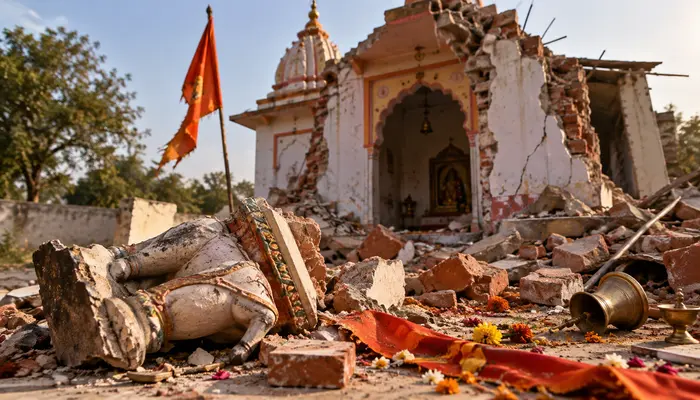
Case Summary
On September 17, 2026, a Baba Ramdev temple in 3 KHM village, under Rojdi-Rawala police station in Anupgarh, Rajasthan, was vandalised, and its priest and family were assaulted by a group of around 15–20 people. According to reports, the incident took place on 17 September 2026, while priest Bhaniram Meghwal and his family were worshipping at the temple. During this time, Kirpal Raisikh, a "land mafia" figure, arrived at the site along with around 15–20 people and began vandalising and demolishing the temple. Bhaniram Meghwal was also brutally assaulted during the incident. The vandalism and assault caused anger among the priest's family and local villagers, who demanded that the administration conduct a fair investigation and inspect the site. The family requested that officials treat the matter seriously and conduct an on-site inspection. They also sought an impartial investigation into the temple vandalism and the assault on the priest.
Why it is Hate Crime ?
The primary category selected in this case is: Attack on Hindu religious representations. The subcategory selected is: Attack on Temples. In Hinduism, a temple is the abode of the Deity. The Deity in the Temple is consecrated, thereby, making it a real, breathing entity. Hindus believe that not just the Deity but the temple premises itself are sacred to Hindus since Hindus hold the faith that the entire Temple space is an amalgamation of the divine energy of the deity. Given the central significance of Temples in Hindu Dharma, any attack against a Hindu Temple or its peripheral premises is an attack on the faith itself and is born out of animosity towards the faith, of which, the Temple is a central tenet. Any manner of attack against a Temple and/or its premises would therefore be considered a religiously motivated hate crime. The other sub-category selected here is - Defiling religious customs. Sanatan Dharma is not a religion of one book, which is to say that while it has religious scriptures that form the central tenets of the faith, there are several traditions followed through thousands of years, mostly passed from generation to generation orally. There are several such customs and traditions that are followed by various Hindus and Hindu sects. Defiling of these traditions and customs is a breach of an individual or group’s religious practices. Such practices can range from dietary restrictions like not eating non-vegetarian food for a certain period of the year, not eating non-vegetarian food at all, not eating beef since the cow is considered holy in Hinduism, the sanctity of religious customs followed in the house (like many ISCKON devotees), etc. Any malicious action leading to the breach of such traditions or defilement of these traditions owing to animosity towards the faith or for the sake of activism stems not only from the lack of faith in the religion itself but also from disregard for the faith of the devotees who follow the customs/traditions and implicit bias against the faith, the tradition itself. Since these specific traditions are central to the faith of the devotees of that specific sect of Hindus, any non-compliance with these traditional rules would be considered a religiously motivated hate crime. The other primary category selected is: Attack not resulting in death. The subcategory selected is: The other subcategory selected is: Attacked for Hindu identity. In several cases, Hindus are attacked merely for their Hindu identity without any perceived provocation. A classic example of this category of religiously motivated hate crime is a murder in 2016. 7 ISIS terrorists were convicted for shooting a school principal in Kanpur because they got ‘triggered’ seeing the Kalava on his wrist and tilak that he had put. In this, the Hindu victim had offered no provocation except for his Hindu religious identity. The motivation for the murder was purely religious, driven by religious supremacy. Such cases where Hindus are targeted merely for their religious identity would be documented as a hate crime under this category. The incident had a clear religious dimension because the violence was connected to the vandalism of a Hindu temple dedicated to Baba Ramdev Ji and the assault of its priest, Bhaniram Meghwal, while he was carrying out his religious role. The confrontation had arisen specifically at the temple during worship, where the priest and his family were present when the temple was targeted. His position as the temple priest further connected the violence to the Hindu religious site and his role in overseeing its religious activities. The circumstances therefore placed the violence directly within the context of Hindu religious worship and observance. At the heart of the incident was the fact that the targeted property had been a Baba Ramdev Ji temple, a Hindu place of worship. A temple holds religious significance in Hinduism as a sacred space for worship, devotion, prayer and religious observance. The destruction and vandalism therefore affected a site that served an important religious function for Hindus, rather than merely an ordinary piece of property. Damage inflicted upon such a site interfered with a space specifically maintained for the practice and expression of Hindu faith and had a direct bearing on the religious life of the community that worshipped there. Equally significant was the fact that Bhaniram Meghwal and his family had been worshipping at the temple when the incident occurred. Worship is a central expression of Hindu religious practice, and their presence at the shrine had been directly connected to the exercise of their faith. The interruption of their worship therefore affected an ongoing act of Hindu religious observance and occurred within a setting specifically dedicated to that purpose. The timing and location of the violence were thus closely connected to an active religious practice rather than being unrelated to the temple's religious function. Another important religious marker was Bhaniram Meghwal’s position as the temple priest. A Hindu temple priest performs and oversees religious duties and occupies a recognised role within the functioning of a place of worship. The assault had consequently involved someone whose connection to the location was specifically religious. It had affected him not simply as a person present at the property, but as the individual serving in a recognised religious capacity there. His role provided an additional and direct link between the violence and the religious character of the site. The assault on the priest while he was performing his religious duties also represented an intrusion into and disruption of established Hindu religious observance. A priest's duties are integral to the functioning of a Hindu temple, including facilitating worship, conducting rituals and maintaining the sanctity of the religious space. Assaulting the priest in the course of these duties therefore did more than cause physical harm to an individual; it disrupted the performance of religious functions within the shrine and interfered with the customary conduct of worship. In this context, the violence had the effect of defiling and desecrating the setting in which Hindu religious practices were being carried out, particularly as the assault occurred alongside the vandalism of the temple itself. The combination of temple vandalism, disruption of worship and violence against the priest had therefore affected multiple aspects of Hindu religious practice at the same time. The physical damage had targeted the sacred space, the interruption had affected worshippers engaged in religious observance, and the assault had directly disrupted the person responsible for performing and overseeing religious duties at the temple. These elements had collectively reinforced the religious character of the incident. Collectively, the circumstances had demonstrated that the incident was centred on a Hindu religious site, its worshippers and a person performing a religious function there. The temple, the act of worship, the priest's religious role and the disruption of religious observance had together established the Hindu religious context in which the incident had occurred, while the damage to the shrine had affected a place of significance to the Hindu community. Accordingly, this case has been documented in the Hinduphobia Tracker's Hate Crime Database as an instance of religiously motivated hostility directed against Hinduism and the religious identity of the Hindu community. Disclaimer: The Hinduphobia Tracker records incidents based on when an event occurred or when the victim's ordeal began. It is important to clarify that none of the media sources covering this case has specified the exact date when the incident occurred. Therefore, for documentation purposes, we have recorded the date based on when the incident was reported in the media, 17th September 2026. The victim count has been recorded as one, including only the Hindu man, Bhaniram Meghwal, who was directly assaulted during the incident. His family members have not been counted as victims because the available account did not specify that they were individually assaulted or directly threatened.
Victim Details
Total Victim
1
Deceased
0
Gender
- Male 1
- Female 0
- Third Gender 0
- Unknown 0
Caste
- SC/ST 0
- OBC 0
- General 1
- Unknown 0
Age Group
- Minor 0
- Adult 0
- Senior Citizen 0
- Unknown 1


Case Status
Complaint filed


Perpetrators Details
Perpetrators
Others
Perpetrators Range
Unknown
Perpetrators Gender
unknown
 Sources




