Hindus minority threatened with expulsion by Muslim cleric amidst the ongoing persecution of Hindus in Bangladesh
 Bangladesh
  19 September, 2026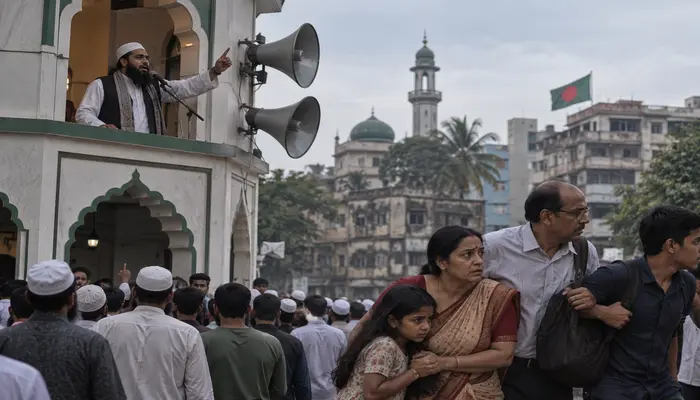
Case Summary
Hindu residents in Dhaka, Bangladesh, were threatened with forced expulsion after a Muslim cleric from a local mosque used loudspeakers to call for Hindus to be driven out of the country. A video that went viral on Facebook showed the Muslim cleric addressing the public over a mosque audio system. In the video, the Muslim cleric declared, “Jitne Hindu yahan hain, unhe bhagao yahan se. Hum lakho Muslims hai, chalo bhagayein inhe.” (Drive out all the Hindus who are here. We are lakhs of Muslims, let us drive them out). The statement specifically targeted Hindus on the basis of their religious identity and called for their removal from the country. This incident is part of a broader pattern of persecution of Hindus in Bangladesh, which has unfolded in three distinct phases: first, following the ouster of Sheikh Hasina’s government in August 2024; second, after the death of Sharif Osman Bin Hadi in December 2025; and third, in the immediate aftermath of the 13th National Parliamentary Election in 2026. Following the ouster of Sheikh Hasina, multiple reports documented attacks on Hindu homes, temples, and religious institutions, alongside intimidation campaigns, arson, and mob assaults targeting minority neighbourhoods. The Hinduphobia tracker has recorded 336 such incidents against the Hindu minority, underscoring the scale and persistence of anti-Hindu violence during this period. A further escalation occurred following the death of Sharif Osman Bin Hadi, a Muslim political activist and student leader known for his anti-Hindu and anti-India rhetoric. Hadi had been involved in political unrest after the fall of the Hasina government and was killed in Dhaka on 18 December 2025 during clashes. In the aftermath of his death, Hindu communities were blamed and subsequently targeted in retaliatory violence. Hindu homes were selectively set ablaze in multiple localities, forcing families to flee and leaving many displaced. The attacks appeared patterned rather than sporadic, with Muslim mobs focusing on Hindu neighbourhoods, properties, and religious symbols. Among the victims was Dipu Chandra Das, who was lynched to death and his body was set ablaze by a Muslim mob over false blasphemy allegations. The Hinduphobia tracker documented 51 incidents of anti-Hindu violence in the period following Hadi’s death alone. Such incidents underscore the vulnerability of the Hindu minority amid rising communal hostility and the weaponisation of religious accusations. Reports further indicated that posters and written materials calling for the extermination of Hindus were displayed in public spaces, signalling an alarming normalisation of genocidal rhetoric. When combined with acts of arson, vandalism, assault, and targeted intimidation, these developments suggest a coordinated environment of hostility aimed at terrorising the Hindu community and reinforcing majoritarian dominance. The third phase of violence was unleashed after the 13th National Parliamentary Election 2026. Within days of the announcement of results, Hindu families in districts such as Noakhali, Rangpur, Nilphamari, Sylhet, Thakurgaon, and Dinajpur reported coordinated attacks involving arson, looting, assault, and vandalism of temples and homes. In several instances, Hindu homes were selectively targeted, looted, and families were threatened with displacement.
Why it is Hate Crime ?
The primary category selected in this case is: Hate Speech against Hindus. The subcategory selected is: Violent threats. Violent threats, explicit, implicit or implied, is the most dangerous form of hate speech since it goes beyond discriminatory and prejudicial language to express the intent of causing harm to an individual or a group of people based on their religious identity and faith. There could be several different kinds of threats that are issued to Hindus based on religious animosity. An explicit threat would mean the direct threat of violence towards an individual Hindu, a group of Hindus or Hindus at large. Physical violence, death threats, threats of destruction of property belonging to Hindus and threats of genocide would mean explicit threats against Hindus for their religious identity. Implicit threats may not be a direct threat but implied through the use of symbols of actions – for example – in the Nupur Sharma case, other than explicit threats, there were also implicit threats when Islamists took to the streets to burn and beat her effigies. It implies that they want to do the same to Nupur Sharma – thereby is considered an implicit threat. Violent threats can be delivered in person, through letters, phone calls, graffiti, or increasingly through social media and other online platforms. It would be important to understand that a threat – explicit or implicit, online or offline – to an individual who happens to be a Hindu does not qualify as a religiously motivated threat. Such a threat, while vile and dangerous, could be owing to non-religious reasons and/or personal animosity. To qualify as a religiously motivated threat, it would need to exhibit an indication that the individual is being targeted for religious reasons and/or owing to his/her religious identity as a Hindu. The incident constituted a religiously motivated hate crime because the Muslim cleric utilised a public platform to issue explicit threats of mass expulsion against the Hindu community. By specifically identifying Hindus based on their religion for forced removal, the accused demonstrated that the hostility was fundamentally rooted in religious animus rather than any personal dispute. The accused explicitly threatened the Hindu community by calling for its members to be driven out of the country solely on the basis of their religious identity. The broadcast established a direct and serious threat against the physical security and residency rights of the targeted Hindu minority. By urging the Muslim majority to mobilise and forcefully drive Hindus out, the accused went beyond prejudicial rhetoric and advocated collective harm and displacement against members of the Hindu community solely on the basis of their faith. The use of mosque loudspeakers amplified the severity of the threat, transforming an individual expression of prejudice into a public call for collective action. By invoking the numerical strength of the local Muslim population, the cleric sought to weaponise demographic dominance to intimidate and terrorise the area's Hindu residents. This public incitement created an atmosphere of fear and vulnerability for members of the targeted religious community. The conduct fit the specific category of violent threats because it explicitly advocated for the forceful uprooting of the victims because of their religious identity. The phrasing and method of delivery were designed to instil fear and encourage coordinated action against Hindus. This targeted hostility exemplified how an influential public platform was exploited to propagate systemic discrimination and intimidation against the vulnerable Hindu religious minority. The remarks also had to be viewed in the context of the wider persecution of Hindus in Bangladesh, particularly following the ouster of Sheikh Hasina’s government in August 2024. Multiple incidents involving attacks, intimidation and other forms of violence against Hindus were documented during this period. Against this background, a public call encouraging Muslims to target Hindus had the potential to reinforce hostility towards an already vulnerable religious minority and contribute to further acts of persecution. The demand for a “Hindu-free” Bangladesh also promoted the exclusion of Hindus from the country on account of their religion, rather than recognising them as an integral part of its religiously diverse population. The statement therefore reflected a form of religious hostility that sought to legitimise the marginalisation and removal of Hindus within a broader environment in which members of the community had faced targeted violence and intimidation. Overall, since this case met the parameters of a hate crime, it was added to the hate crime database of the Hinduphobia Tracker. Disclaimer: The Hinduphobia Tracker records incidents based on when an event occurred or when the victim's ordeal began. It is important to clarify that none of the media sources covering this case has specified the exact date when the Imam (cleric) made the speech. Therefore, for documentation purposes, we have recorded the date based on when the incident was reported in the media, 19 September 2026.


Case Status
Unknown


Perpetrators Details
Perpetrators
Muslim Extremists
Perpetrators Range
One Person
Perpetrators Gender
male
 Sources




