Hindu villagers lured and offered inducements for forced Christian conversion in Maharajganj, Uttar Pradesh
 Maharajganj, Uttar Pradesh, India
  16 September, 2026
Case Summary
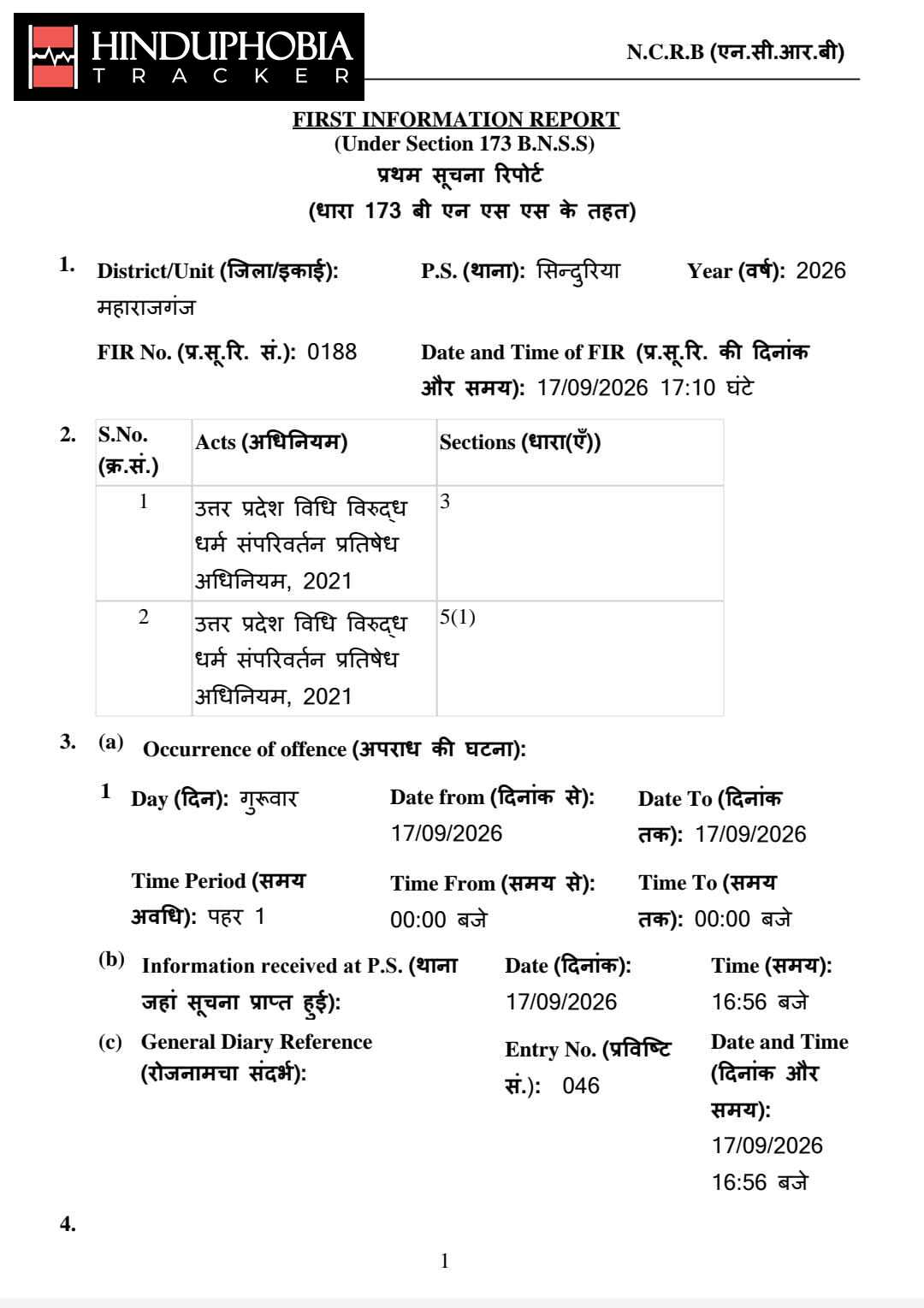
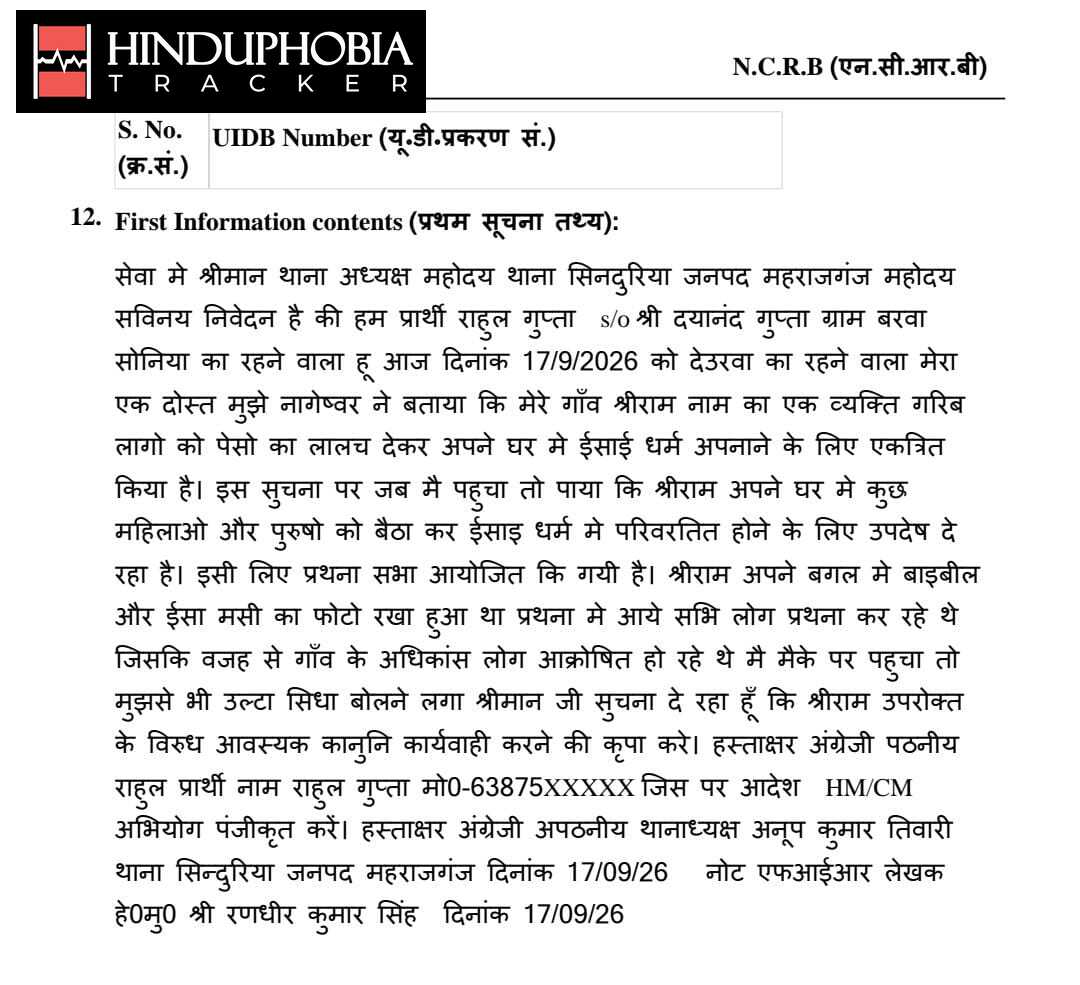
In the Deurwa village in Maharajganj district, Uttar Pradesh, Hindu villagers were lured under the guise of a prayer meeting and offered inducements for religious conversion by a Christian man named Shriram Prasad. According to the FIR filed by Rahul Gupta on 17 September 2026, Shriram had gathered several Hindu men and women at his residence and was conducting a prayer meeting where he preached Christianity and encouraged those present to adopt the faith. A Bible and a photograph of Jesus Christ had been placed beside him during the gathering, while the attendees were engaged in prayer. The FIR also stated that Shriram had lured poor people with money to convert to Christianity and pressured them to do so. Gupta further stated that when he reached the residence, Shriram spoke to him in an abusive manner. Based on the complaint, Sinduria Police registered Case No. 188/2026 under Sections 3/5(1) of the Uttar Pradesh Prohibition of Unlawful Conversion of Religion Act, 2021. The police recorded witness statements and collected evidence during the investigation before identifying Shriram Prasad, son of Bhimal, aged approximately 55, as the accused. He was subsequently arrested, and further legal proceedings were initiated.
Case Images
Why it is Hate Crime ?
This case has been added to the tracker under the primary category- Predatory Proselytisation. Within this, the subcategory selected is - Conversion/attempts to convert by inducements. Predatory Proselytisation is not just limited to threat, harassment, force and violence, but it also has contours of stealth. In several cases, the Hindu victim is exploited to convert, with non-Hindus taking advantage of their poverty. In such cases, the Hindu victim who is suffering financially is offered monetary benefits, including lucrative offers for jobs, health treatment, education, etc, to induce the victim into changing his/her religion. In such cases, the religious identity of the victim and the aim to disenfranchise him from his faith form the heart of the crime. Also, taking advantage of and exploiting an individual’s economic vulnerabilities is widely acknowledged as exploitation, forms of which are often penalised by law. Such cases, therefore, are considered religiously motivated hate crimes since the victim’s religious identity forms the very heart of the crime itself. The other sub-category selected here is - Harassment, threats, coercion for conversion. Harassment covers a wide range of behaviours of an offensive nature. It is commonly understood as behaviour that demeans, humiliates, and intimidates a person, including threats and coercion. Harassment and threats, in this case, find their root on discriminatory grounds which has the effect of nullifying a person’s rights or infringing upon his freedom to exercise his right specifically owing to the victim’s religious identity. Verbal and physical threats and psychological or physical harassment are often used against Hindu victims because they choose to practice their professed religion. Religious harassment also includes forced and involuntary conversions by harassment, threats or coercion. Coercion includes intimidatory tactics like force-feeding a Hindu victim beef to convert to another religion, forceful circumcision etc. In several cases documented, non-Hindu perpetrators or those who harbour specific animosity towards Hinduism, harass victims simply based on their religious identity. Such cases often also include harassment to ensure the Hindu victim abandons his/her professed religion and adopts the religion of the perpetrator. Such cases where Hindu victims are harassed to convert to the perpetrator’s religion are rooted in animosity towards the victim’s religious identity and are therefore documented as religiously motivated hate crimes. The case was included in the Hinduphobia Tracker because the conversion activity specifically targeted economically vulnerable people from the Hindu community and sought to influence their religious affiliation through financial inducement and pressure. The religious identity of those targeted was therefore central to the conduct, as the objective was not merely to conduct a Christian prayer meeting or propagate Christian beliefs, but to persuade Hindu villagers to abandon their existing faith and adopt Christianity. This made the incident materially different from an ordinary instance of religious preaching or voluntary participation in another faith's worship. Firstly, offering incentives or making false promises, especially when directed at vulnerable individuals in need, shows that these incentives are not acts of kindness or charity. Instead, they are calculated moves to exploit vulnerable Hindus because of religion. By providing inducements or promising healing in exchange for conversion, the accused were effectively blackmailing those who might have been desperate for assistance or hope. Such instances are seen in many cases where members of Christian missionary groups target socially and economically vulnerable Hindus to further their agenda of religious conversions. This form of coercion strips people of their agency and dignity and results in coerced conversions. These are not random or isolated incidents, but rather cases deeply rooted in religious animosity towards Hindu victims Secondly, what was presented as a simple prayer gathering inside a house was in reality a covert attempt at religious conversion. These were not genuine community prayers but calculated efforts to exploit the trust of Hindus and manipulate them into abandoning their faith. The Bible and image of Jesus placed during the gathering provided the religious context, but the significance from a hate-crime perspective lay in the objective of using that setting to influence the religious identity of Hindu villagers. The activity therefore directly engaged with their existing Hindu identity by seeking its replacement with another religious affiliation. By conducting such gatherings, the accused sought to manipulate ulnerable Hindus, taking advantage of their emotional and social circumstances to push them towards conversion Thirdly, the pressure to convert was significant because religious conversion ordinarily concerns an individual's deeply held beliefs and identity. Attempts to secure such a change through inducement and pressure interfere with the person's religious autonomy and ability to retain their existing faith. The combination of financial inducement, Christian preaching and pressure towards conversion therefore indicated that the targeted individuals were being approached not simply as members of the general public, but as people whose existing religious affiliation was the intended subject of change. Taken together, the targeting of economically vulnerable Hindu villagers, the use of money as an inducement, and the pressure to adopt Christianity demonstrated a pattern of predatory proselytisation directed at their religious identity. The conduct sought to exploit vulnerability to facilitate the abandonment of Hinduism rather than allowing religious choice to arise solely from free and informed conviction. On this basis, the incident was included in the Hinduphobia Tracker as a religiously motivated hate crime involving conversion by inducement and pressure.


Case Status
Arrested


Perpetrators Details
Perpetrators
Christian Extremists
Perpetrators Range
One Person
Perpetrators Gender
male
 Sources




