Hindu businessman threatened with being burned alive in Bangladesh; Muslim politician invoked Hindu religious chant during murder threat
 Patuakhali District, Bangladesh
  17 September, 2026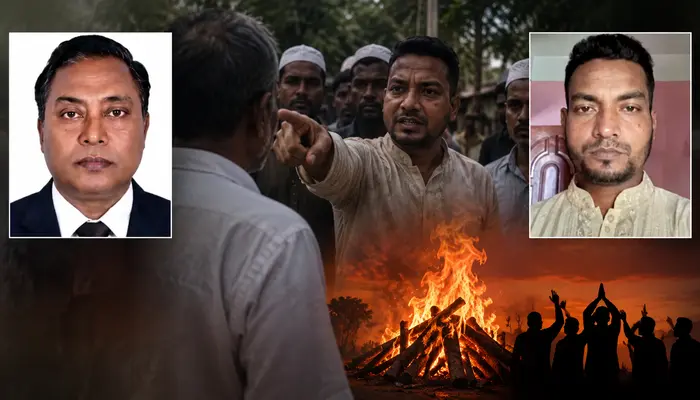
Case Summary
In the Bauphal area of Patuakhali district, Bangladesh, Hindu businessman Gobinda Chandra Mandal, who was contesting the local Union Parishad election, was threatened with being burned alive by Muslim politician Farid Uddin Gazi, leader of the opposition Bangladesh Nationalist Party (BNP), who declared his wish to imitate a Hindu funeral procession by having bystanders chant 'Hari Bol' during the murder. The victim, Gobinda Chandra Mandal, was targeted by Farid Uddin Gazi after announcing his candidacy for the then upcoming Bauphal Sadar Union Parishad elections. Mandal, a real estate businessman and resident of Bilbilas village, served as a representative of the local Hindu community. After he announced his candidacy and displayed campaign banners and festoons across the locality, Gazi subjected him to continuous death threats. Gazi also demanded Tk 50 lakh from Mandal, pressuring him to withdraw his candidacy from the election. In a leaked 1-minute-and-57-second phone conversation, Gazi Gazi addressed the businessman in a provocative manner as 'Dadu'. Gazi stated that in Hinduism, people are cremated after death, but his desire was to burn Mandal alive. Gazi confirmed that he had specifically chosen the Hindu businessman for this purpose and declared his wish for bystanders to chant 'Hari Bol' during the act, directly mocking sacred Hindu funeral rites. Confronting extreme insecurity, Mandal approached the Bauphal Police Station and registered a General Diary (GD) seeking protection. Following widespread outrage over the circulating audio recording, police arrested Gazi in connection with a separate cheque fraud case. The Officer-in-Charge of the Bauphal Police Station, Sirajul Islam, assured that necessary legal action would be taken regarding the death threats against the Hindu businessman, while local and district units of the BNP pledged organisational action against the accused. This escalation of violence against Hindus in Bangladesh has unfolded in three distinct phases: first, following the ouster of Sheikh Hasina’s government in August 2024; second, after the death of Sharif Osman Bin Hadi in December 2025; and third, in the immediate aftermath of the 13th National Parliamentary Election 2026. Following the ouster of Sheikh Hasina, multiple reports documented attacks on Hindu homes, temples, and religious institutions, alongside intimidation campaigns, arson, and mob assaults targeting minority neighbourhoods. The Hinduphobia Tracker has recorded 336 such incidents against the Hindu minority, underscoring the scale and persistence of anti-Hindu violence during this period. A further escalation occurred following the death of Sharif Osman Bin Hadi, a Muslim political activist and student leader known for his anti-Hindu and anti-India rhetoric. Hadi had been involved in political unrest after the fall of the Hasina government and was killed in Dhaka on 18th December 2025 during clashes. In the aftermath of his death, Hindu communities were blamed and subsequently targeted in retaliatory violence. Hindu homes were selectively set ablaze in multiple localities, forcing families to flee and leaving many displaced. The attacks appeared patterned rather than sporadic, with Muslim mobs focusing on Hindu neighbourhoods, properties, and religious symbols. Among the victims was Dipu Chandra Das, who was lynched to death and his body was set ablaze by a Muslim mob over false blasphemy allegations. The Hinduphobia Tracker documented 51 incidents of anti-Hindu violence in the period following Hadi’s death alone. Such incidents underscored the vulnerability of the Hindu minority amid rising communal hostility and the weaponisation of religious accusations. Reports further indicated that posters and written materials calling for the extermination of Hindus were displayed in public spaces, signalling an alarming normalisation of genocidal rhetoric. When combined with acts of arson, vandalism, assault, and targeted intimidation, these developments suggested a coordinated environment of hostility aimed at terrorising the Hindu community and reinforcing majoritarian dominance. The third phase of violence was unleashed after the 13th National Parliamentary Election 2026. Within days of the announcement of results, Hindu families in districts such as Noakhali, Rangpur, Nilphamari, Sylhet, Thakurgaon, and Dinajpur reported coordinated attacks involving arson, looting, assault, and vandalism of temples and homes. In several instances, Hindu homes were selectively targeted, looted, and families were threatened with displacement.
Why it is Hate Crime ?
This case is added to the tracker under the primary category – Hate speech against Hindu. Within it, the sub-category selected is - Violent threats. Violent threats, explicit, implicit or implied, is the most dangerous form of hate speech since it goes beyond discriminatory and prejudicial language to express the intent of causing harm to an individual or a group of people based on their religious identity and faith. There could be several different kinds of threats that are issued to Hindus based on religious animosity. An explicit threat would mean the direct threat of violence towards an individual Hindu, a group of Hindus or Hindus at large. Physical violence, death threats, threats of destruction of property belonging to Hindus and threats of genocide would mean explicit threats against Hindus for their religious identity. Implicit threats may not be a direct threat but implied through the use of symbols of actions – for example – in the Nupur Sharma case, other than explicit threats, there were also implicit threats when Islamists took to the streets to burn and beat her effigies. It implies that they want to do the same to Nupur Sharma – thereby is considered an implicit threat. Violent threats can be delivered in person, through letters, phone calls, graffiti, or increasingly through social media and other online platforms. It would be important to understand that a threat – explicit or implicit, online or offline – to an individual who happens to be a Hindu does not qualify as a religiously motivated threat. Such a threat, while vile and dangerous, could be owing to non-religious reasons and/or personal animosity. To qualify as a religiously motivated threat, it would need to exhibit an indication that the individual is being targeted for religious reasons and/or owing to his/her religious identity as a Hindu. The other sub-category selected here is - Anti-Hindu slurs, mocking faith. Anti-Hindu slurs and the deliberate mocking of the Hindu faith owing to religious animosity involve the usage of derogatory terms, stereotypes, or offensive references to religious practices, symbols, or figures. One of the common anti-Hindu slurs used against Hindus is “cow-worshipper” and “cow piss drinker”. The intention of using this term is to demean and mock Hindus as a group and their religious beliefs since Hindus consider the cow holy. Additionally, some symbols and the slurs attached to them have a historical context that exacerbates the insult, hate, stereotyping, dehumanisation and oppression against Hindus. Cow worship has been used for centuries to denigrate Hindus, insult their faith and oppress Hindus specifically as a religious group. There has been overwhelming documentation about how cow slaughter has been used to persecute Hindus with cow meat being thrown in temples and places of worship. There has also been overwhelming documentation where cow meat (beef) has been force-fed to Hindus to either forcefully convert them to Islam or denigrate their faith. Apart from cow worship, the Swastika – which holds deep religious significance for the Hindus – has also been misinterpreted and distorted to use as a slur against Hindus. Similarly, the worship of the Shivling has been used by supremacist ideologies and religions to denigrate Hindus owing to religious animosity. Such slurs and denigration stem out of inherent animosity and hate towards Hindus and their faith, therefore, it is categorised as hate speech targeted at Hindus specifically owing to their religious identity. The incident qualified as a religiously motivated hate crime because the perpetrator explicitly singled out the victim owing to his Hindu faith and deliberately incorporated his religious identity into a threat of lethal violence. By contrasting the traditional Hindu practice of cremating the dead with his stated desire to burn the victim alive, the perpetrator directly linked the threatened method of killing to a defining religious practice of the victim. The reference to cremation was therefore not incidental to the threat, but formed part of the way in which the perpetrator described the violence he intended to inflict upon a Hindu victim. In doing so, he weaponised an important Hindu funerary practice against the victim and used his religious identity to personalise and intensify the threat. The deliberate invocation of Hindu religious rites demonstrated that the hostility extended beyond the victim as an election candidate or individual and was directed at him as a Hindu, making his religious identity an explicit element of the threatened violence. In this case one could argue that the dispute and threats were political in nature. If the dispute had been solely political or electoral, there would have been no apparent reason for the perpetrator to invoke the victim’s Hindu religious practices while threatening him with death. Instead, the accused deliberately brought the victim’s faith into the threat, weaponising a defining aspect of his religious identity in order to intimidate and terrorise him. This explicit religious framing demonstrated that the hostility could not be reduced to disagreement over the victim’s political participation. The perpetrator further exhibited anti-Hindu hostility by mocking and weaponising sacred Hindu traditions in the context of the threatened murder. His declaration that he wanted bystanders to chant “Hari Bol” while the victim was burned was particularly significant because “Hari Bol” was a Hindu devotional expression associated with the worship of Hari, and was also used in Hindu funeral contexts. Rather than merely mentioning the victim’s religion, the perpetrator incorporated a Hindu religious chant into his description of the proposed killing. This turned an expression of Hindu devotion into an element of psychological intimidation and humiliation directed at a Hindu victim for his religious identity. The reference was especially significant because it accompanied a threat to burn the victim alive, creating a deliberate association between the victim’s religious traditions and the violence being threatened against him. The conduct therefore amounted to more than a generic threat of death: it used recognisably Hindu religious practices to convey, personalise and intensify the threat against the victim. Given the prevailing anti-Hindu persecution environment in Bangladesh, the vulnerability of Hindu minorities in local political processes, and the broader pattern of intimidation against community figures, this case meets the threshold for inclusion in the Hinduphobia Tracker’s hate crime database. Disclaimer: The Hinduphobia Tracker records crimes based on when the victim’s ordeal begins rather than when they are reported by the media. In this case, the available sources do not specify when the victims announced his election candidacy or since when he is receiving threats. Hence, 18 September 2026 has been selected as the indicative incident date. This is documented for record-keeping purposes only.
Victim Details
Total Victim
1
Deceased
0
Gender
- Male 1
- Female 0
- Third Gender 0
- Unknown 0
Caste
- SC/ST 0
- OBC 0
- General 0
- Unknown 1
Age Group
- Minor 0
- Adult 1
- Senior Citizen 0
- Unknown 0


Case Status
Complaint registered


Perpetrators Details
Perpetrators
Muslim Extremists
Perpetrators Range
One Person
Perpetrators Gender
male
 Sources




