Hindu villagers targeted for Christian conversion through miraculous healing and rejection of Hindu deities
 Saran, Bihar, India
  12 September, 2025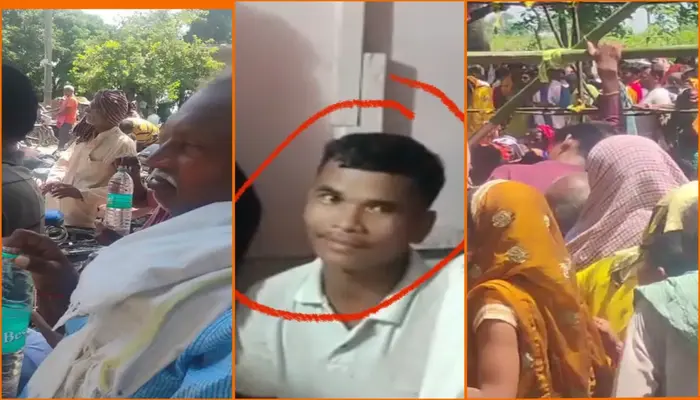
Case Summary
In the Saran district of Bihar, Hindu villagers were brainwashed for religious conversion under the guise of miraculous healing by a Christian pastor, Vikas Choudhary. Rashtra Jyoti, a media channel, did a ground report in which it was revealed that the Christian pastor identified as Vikas Choudhary, also known locally as “Paniwale Baba”, had been conducting large religious gatherings near Laher Chapra village in Saran district with the aim of religious conversion. In these meetings, Hindu villagers were told to bring bottles of water that would be blessed in the name of Jesus and could cure serious illnesses. According to the report, the weekly gatherings, held on Thursdays in open fields with tents and sound systems, had attracted more than 5,000 people, primarily from poor, Dalit and backward-caste communities. Choudhary, who introduced himself as being from Nepal, stated during an interview with a local journalist that he could infuse water with healing properties by invoking Jesus and that the water could treat diseases such as cancer, kidney failure and gallstones within three months. During the gatherings, he prayed over bottles brought by Hindu villagers and instructed them to consume the water for healing, while monetary offerings were also sought as part of the ritual. Residents interviewed by Rashtra Jyoti, including farmer Harendra Rai and Om Prakash Kumar, said that their family members had consumed the so-called blessed water after paying money, but their health conditions had not improved. The report further stated that the activities had been linked by local media to a Christian proselytisation network and that the gatherings were being used to attract vulnerable families by associating healing with the name of Jesus. Hindu villagers also revealed that people who experienced perceived improvement in their health were subsequently encouraged to attend separate prayer sessions, where they were urged to stop worshipping deities other than Jesus. The healing sessions were accompanied by religious messaging that encouraged Hindu participants to distance themselves from their existing religious practices and convert to Christianity. Rashtra Jyoti subsequently submitted complaints to the Bihar Police, Saran Police and the Saran District Magistrate and raised the matter with the National Human Rights Commission, citing concerns that residents were being diverted from proper medical treatment. Following the complaints, Saran Police shut down the operation.
Why it is Hate Crime ?
This case has been added to the tracker under the primary category- Predatory Proselytisation. Within this, the subcategory selected is - Conversion/attempts to convert by inducements. Predatory Proselytisation is not just limited to threat, harassment, force and violence, but it also has contours of stealth. In several cases, the Hindu victim is exploited to convert, with non-Hindus taking advantage of their poverty. In such cases, the Hindu victim who is suffering financially is offered monetary benefits, including lucrative offers for jobs, health treatment, education, etc, to induce the victim into changing his/her religion. In such cases, the religious identity of the victim and the aim to disenfranchise him from his faith form the heart of the crime. Also, taking advantage of and exploiting an individual’s economic vulnerabilities is widely acknowledged as exploitation, forms of which are often penalised by law. Such cases, therefore, are considered religiously motivated hate crimes since the victim’s religious identity forms the very heart of the crime itself. The other sub-category selected here is - Attempting to convert/converting by denigrating Hinduism. In several cases, Hindus are converted or an attempt is made to convert Hindus by denigrating their faith, Hinduism. In such cases, the Hindus associate with the non-Hindu perpetrators often by choice and then, the attempt to convert them by insulting their faith, showing the faith down etc begins. An example of this would be a non-Hindu gathering where the Hindus are attending the gathering of their own free will. However, once they attend the gathering, there is an explicit attempt to convert them by abusing their faith and hailing the faith of the perpetrator. The denigration of the Hindu faith is often based on misrepresentation of the Hindu faith, its doctrine and scriptures and insult to espoused traditions if not blatant lies about Hindu beliefs and ways. Such conversions or attempts at conversions are driven by animosity towards the Hindu faith and are therefore documented as religiously motivated hate crimes. The other sub-category selected here is - Proselytisation by grooming, brainwashing, manipulation or subtle indoctrination, with the tertiary category being - Pattern of targeting Hindus. Religious brainwashing essentially means the often subtle and forcible indoctrination to induce someone to give up their religious beliefs to accept contrasting regimented ideas. Religious grooming or brainwashing also involves propaganda and manipulation. It involves the systematic effort, driven by religious malice and indoctrination, to persuade “non-believers’ to accept allegiance, command, or doctrine to and of a contrasting faith. Cases of such grooming or brainwashing are far more nuanced than direct threats, coercion, inducement and violence. In such cases, it is often seen that there is repeated, subtle and continual manipulation of the victim to induce disaffection towards their own faith and acceptance of the contrasting faith of the perpetrator. While subtle indoctrination is widely acknowledged as predatory, an element which is often understated in such conversions or the attempts of such conversion is the role of loyalty and trust which might develop between the perpetrator and the victim. Fiduciary relationships are often abused to affect such religious conversion. For example, an educator transmitting religious doctrine of a competing faith to a Hindu student. The Hindu student is likely to accept what the teacher is transmitting owing to existence of the fiduciary relationship. The exploitation of the fiduciary relationship to religiously indoctrinate victims would also be included in this category. Since the underlying animosity towards the victim’s faith forms the basis of predatory proselytization, such cases are considered religiously motivated hate crimes. This case was a clear example of a religiously driven hate crime because vulnerable members of the Hindu community were targeted through organised Christian proselytisation carried out under the guise of faith healing. The gatherings expanded from small meetings into large weekly events attended by at around 5,000 people, demonstrating that the practice had developed into an organised mechanism for drawing vulnerable people into a Christian religious environment. Firstly, the use of purported healing as a pathway to religious influence was relevant not merely because the healing itself was questionable, but because it provided a mechanism for establishing religious dependence. Using a person's illness, fear and hope of recovery as the means through which they were brought into a Christian religious setting exploited their vulnerability and interfered with their ability to make a completely free and independent religious choice. The religious activity was tied to a situation in which vulnerable persons were being influenced at a particularly susceptible point in their lives. When relief from illness was associated with a particular religious figure, ritual and deity, participation could gradually become linked with acceptance of the underlying religious message. The subsequent reported instruction to reject the worship of other deities showed that the objective was not confined to providing spiritual comfort or prayer. It involved changing the individual's relationship with their existing faith. Where such methods were directed at Hindus, they interfered with their ability to make an unpressured decision concerning their religious identity. The Changai Sabha format, often described publicly as a faith healing gathering, is a well-recognised tool in organised Christian proselytisation networks. These meetings usually employ songs, testimonies and emotionally charged prayer sessions to influence and induce vulnerable individuals without openly declaring the underlying objective. The absence of transparency is itself central to the method. People attend believing they are seeking comfort, healing or spiritual support, only to be gradually drawn into teachings that undermine their own religious identity and introduce them to the Christian framework presented as the only path to relief. Secondly, the instruction that participants should stop worshipping deities other than Jesus was particularly significant from an anti-Hindu perspective. Hindu deities were not peripheral cultural figures but objects of religious reverence and worship, and encouraging Hindus to abandon their worship directly undermined an essential element of their religious practice. Such messaging effectively presented continued adherence to Hindu worship as something that had to be discarded in order to embrace the promoted faith. This constituted a form of denigration of Hindu religious belief and practice, because it sought to devalue or displace practices that were central to the targeted community's religious identity rather than merely presenting Christianity as an alternative. Such remarks are designed to demean and undermine the faith of Hindus and intend to create an inferiority complex in the minds of the victims against their own faith. This fosters an environment of hostility and disrespect towards the Hindu community and Hindu deities. These acts of insulting Hinduism stem from Christian theology, which harbours disdain and hatred for polytheistic faiths, and which categorises Hindus as ‘polytheists’, thereby fostering hatred against them. Such actions make the religiously motivated nature of the crime even more evident. The nature of the conversion efforts and the wider impact on the Hindu community all indicate a targeted action against Hindus as a collectivity. When individuals or groups focus their efforts on converting members of a particular religion, in this case, Hindus, then it demonstrates a fundamental disregard for the Hindu faith. Conversion, especially when not based on personal conviction but rather on external persuasion or pressure, is not simply about sharing a different belief system. It is an attempt to undermine the values, traditions, and identity of the Hindu community. In this context, the Christian perpetrators specifically targeted Hindus, which demonstrates a lack of respect for Hinduism and its followers. The Christian faith, by its very theological foundations, places a strong emphasis on proselytisation. In pursuit of conversion objectives, Christian evangelists often employ unethical means, ranging from psychological pressure and misinformation to inducements such as money or jobs. These tactics are designed not as acts of charity but as tools to engineer religious change under the guise of social upliftment, particularly among vulnerable and underprivileged communities. This systematic attempt to erode the religious foundation of individuals and replace it with allegiance to another faith reflects deep religious malice and animus against the Hindu identity. Because the core motivation of the act stems from hostility toward the victim’s religion, it meets the threshold of a hate crime. Hence, categorised as a hate crime in the database. Disclaimer: The Hinduphobia Tracker records incidents based on when an event occurred or when the victim's ordeal began. It is important to clarify that none of the media sources covering this case has specified the exact date when the conversion activities began. Therefore, for documentation purposes, we have recorded the date based on when the incident was reported in the media, 13 September 2025.
Victim Details
Total Victim
5000
Deceased
0
Gender
- Male 0
- Female 0
- Third Gender 0
- Unknown 5000
Caste
- SC/ST 0
- OBC 0
- General 0
- Unknown 5000
Age Group
- Minor 0
- Adult 0
- Senior Citizen 0
- Unknown 5000


Case Status
Complaint filed


Perpetrators Details
Perpetrators
Christian Extremists
Perpetrators Range
One Person
Perpetrators Gender
male
 Sources




