Ganesh Chaturthi pandal vandalised, sacred idol of Lord Ganesha desecrated in Jodhpur, Rajasthan
 Jodhpur, Rajasthan, India
  15 September, 2026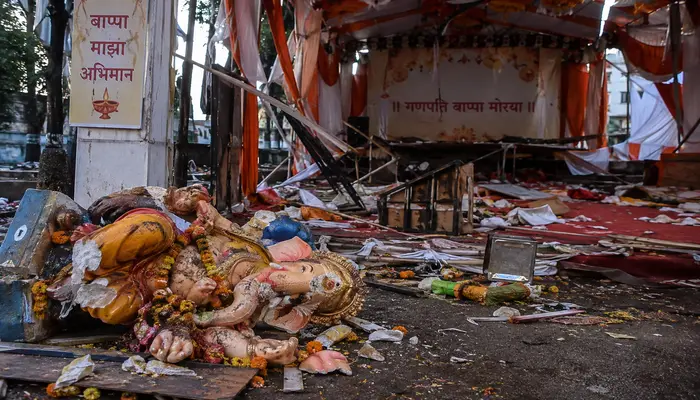
Case Summary
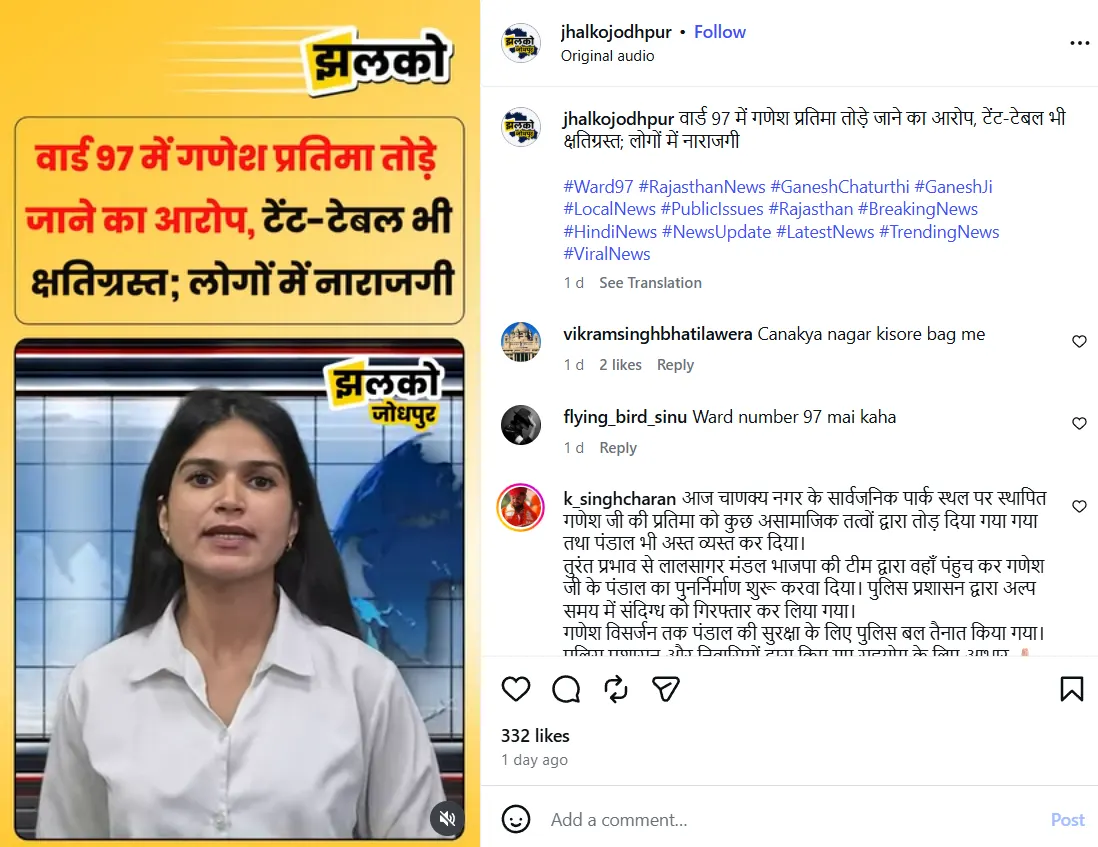
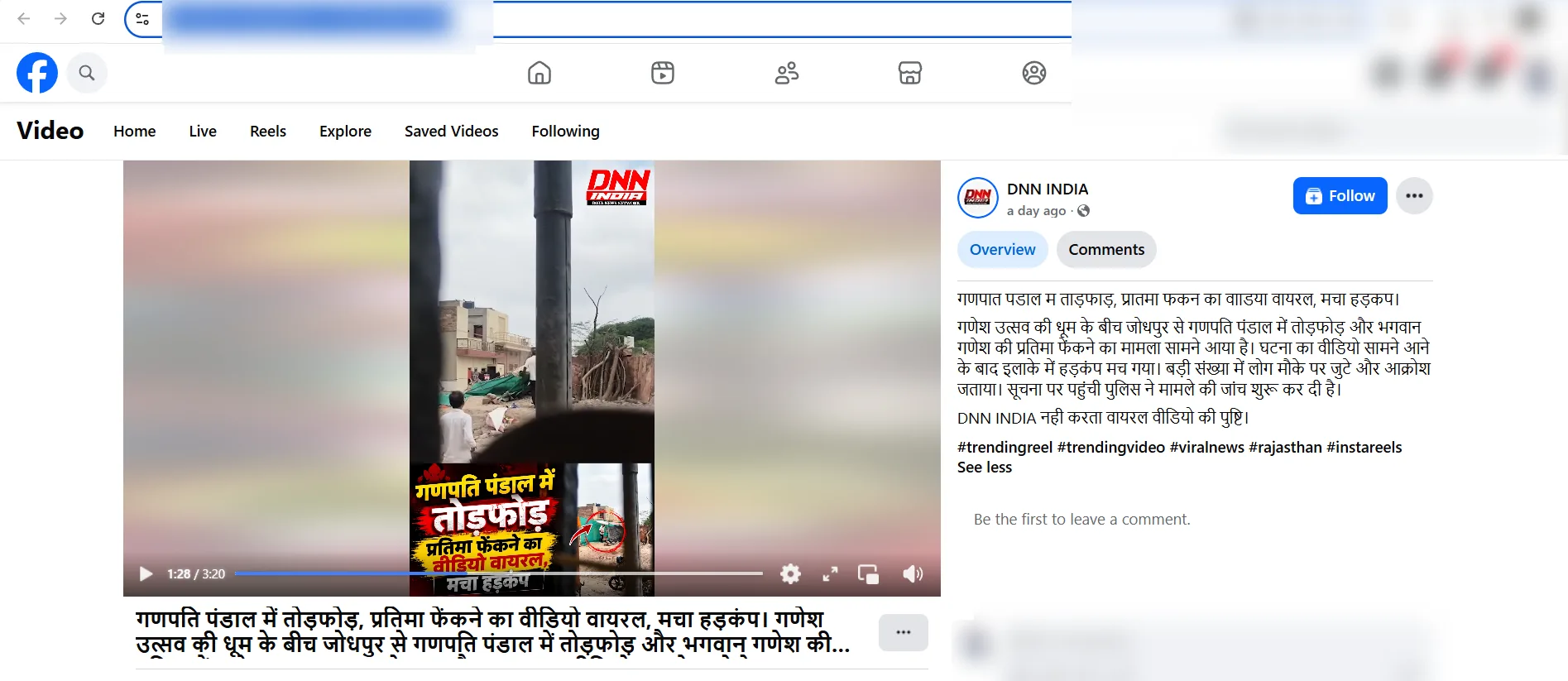
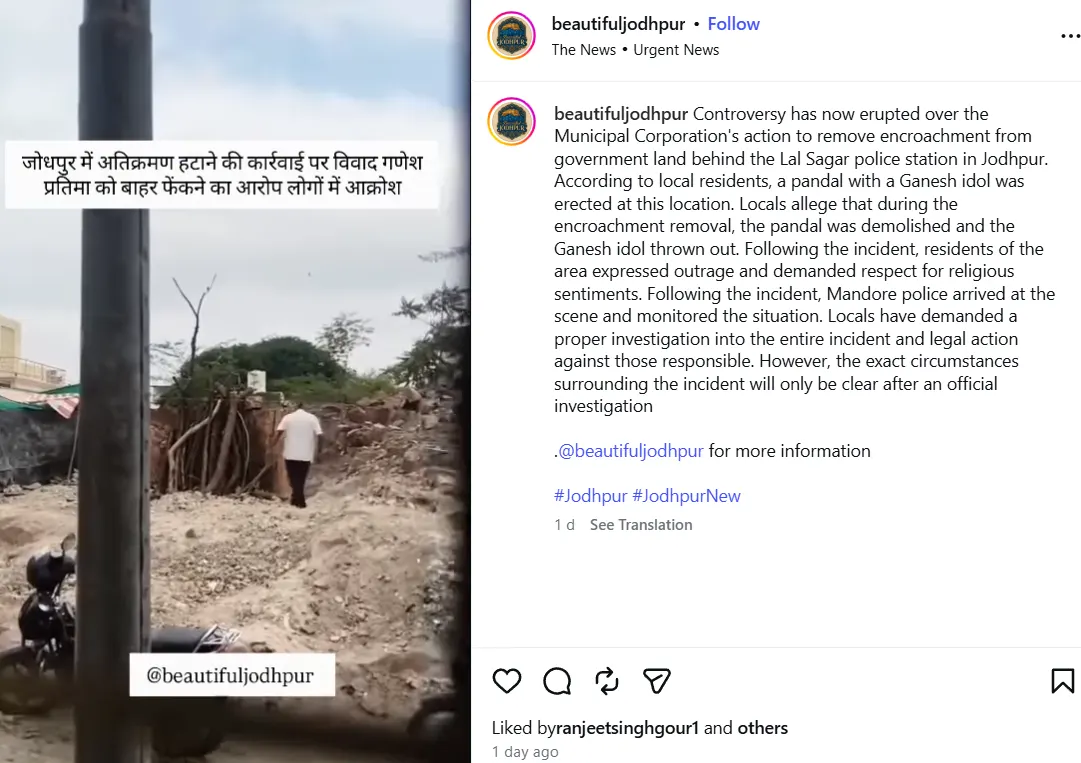
In Rajasthan's Jodhpur, a pandal erected for Ganesh Chaturthi celebrations was vandalised, and the idol of Lord Ganesha installed inside it was desecrated by an unidentified man. The incident took place in Ward No. 97, in a government park located directly behind the Lal Sagar police station and under its jurisdiction. Local Hindu residents had erected the pandal at the site and installed an idol of Lord Ganesha along with other religious materials for Ganesh Chaturthi celebrations. The vandalism came to light after a video of the incident went viral on 16th September 2026. The video showed a man tearing down the pandal, uprooting its tent-like structure and throwing away the religious materials kept inside. He then removed the idol of Lord Ganesha and threw it away. One or two other men were also seen standing nearby and watching the vandalism. As news of the incident spread, local Hindu residents expressed outrage and strongly opposed the desecration. They stated that vandalising a pandal erected for a Hindu festival and throwing away the idol of Lord Ganesha had hurt their religious sentiments and violated the sanctity of their religious observance. The Hindu residents demanded action against those responsible and called for an impartial investigation into the incident. They sought the identification of the perpetrator and strict legal action against those responsible for desecrating the religious installation. Notably, some social media accounts also claimed that the vandalism had been carried out by municipal corporation workers under the pretext of removing encroachments from the government park. However, the Hinduphobia Tracker could not independently verify this claim at the time of writing, and it remained unverified. At the time of writing, the police had initiated an investigation into the incident. The investigation was underway, and no further details were available in the public domain.
Case Images
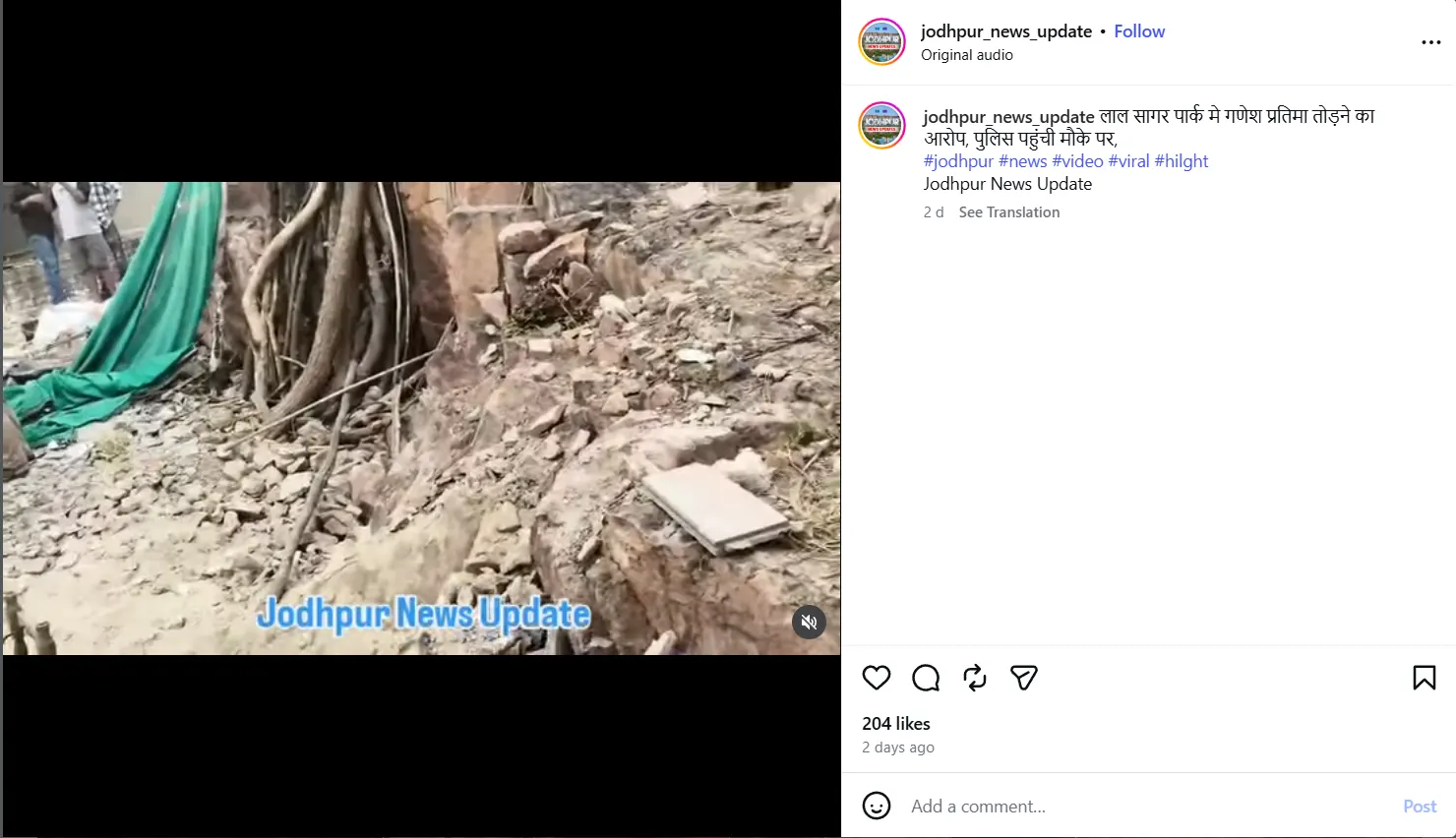
Why it is Hate Crime ?
This case has been added to the tracker under the primary category: Attack on Hindu religious representations. The subcategory selected is: Violence against religious structures or centres. In Hinduism, a religious structure is also considered divine. Hindus believe that not just the Deity but the religious structure itself is sacred. In this sub-category, we would document attacks against religious structures which are not consecrated temple spaces. Such religious spaces could be temporary in nature – for example – the religious spaces erected specifically for festivals like Durga Puja etc. This category would also document cases of attacks against religious centres. These spaces in their own right may not be ‘sacred’ per se, however, are often spaces where religious gurus live, religious teaching is imparted, or belong to religious institutions. Any attack against religious structures is a result of animosity towards the religion itself, which manifests itself through the religious spaces and therefore, such attacks are considered religiously motivated hate crimes. Religious centres are also manifestations of the religion, its teachings or gurus and therefore, attacks against such centres would be considered religiously motivated hate crimes. The other subcategory selected is: Desecration of Hindu religious symbol. Icons and symbols or a religious representation of a spiritual ideal are widely revered in Hinduism. Iconography is of vital significance in the Hindu milieu. It helps connect people’s spiritual beliefs with the real world. Iconography within the Hindu faith takes several shapes and forms. Murtis are of most significance to Hindus, to which daily rituals, prayers and offerings are done. Besides the murtis, there are several other symbols which have deep significance in the Hindu faith – the Om and Swastika for example. Since these Hindu religious symbols hold paramount importance in Hinduism, any desecration of symbols, icons, murtis, religious representations and manifestations, is driven by animosity towards the faith itself which manifests itself through these murtis, icons and symbols. Therefore, any desecration of these Hindu religious symbols and representations is considered religiously motivated hate crimes under this category. This case is a clear example of a religiously driven hate crime because a sacred idol of Lord Ganesha was desecrated and a pandal erected for Ganesh Chaturthi was vandalised by the perpetrator. The deliberate destruction of the religious installation and the disrespectful removal of the idol constituted an attack on sacred Hindu religious representations. To understand the nature of the violation, it is important to understand the religious significance of Ganesh Chaturthi, Hindu idols and the pandal in which the idol was installed. Ganesh Chaturthi is a major Hindu festival dedicated to the worship of Lord Ganesha, the revered deity associated with wisdom, auspiciousness and the removal of obstacles. During the festival, devotees install an idol of Lord Ganesha and worship the deity through prayers, rituals, offerings and other religious observances. The idol is not treated as an ordinary object but as a sacred representation of the deity and becomes the focal point of worship and devotion during the festival. A Ganesh Chaturthi pandal is similarly not merely a temporary tent or public structure; it is a space specifically established by devotees for the installation and worship of Lord Ganesha and for conducting religious rituals and celebrations. Such pandals therefore hold religious significance for the Hindu community as temporary places of worship and collective religious observance. Therefore, the deliberate destruction of the Ganesh Chaturthi pandal and the forcible removal and disrespectful disposal of Lord Ganesha’s idol amounted to a direct desecration of sacred Hindu religious representations. The perpetrator did not merely damage a temporary structure; he destroyed a space established specifically for Hindu worship and then treated the revered idol of the deity with blatant disregard by throwing it away. Such conduct directly violated the sanctity of Hindu religious worship, insulted a sacred representation of Lord Ganesha, and caused deep hurt to the religious sentiments of Hindu devotees. The deliberate targeting and desecration of these sacred symbols demonstrated clear disdain towards Hinduism and the Hindu community. Some social media accounts claimed that the vandalism had been carried out by municipal corporation workers under the pretext of removing an encroachment from government land. However, the mere installation of a temporary pandal for Ganesh Chaturthi celebrations could not, in itself, be equated with a permanent encroachment. Such pandals are erected for a limited period during the festival and are intended to remain in place only for the duration of the religious celebrations, after which they are ordinarily dismantled. The structure in question was therefore temporary and had been established specifically to facilitate Hindu religious worship during Ganesh Chaturthi. Treating the destruction and desecration of such a temporary religious installation as an ordinary encroachment-removal exercise failed to account for its religious nature and the manner in which it was dismantled. Some might argue that the removal could still be justified as action against an encroachment, particularly since religious structures of non-Hindu faiths such as mosques and churches have, in some instances, been removed or demolished when found to have been constructed on government land in violation of applicable rules. However, the circumstances in this case were materially different. Permanent structures erected on government land constitute a different category of encroachment, and their removal ordinarily involves administrative and legal procedures, including notices and directions to the occupants before enforcement action is taken. In this case, the installation was a temporary pandal erected for a Hindu festival, rather than a permanent religious structure occupying government land. There was also no indication at the time of documentation that the Hindu devotees had been served with a prior notice directing them to remove the structure. The comparison with the removal of permanent religious structures therefore did not justify the manner in which the Ganesh Chaturthi pandal and idol were desecrated. Even if the structure were to be considered an encroachment, the matter could have been handled through a lawful and proportionate process. If government or municipal officials had determined that the pandal could not remain at the location, they should have issued a notice and directed the organisers to remove the temporary structure themselves. Instead, the entire pandal was forcefully dismantled, religious materials were thrown away, and the idol of Lord Ganesha was removed and discarded in a deeply disrespectful manner. The severity and manner of the destruction therefore went beyond what would ordinarily be necessary to address a temporary encroachment and demonstrated disregard for the religious nature of the installation. The encroachment argument consequently appeared to function merely as a pretext to justify the desecration and destruction of sacred Hindu religious representations, rather than adequately explaining the manner in which the idol and pandal were treated. The incident thus demonstrated hostility towards the presence of a Hindu religious installation and the celebration of Ganesh Chaturthi. Overall, although the identity of the perpetrator had not been independently verified at the time of documentation, the nature and manner of the act demonstrated hostility towards Hinduism, Hindu religious representations and the Ganesh Chaturthi festival. Therefore, the case was added to the hate crime database of the Hinduphobia Tracker. Disclaimer: The Hinduphobia Tracker records incident dates based on when the crime occurred, rather than when the incident was reported by the media. However, in this case, the media reports did not specify the exact date on which the vandalism occurred. The only clearly established date was 16 September 2026, when the video of the incident went viral, and the earliest media report was also published on the same date. Therefore, 16 September 2026 has been taken as the indicative incident date for documentation purposes only. In this case, some social media accounts claimed that the vandalism was carried out by municipal corporation workers. However, the Hinduphobia Tracker could not independently verify this information, and none of the available media reports explicitly identified the perpetrator as a municipal corporation worker. Therefore, the perpetrator's identity has been recorded as 'Unknown'. If further information emerges establishing his identity, the case will be updated accordingly.


Case Status
Unknown


Perpetrators Details
Perpetrators
Unknown
Perpetrators Range
One Person
Perpetrators Gender
male
 Sources




