Hindu devotees threatened with bomb blasts and death by Muslim youths for taking out religious procession through a mosque area in Srivilliputhur, Tamil Nadu
 Srivilliputhur, Tamil Nadu, India
  15 September, 2026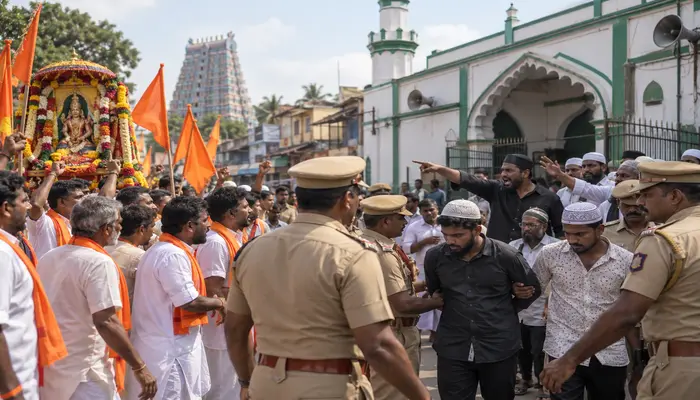
Case Summary
In Srivilliputhur, Tamil Nadu, Muslim youths threatened Hindu devotees with bomb blasts and death for taking out a Hindu Munnani religious procession through a mosque area. On 16 September 2026, Hindu devotees participated in a procession that passed through a mosque area. The participants refrained from beating drums and were only chanting the slogan "Bharat Mata ki Jai". As the procession moved forward, charged Muslim youths emerged from inside the mosque and confronted the Hindu devotees. The youths aggressively objected to the procession and the chanting of "Bharat Mata ki Jai", issuing violent threats that they would throw bombs and kill all the participants if the chanting did not stop. Police personnel, who were deployed to provide protection to the procession, intervened and detained two of the youths to pacify the Hindu community and calm the tense situation. However, after detaining them for only a few hours, the authorities released the individuals without registering a First Information Report (FIR) or pressing any charges. Following the severe threats and the subsequent police inaction, Hindu leaders expressed deep concerns over the safety of the devotees. They demanded enhanced security measures, including the installation of metal detectors, mandatory frisking, and closed-circuit television (CCTV) cameras at the nearby world-famous Srivilliputhur Andal Temple, alongside a joint investigation by the state police and the National Investigation Agency (NIA)
Why it is Hate Crime ?
The Primary category relevant to this case is: Hate speech against Hindus. The subcategory is: Violent threats. Violent threats, explicit, implicit or implied, is the most dangerous form of hate speech since it goes beyond discriminatory and prejudicial language to express the intent of causing harm to an individual or a group of people based on their religious identity and faith. There could be several different kinds of threats that are issued to Hindus based on religious animosity. An explicit threat would mean the direct threat of violence towards an individual Hindu, a group of Hindus or Hindus at large. Physical violence, death threats, threats of destruction of property belonging to Hindus and threats of genocide would mean explicit threats against Hindus for their religious identity. Implicit threats may not be a direct threat but implied through the use of symbols of actions – for example – in the Nupur Sharma case, other than explicit threats, there were also implicit threats when Islamists took to the streets to burn and beat her effigies. It implies that they want to do the same to Nupur Sharma – thereby is considered an implicit threat. Violent threats can be delivered in person, through letters, phone calls, graffiti, or increasingly through social media and other online platforms. It would be important to understand that a threat – explicit or implicit, online or offline – to an individual who happens to be a Hindu does not qualify as a religiously motivated threat. Such a threat, while vile and dangerous, could be owing to non-religious reasons and/or personal animosity. To qualify as a religiously motivated threat, it would need to exhibit an indication that the individual is being targeted for religious reasons and/or owing to his/her religious identity as a Hindu. The victims were specifically targeted because they were participating in a Hindu Munnani procession, a clear public manifestation of their faith. By threatening the devotees during a religious gathering, the perpetrators demonstrated explicit hostility towards the public display of Hindu identity. The devotees offered no provocation other than peacefully exercising their right to religious expression. This proved that the aggression was driven entirely by an intolerance of Hindu religious practices. Furthermore, the attackers’ specific objection to “Bharat Mata Ki Jai” matters because it shows their hostility extended beyond the immediate dispute to a distinctly Hindu cultural expression. The slogan is fundamentally patriotic, while the idea of Bharat Mata, or Mother India, is deeply rooted in India’s cultural and civilisational tradition and carries strong Hindu associations. It is pertinent to note that Muslim extremists harbour specific animosity towards Hindus and their faith and also view India as a Hindu collectivity. The very basis of the partition of India was that the Muslims believed that Islam was a nation unto itself, which could not survive with a Hindu collectivity like India. This also meant the slogan 'Bharat Mata ki Jai' was met with hostility because of its Hindu associations. This gives the incident a clear religious dimension. By objecting to the chant and using it as a trigger for confrontation and violence, the attackers were not simply rejecting a patriotic slogan; they were targeting a form of Hindu cultural expression. This incident squarely fits the category of hate speech in the form of explicit violent threats. The perpetrators did not merely express discriminatory views; they expressed a direct, verbalised intent to cause fatal harm by threatening to throw bombs and kill the participants. This went beyond mere prejudice and escalated into a severe attempt to cause mass casualties, targeting a group of people solely because of their religious affiliation and actions. The confrontation also exposed a dangerous sense of territorial supremacy. By emerging from a mosque to dictate what Hindus could or could not chant while passing by, the perpetrators attempted to enforce artificial boundaries against Hindu religious freedoms. This mindset viewed the area as an exclusive zone where Hindu religious expressions were unwelcome. Subjecting the devotees to death threats for simply moving through a public space illustrated a malicious enforcement of religious dominance. Ultimately, deploying bomb threats against unarmed devotees was a calculated tactic of religious intimidation. The severe nature of the threats aimed not just to halt a single procession, but to instil widespread terror within the broader Hindu community. This deliberate effort to suppress the religious freedom of Hindus through the threat of extreme violence firmly established the incident as a religiously motivated hate crime. In this case, the police detained the perpetrators for only a few hours to pacify the devotees before releasing them without registering a First Information Report or pressing charges, despite severe bomb and death threats. In many such incidents, law enforcement authorities downplay explicit religious hostility or dismiss the communal dimension to avoid scrutiny over local law and order failures or to prevent tensions from escalating. However, an administrative refusal to act or officially acknowledge the communal angle cannot obscure the severity of the crime; the ground realities must take precedence. Despite the authorities' failure to initiate legal proceedings, the explicit targeting of devotees with bomb threats demonstrated unmistakable anti-Hindu animus. Because the ground realities made it evident that the intimidation was a calculated act of religious hostility met with institutional inaction, this incident has been documented in the hate tracker.


Case Status
Perpatrator released by Police


Perpetrators Details
Perpetrators
Muslim Extremists
Perpetrators Range
Unknown
Perpetrators Gender
unknown
 Sources




