Hindu faith, saints and historical figures targeted through misleading and anti-Hindu posts, court orders FIR against Muslim journalist Karishma Aziz
 Delhi, India
  11 September, 2024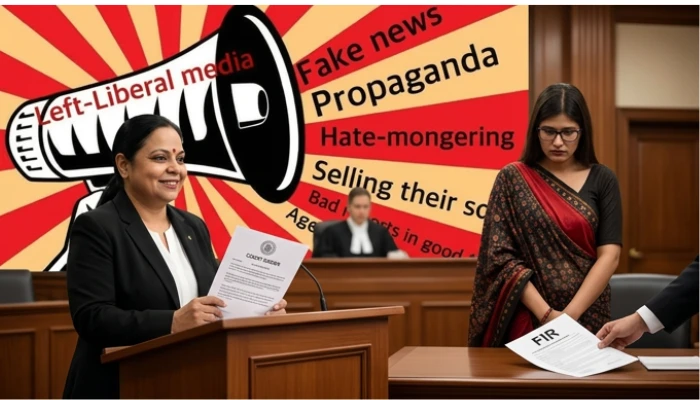
Case Summary
Anti-Hindu prejudice was propagated on social media by journalist Karishma Aziz through derogatory remarks targeting Hindu saints, religious figures, historical personalities and Hindu religious traditions. Through her X account, which had 26.9K followers and 11.4K posts, Aziz circulated content targeting Bhagwan Shri Ram, Veer Savarkar, Chhatrapati Shivaji Maharaj, Hindu festivals and Hindu culture. Several of her posts also contained misleading or fabricated claims concerning incidents involving Hindus. On 17 September 2026, the Patiala House Court in Delhi directed the registration of an FIR against Aziz in connection with her social media activity. The matter reached the Patiala House Court after Advocate Amita Sachdeva filed a complaint against Aziz over her social media posts. Sachdeva had earlier approached the Delhi Police in 2025 seeking registration of an FIR against Aziz, but no action was taken on her complaint. She subsequently approached the Patiala House Court under Section 175(3) of the Bharatiya Nagarik Suraksha Sanhita, seeking directions for registration of an FIR. On 17 September 2026, Chief Judicial Magistrate Mridul Gupta examined the complaint and directed the Delhi Cyber Police to register an FIR against Aziz. According to the complaint, Aziz had repeatedly made derogatory posts concerning Bhagwan Shri Ram, freedom fighter Veer Savarkar, Maratha King Chhatrapati Shivaji Maharaj and Prime Minister Narendra Modi. The complaint also referred to posts in which she mocked Hindu religion, Hindu saints and Hindu rulers, and circulated claims that distorted historical and contemporary events. Her social media activity also included posts that presented Hindu historical figures and their legacy in a derogatory manner while praising Islamic invaders such as Babur and Aurangzeb and expressing pride in their actions. One of her social media accounts was subsequently suspended. In one post, Aziz mocked Hindu faith and Bhagwan Shri Ram by claiming that people were being lynched and mosques demolished in His name, while questioning how Ram could be relevant when He was not mentioned during the Mahabharata period. Her claim was contradicted by the Mahabharata itself, which contains references to the Ramayana and its characters. The Vana Parva contains the Ramopakhyana, an account of the story of Bhagwan Ram, while Bhagwan Hanuman and Jambavan also feature in the Mahabharata tradition. The post was therefore criticised for presenting a historically inaccurate claim about the presence of the Ram narrative within the Mahabharata. In another post, Aziz targeted Hindu saints by claiming that they had harassed a person and assaulted a young man who protested against them. Ayodhya Police subsequently clarified that the incident arose from a dispute while a person was making a reel on a motorcycle and that no harassment had taken place. Aziz's post had therefore presented the incident without the circumstances subsequently clarified by the police. Aziz also misidentified a person involved in a Baghpat incident in which a man was seen spitting on a tandoori roti. She identified the man as Naresh, presenting the incident through a Hindu identity, whereas the worker making the roti was identified as Shehzad. The identity presented in her post was therefore inconsistent with the available details of the incident. In another instance, Aziz circulated a fabricated postcard concerning a young man from Madhya Pradesh named Rishabh. The postcard claimed that Rishabh had a sexual relationship with his own sister and carried the logo of a media organisation. Rishabh and the media organisation subsequently confirmed that the postcard was fake. She also circulated a video showing a man kicking the bicycle of a disabled person and presented it as an incident involving Hindus. The video was scripted, and the two individuals involved were identified as Muslims. The post therefore attributed a Hindu identity to an incident in which the people involved did not have that identity. A similar pattern appeared in her post concerning a video in which she claimed that people were being forced to play Holi at gunpoint. The post invoked Bhagwan Shri Ram, Hindu culture and Prime Minister Narendra Modi while presenting the incident as one involving Hindus. The people involved in the actual incident were Muslims, and the circumstances were therefore different from the portrayal in her post. Her posts also repeatedly targeted Veer Savarkar and Chhatrapati Shivaji Maharaj, presenting the two Hindu historical figures and their legacy in derogatory terms. Hinduphobia Tracker had previously documented her circulation of content concerning the flash floods and cloudburst in Uttarakhand in August 2025. Aziz described the destruction caused by the natural disaster as "nature's bulldozer" and linked it to the Uttarakhand government's removal of illegal religious structures, which she described as mostly Islamic structures. Her posts framed the devastation as a form of divine retribution, with one message questioning whether the floods represented a disaster or "a bulldozer at work". The posts thus connected a natural disaster with government action concerning religious structures and portrayed the resulting destruction through a religiously charged narrative. In another case, she shared a picture of a burqa-clad woman being harassed in broad daylight and wrote in Hindi on X, roughly translating to: "The moment they saw a burqa, the hateful blind devotees showed their Asaram-like DNA. But the sister was alert too, so she rightfully rewarded the act." The reference to Asaram was an allusion to Asaram Bapu, a self-proclaimed Hindu religious leader who was convicted of sexually assaulting a minor girl. However, X user Treeni fact-checked the claim and reported that the accused was actually a Muslim man named Adnan Abdul Masood, who had molested the woman in Kanpur's Bekanganj Market and was slapped 14 times by the victim. The fact-check therefore contradicted the portrayal in Aziz's post, which had attributed the incident to Hindu men. Aziz also faced legal action in Bihar in November 2025 over her social media activity. Bihar Police registered an FIR after she posted false information about a youth-led protest in Bihar that had not taken place. The post presented the situation as one that could lead to an atmosphere similar to the Gen-Z protests in Nepal following the Bihar Assembly elections. She was booked in connection with the circulation of the information and the police's stated concern that it could contribute to an atmosphere conducive to violent protests.
Why it is Hate Crime ?
This case has been added to the tracker under the prime category of- Hate speech against Hindus. Under this, the sub-category selected is- Anti-Hindu subversion and prejudice. Further, the tertiary categories selected are- Mislabelling/Misrepresentation of perpetrator's religion as Hindu and Anti-Hindu Fake News or Downplaying. Hate speech is defined as any speech, gesture, conduct, writing, or display that is prejudicial against a specific individual and/or group of people, which is leading to or may lead to violence, prejudicial action or hate against that individual and/or group. Media plays a specific and overarching reach in perpetuating prejudicial attitudes towards a community owing to unfair, untrue coverage and/or misrepresentation/misinterpretation, selective coverage and/or omission of facts of/pertaining to issues affecting a specific religious group. This type of bias can dehumanise the victim group, making it easier for others to justify harmful actions against them, which aligns with the objectives of hate speech laws aimed at preventing such harm. It is often observed that the media takes a prejudicial stand against the Hindu community driven by their need to shield the aggressor community which happens to be a numeric minority, however, is the one perpetrating violence against Hindus. For example, the media is often quick to contextualise religiously motivated crimes against Hindus, omit or misrepresent facts that point towards religiously motivated hate crimes, justify and/or downplay religiously motivated hate crimes or simply present fake news to stereotype Hindus. Such media bias leads to the denial of persecution and is often used to dehumanise Hindus, leading to justification for violence against them. For example, the media covered several fake allegations of Hindus targeting Muslims and forcing them to chant Jai Shree Ram. Most of these cases were proved false and fabricated after police investigation. These fake news reports were subsequently never retracted or clarified. Such fake news led to the justification of violence and dehumanisation of Hindus based on the argument that since Hindus targeted Muslims and forced them to chant Jai Shree Ram, the dehumanisation of Hindus and violence against them was par for the course and merely a retaliation. Such media bias leads to prejudicial portrayal of Hindus and offers a justification for violence against them and therefore, is considered hate speech under this category. The other sub-category selected in the case is: Anti-Hindu slurs, mocking faith Anti-Hindu slurs and the deliberate mocking of the Hindu faith owing to religious animosity involve the usage of derogatory terms, stereotypes, or offensive references to religious practices, symbols, or figures. One of the common anti-Hindu slurs used against Hindus is “cow-worshipper” and “cow piss drinker”. The intention of using this term is to demean and mock Hindus as a group and their religious beliefs since Hindus consider the cow holy. Additionally, some symbols and the slurs attached to them have a historical context that exacerbates the insult, hate, stereotyping, dehumanisation and oppression against Hindus. Cow worship has been used for centuries to denigrate Hindus, insult their faith and oppress Hindus specifically as a religious group. There has been overwhelming documentation about how cow slaughter has been used to persecute Hindus with cow meat being thrown in temples and places of worship. There has also been overwhelming documentation where cow meat (beef) has been force-fed to Hindus to either forcefully convert them to Islam or denigrate their faith. Apart from cow worship, the Swastika – which holds deep religious significance for the Hindus – has also been misinterpreted and distorted to use as a slur against Hindus. Similarly, the worship of the Shivling has been used by supremacist ideologies and religions to denigrate Hindus owing to religious animosity. Such slurs and denigration stem out of inherent animosity and hate towards Hindus and their faith, therefore, it is categorised as hate speech targeted at Hindus specifically owing to their religious identity. Another category selected is : Mocking/ denigrating Hindu leaders Hate speech is defined as any speech, gesture, conduct, writing, or display that is prejudicial against a specific individual and/or group of people, which is leading to or may lead to violence, prejudicial action or hate against that individual and/or group. Religious leaders are often seen as representatives of the community, especially, the community’s religious faith and beliefs. Mocking or denigrating a religious leader specifically owing to his religious identity and/or the religious rituals he observes can be considered hate speech because the motivating factor of the speech is animosity and/or dislike for what he represents – the religious beliefs and faith of the community. It is important to note that mere insulting words against an individual do not constitute hate speech. It is entirely possible that insulting words are used for an individual, however, the specific speech is not the result of religious hate and/or animosity towards the professed faith of the religious leader, but the individual himself. For the speech to be considered hate speech, the speech itself or the motivating factor behind the speech has to be religious in nature. Such speech which denigrates Hindu religious leaders specifically owing to animosity towards the faith they profess and the community faith they represent will be treated as hate speech under this category. This case was added to the Tracker because Aziz's social media activity repeatedly targeted Hindu faith, identity, revered figures and cultural heritage through ridicule, misleading claims and fabricated content. The nature of these posts went beyond criticism of a particular individual or disagreement over an isolated incident. Her posts specifically referred to Bhagwan Shri Ram, Hindu saints, Veer Savarkar, Chhatrapati Shivaji Maharaj, Hindu festivals and other aspects of Hindu religious and cultural life, often presenting them in a derogatory or misleading manner. One example was her post mocking Bhagwan Shri Ram, in which she referred to lynchings and the demolition of mosques being carried out in His name and questioned how Ram could be relevant when He was not mentioned during the Mahabharata period. This was not simply criticism of a contemporary political issue. It directly questioned the relevance of a central Hindu deity while relying on a historically inaccurate claim about the presence of the Ram narrative in the Mahabharata. The Mahabharata itself contains the Ramopakhyana in the Vana Parva, which recounts the story of Bhagwan Ram, along with references to figures such as Hanuman and Jambavan. The post therefore used a false historical premise to ridicule a figure deeply revered by Hindus. Her post targeting Hindu saints followed a similar pattern. Aziz claimed that saints had harassed a person and assaulted a young man who protested against them. Ayodhya Police subsequently clarified that the incident arose from a dispute involving a person making a reel on a motorcycle and that no harassment had taken place. By presenting the incident as one involving Hindu saints harassing and assaulting others, the post did more than misrepresent what had happened. It attached wrongdoing to Hindu religious figures and presented such conduct as emanating from a Hindu religious identity. A separate pattern emerged in posts where Aziz misrepresented the religious identity of people involved in incidents. In the Baghpat tandoori roti case, she identified the worker involved as Naresh, thereby presenting the incident as one involving a Hindu, although the worker was actually identified as Shehzad. Similarly, she shared a video in which a man kicked the bicycle of a disabled person and presented it as an incident involving Hindus, even though both individuals in the video were Muslims. In another post concerning a burqa-clad woman being harassed in Kanpur, Aziz referred to "blind devotees" and invoked Hindu identity while blaming Hindu men for the incident, although the accused was identified as a Muslim man, Adnan Abdul Masood. In each of these instances, the communal identity of the person involved was changed in the telling of the incident, and Hindu identity was attached to conduct with which Hindus had no connection. These posts are significant because the misinformation did not concern incidental details. The religious identity of the people involved was itself altered. By presenting Muslims as Hindus, Aziz transferred responsibility for misconduct onto a community that was not responsible for it. Repeatedly associating criminal or objectionable behaviour with Hindus created a false association between wrongdoing and Hindu identity. Individual incidents were consequently made to appear as examples of Hindu behaviour, contributing to a distorted and derogatory portrayal of Hindus before the audience. The same pattern was evident in the fabricated postcard concerning Rishabh from Madhya Pradesh. Aziz circulated a postcard claiming that the young man had a sexual relationship with his own sister and used the logo of a media organisation, although Rishabh and the organisation subsequently confirmed that the postcard was fake. Likewise, in the video concerning people allegedly being forced to play Holi at gunpoint, the presentation of the incident invoked Bhagwan Shri Ram, Hindu culture and Prime Minister Narendra Modi and conveyed the impression that the people involved were Hindus, whereas the actual individuals involved were Muslims. In both instances, the original presentation carried the potential to attach disgraceful or criminal conduct to a Hindu identity that was not actually involved. The religious targeting was not limited to contemporary incidents. Aziz's posts also targeted Veer Savarkar and Chhatrapati Shivaji Maharaj in derogatory terms, while posts concerning Indian history praised or glorified figures such as Babur and Aurangzeb, while the Mughal rulers she praised were responsible for documented acts of violence and persecution against Hindus and the destruction of Hindu religious institutions. This contrast is significant because Savarkar and Shivaji Maharaj occupy an important place in Hindu historical and cultural memory. Presenting Hindu historical figures through ridicule while praising rulers associated with documented atrocities against Hindus and Hindu religious institutions diminished the figures through whom Hindus preserve their historical memory and civilisational identity, while placing those who had persecuted them in a position of admiration. Her treatment of the Uttarakhand floods provided another example of this framing. In posts concerning the August 2025 flash floods and cloudburst, Aziz described the devastation as "nature's bulldozer" and linked it to the Uttarakhand government's removal of illegal religious structures, which she described as mostly Islamic structures. She framed the destruction as divine retribution and questioned whether the floods represented a disaster or "a bulldozer at work". By linking a natural disaster to the removal of religious structures and presenting the resulting devastation as a form of divine punishment, the posts introduced a religiously charged interpretation of the tragedy and used it to comment on developments in a Hindu-majority state. Taken together, these examples show that the targeting operated across several dimensions of Hindu identity. Bhagwan Shri Ram was mocked through a misleading historical claim; Hindu saints were presented as perpetrators of conduct that police subsequently disputed; Hindu identity was falsely attached to incidents involving Muslims; Hindu historical figures such as Savarkar and Shivaji Maharaj were subjected to ridicule; Hindu festivals and cultural symbols were brought into misleading narratives; and Hindu civilisational memory was contrasted unfavourably with praise for rulers associated with documented persecution and atrocities against Hindus. The common thread was not criticism of one individual or one isolated event, but repeated negative framing of people, beliefs, symbols and figures specifically associated with Hindu identity. The cumulative effect of these posts was therefore greater than the dissemination of inaccurate information. By repeatedly portraying Hindu deities and revered figures as objects of ridicule, attributing wrongdoing by others to Hindus, and presenting Hindu historical and cultural figures in a derogatory manner, the posts contributed to a false and degrading portrayal of Hindu identity. The misinformation was particularly significant where the communal identity of the people involved was changed, because it allowed conduct by individuals from another community to be projected onto Hindus as a whole. Most importantly, the hostility was not confined to particular individuals or isolated incidents. The posts repeatedly targeted what Hindus worship, whom they revere, the historical figures through whom they understand their civilisational past, and the festivals and traditions that form part of Hindu life. At the same time, Hindu identity was repeatedly associated with misconduct through misleading portrayals of incidents involving people from another community. Taken together, this created a pattern in which Hindu faith, heritage and identity were not merely criticised, but repeatedly subjected to ridicule, distortion and negative stereotyping. By making the disparaging remarks, the Muslim journalist revealed her disdain for Hinduism. Her words are not just casual insults but indicate a deeper hostility, fueled by a desire to demean and belittle Hindu beliefs and customs. As such, this incident is being categorised as a religiously motivated hate crime against Hindus. Disclaimer: The Hinduphobia Tracker records incident dates based on when the anti-Hindu act, crime, discriminatory conduct, or victim's ordeal began, rather than when the media reported it, or it came to public attention. However, in the present case, the incident concerns the dissemination of a misleading media narrative and not a standalone physical crime with a clearly identifiable date of occurrence. Among the posts discussed, the earliest post advancing this narrative was published on 12 September 2024. Accordingly, this date has been selected as the indicative incident date, as it marks the earliest identified instance in which this narrative was propagated in the media. This date has been recorded for documentation purposes only.


Case Status
Complaint filed


Perpetrators Details
Perpetrators
Muslim Extremists
Perpetrators Range
One Person
Perpetrators Gender
female
 Sources




