Hindu devotees assaulted by Muslims over religious chants during Ganesh immersion procession in Aruppukkottai, Tamil Nadu
 Aruppukkottai, Tamil Nadu, India
  14 September, 2026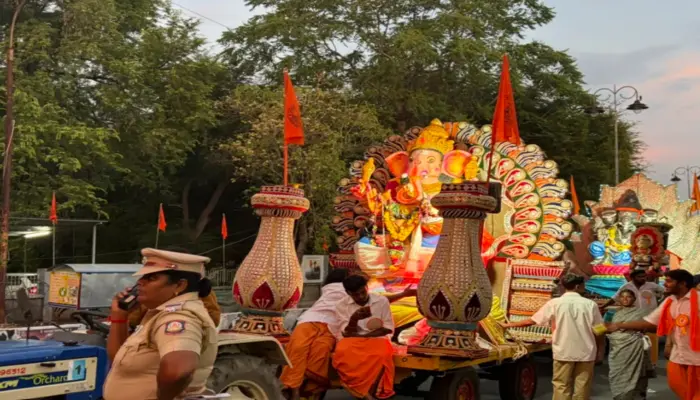
Case Summary
In Aruppukkottai, Tamil Nadu, a group of Muslims trespassed into a Bhagwan Ganesh murti visarjan (idol immersion) procession and physically assaulted Hindu devotees over the chanting of slogans like "Om Ganesha", "Jai Ganesha", and "Bharat Mata ki Jai". On 15 September, 2026, Hindu devotees participated in the Ganesh idol immersion. Law enforcement authorities permitted the religious procession on the condition that the devotees refrain from beating drums while passing mosque and church areas along the designated route. As the procession moved, the devotees chanted religious slogans. During the procession, a group of Muslims trespassed into the gathering and explicitly objected to the Hindu religious chants. The group created a sudden disruption and launched a physical assault against Hindu Munnani functionaries participating in the event. Law enforcement personnel, who were specifically deployed to provide security and protect the Hindu devotees, became mute spectators during the physical attack.
Why it is Hate Crime ?
The primary category selected in this case is- Attack not resulting in death. The subcategory selected is- Attacked for crossing 'Muslim area'. One of the reasons that Hindus get attacked unprovoked specifically by Islamists is for crossing ‘Muslim areas’. Essentially, Muslim mobs often attack Hindus crossing or present in certain areas which have a majority Muslim population. It has often been cited as one of the reasons to blame Hindus for attacks against themselves, signalling that Hindus displaying religious symbols, taking our religious processions or crossing any area which is dominated by Muslim residents is a provocation in and of itself. These areas are mostly ghettoized areas where mobs mobilize quickly to attack Hindus for a variety of reasons like playing music during a religious procession, crossing a mosque, wearing a tilak or any other religious symbol in a Muslim-dominated area, praying at a local temple in that area etc. There have been cases where the few local Hindus of that area have been attacked on their way to the Temple for prayers as well, simply because the area is considered a Muslim-dominated area. Several times, it is entirely possible that the immediate trigger for the violence against Hindus was non-religious in nature, however, the violence became religiously motivated in nature because the area was Muslim dominated and the residents on the whole harboured animosity towards Hindus, evidenced from the actions of the mob, the slogans, and the nature of the attack. Such crimes are motivated by the religious identity of the victims and are therefore classified as hate crimes under this category. The other subcategory selected is- Attacked for Hindu identity. In several cases, Hindus are attacked merely for their Hindu identity without any perceived provocation. A classic example of this category of religiously motivated hate crime is a murder in 2016. 7 ISIS terrorists were convicted for shooting a school principal in Kanpur because they got ‘triggered’ seeing the Kalava on his wrist and tilak that he had put. In this, the Hindu victim had offered no provocation except for his Hindu religious identity. The motivation for the murder was purely religious, driven by religious supremacy. Such cases where Hindus are targeted merely for their religious identity would be documented as a hate crime under this category. The victims were specifically targeted because they were visibly participating in a Bhagwan Ganesh murti visarjan, a central religious observance in the Hindu faith. By attacking the devotees during a traditional immersion procession, the perpetrators demonstrated explicit hostility towards the public manifestation of Hindu identity. The devotees offered no provocation other than peacefully exercising their right to religious expression, proving the assault was driven entirely by anti-Hindu animus. The perpetrators' specific objection to traditional slogans such as "Om Ganesha" and "Jai Kali" constituted a direct attack on Hindu spiritual practices. These chants are fundamental expressions of devotion and reverence for Hindu deities. The attackers weaponised their intolerance by using these purely religious incantations as a justification for violence, confirming that the victims' adherence to Hindu customs was the exact reason they were singled out for the assault. The incident also exposed a territorial dimension to the religious hostility, as the perpetrators trespassed into the procession to enforce artificial boundaries against Hindu rituals. The attack stemmed from the deeply prejudiced notion that the mere passage of a Hindu procession or the utterance of Hindu chants in certain vicinities is an inherent provocation. Subjecting Hindus to violence for simply crossing an area while displaying their religious symbols perfectly illustrated the malicious enforcement of religious supremacy and territorial dominance. Finally, the swift escalation from verbal objection to unprovoked physical violence against the Hindu Munnani functionaries cemented the incident as a hate crime. The perpetrators did not merely express dissent; they actively deployed physical force to intimidate the Hindu community and suppress their religious freedoms. This calculated assault, aimed at instilling fear and punishing Hindus for their visible religious identity, squarely fitted the category of an attack not resulting in death motivated by religious prejudice. In this case, the police remained mute spectators while Hindu devotees were physically assaulted. In many such incidents, law enforcement and sections of the media often downplay the religious bias, citing a lack of a 'communal angle' to prevent further flare-ups or to avoid scrutiny of their jurisdiction. However, police inaction or official statements alone cannot determine the nature of a crime; the ground realities must take precedence. Despite the authorities' failure to intervene or officially acknowledge the religious motive, the circumstances clearly demonstrated an anti-Hindu animus. Since the ground realities made it clear that the assault on the Hindu procession was a deliberate act of religious hostility met with deliberate police inaction, this incident has been documented in the hate tracker.


Case Status
Unknown


Perpetrators Details
Perpetrators
Muslim Extremists
Perpetrators Range
Unknown
Perpetrators Gender
unknown
 Sources




