Ancient Hindu temple converted into mosque, with the idol of Lord Shiva removed and two Shivlings blocked with stone slabs
 Shivpuri, Madhya Pradesh, India
  2 September, 2026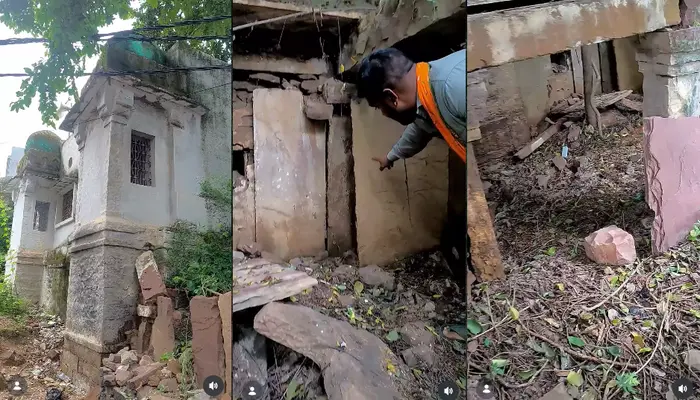
Case Summary
In Kalipahadi village in Narwar, Shivpuri district, Madhya Pradesh, an ancient Shiva temple was converted into a mosque, with the idol of Lord Shiva removed, the Nandi idol displaced, and two Shivlings inside an underground temple structure blocked with stone slabs. On 3 September 2026, Raju Solanki, a resident of Kalipahadi village, submitted an application to the Chief Municipal Officer (CMO) of the Narwar Municipal Council regarding the Shiva temple near Duhai Pond in Ward No. 8. Solanki, along with other local residents, stated that the religious character of the site had been altered and that a mosque had been constructed over the ancient temple. According to the application, the idol of Lord Shiva had been removed from the temple premises, while the idol of Nandi Maharaj had been displaced and was lying outside the structure. A Trishul remained on the structure, providing a visible indication of its earlier Hindu religious character. Solanki and his associates further stated that the site contained an underground temple and cave-like entrances, with two Shivlings inside that had been blocked with stone slabs. Videos circulated by Solanki on Instagram showed the structure and its surroundings, with the footage presented as evidence of the former Shiva temple and the subsequent construction over the site. The application also referred to another site of a similar nature in Ward No. 12 and raised concerns regarding the gradual alteration or encroachment of Hindu religious sites in the area. The application additionally stated that a graveyard had been constructed on adjoining government land through encroachment, which the applicants describing it as a broader pattern of land encroachment. Solanki stated that the removal of the Hindu religious representations and alteration of the site had hurt the religious sentiments of local residents. He questioned the lack of administrative action despite the submission of the application and called for a high-level inquiry into the site's history, the construction carried out there, and the status of the adjoining government land. He also sought legal action against those found responsible, removal of any encroachments from government land, and measures to maintain law and order.
Why it is Hate Crime ?
The primary category selected in this case is: Attack on Hindu religious representations. The subcategory selected is: Desecration of Hindu religious symbols. Icons and symbols, or religious representations of a spiritual ideal, are widely revered in Hinduism. Iconography is of vital significance in the Hindu milieu. It helps connect people’s spiritual beliefs with the real world. Iconography within the Hindu faith takes several shapes and forms. Murtis are of great significance to Hindus, to which daily rituals, prayers and offerings are performed. Besides the murtis, there are several other symbols which have deep significance in the Hindu faith – the Om and Swastika, for example. Since these Hindu religious symbols hold paramount importance in Hinduism, any desecration of symbols, icons, murtis, religious representations and manifestations is driven by animosity towards the faith itself, which manifests itself through these murtis, icons and symbols. Therefore, any desecration of these Hindu religious symbols and representations is considered religiously motivated hate crimes under this category. The other sub-category selected here is - Encroachment or illicit takeover of temple land/land near temple. In Hinduism, a temple is the abode of the Deity. The Deity in the Temple is consecrated, thereby, making it a real, breathing entity. Hindus believe that not just the Deity but the temple premises itself are sacred to Hindus since Hindus hold the faith that the entire Temple space is an amalgamation of the divine energy of the deity. Not only the Temple but the Temple premises in its entirety are considered sacred by Hindus. In several cases, the premises of the Temple and/or religious centre are illicitly taken over by institutions belonging to other faiths – like the Waqf board or the Church. Other times, the temple property, land or the property of religious centres are illicitly encroached by non-Hindu groups. Any illicit take over or encroachment is a crime an initio, however, when non-Hindu groups illicitly take over or encroach the sacred land of Hindus, it is an affront to the Hindu community and is therefore classified as a religiously motivated hate crime under this category. This case was classified as a religiously motivated hate crime because the conduct concerned the alteration of a site identified as a Hindu place of worship and its conversion for use as a mosque. The religious significance of the incident therefore went beyond an ordinary dispute concerning land, construction, ownership, or redevelopment. The central issue was the transformation of a site associated with Lord Shiva and Hindu worship into a place being used for another religion, accompanied by the removal, displacement and obstruction of Hindu religious representations that remained associated with the premises. The change in the religious character and use of the site was therefore directly relevant to the classification. The conversion into a mosque was particularly significant because it represented more than the physical construction of a different structure at the location. A Hindu temple is a sacred space in which the Deity is worshipped, and the religious identity of the premises is intrinsically connected to the consecrated Deity, the objects of worship and the rituals performed there. Consequently, where a site identified as a Shiva temple is converted into a mosque, the conduct affects not merely the physical structure but the religious character and function of a space regarded by Hindus as sacred. The removal of the Shiva idol and displacement of the Nandi idol were consistent with a broader alteration of the site's Hindu religious character, while the continued presence of a Trishul and Shivlings indicated that Hindu religious representations remained connected to the location. The nature of the conversion was further significant because the Hindu religious elements were not simply abandoned or relocated in the ordinary course of redevelopment. The two Shivlings remained within an underground temple structure but had been blocked with stone slabs, preventing access to objects regarded as sacred and used for Hindu worship. This was particularly relevant to the religious-harm dimension of the incident because it concerned the obstruction of Hindu religious representations within a site that was being used as a mosque. The combination of removing the principal Shiva idol, displacing Nandi, retaining Hindu religious remnants within the structure and blocking access to Shivlings indicated a physical and functional displacement of Hindu religious worship from the site. The encroachment and conversion of the Hindu temple into a mosque gave the incident a distinct inter-religious dimension. The concern was not merely that a Hindu temple had fallen into disuse or that its ownership or physical condition had changed. Such a transformation amounted to a substantive alteration of the religious use and character of a Hindu place of worship, effectively displacing the site's Hindu religious function with that of another faith. The encroachment and conversion of the temple into a mosque was therefore central to understanding the incident as an attack on Hindu religious space rather than as an ordinary property or construction dispute. The treatment of the Hindu religious representations independently reinforced this religious dimension. Lord Shiva, Nandi Maharaj, the Shivlings and the Trishul were all specifically connected with Hindu religious practice and symbolism. Their removal, displacement or obstruction affected sacred representations rather than ordinary objects. Such interference has significance for the Hindu community because these representations serve as focal points of worship and religious practice. Consequently, the reported destruction, removal or obstruction of such representations, particularly in conjunction with the conversion of the surrounding sacred space into a mosque, had implications extending beyond the physical objects themselves. The takeover or encroachment of temple-associated land was similarly relevant because the sacred character of a Hindu temple is not ordinarily confined to the central structure alone. The temple premises form part of the religious space in which worship and associated activities take place. The application further raised concerns regarding encroachment on adjoining government land and the construction of a graveyard. While the precise legal status of the land and the circumstances of the construction remained to be established, the reported expansion of the non-Hindu religious use around a site identified as a Hindu temple contributed to the religious character of the complaint. Taken together, the encroachment of a Hindu temple, its conversion for use as a mosque, the removal and displacement of Hindu religious representations, and the obstruction of access to the Shivlings gave the incident a clear religious dimension. The conduct affected both the physical sacred space and the ability to use Hindu religious representations associated with it for worship. The case was therefore classified as a religiously motivated hate crime because the harm was directed at, and substantially concerned, a Hindu place of worship and its religious character.


Case Status
Complaint filed


Perpetrators Details
Perpetrators
Muslim Extremists
Perpetrators Range
Unknown
Perpetrators Gender
unknown
 Sources




