Hindus subjected to religious conversion through unauthorised prayer meetings in Narayanpur, Chhattisgarh
 Narayanpur, Chhattisgarh, India
  10 September, 2026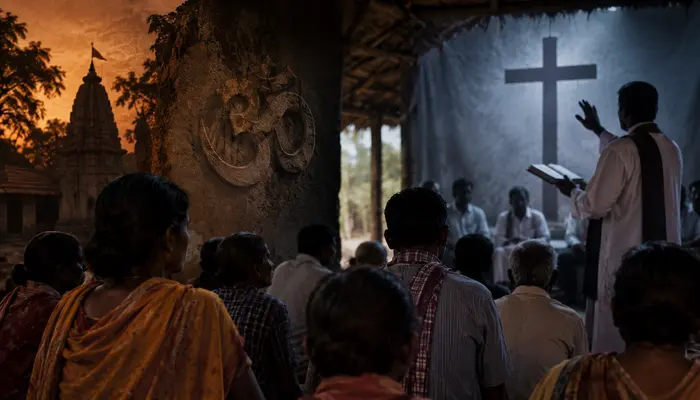
Case Summary
In Karlakha Gram Panchayat, Narayanpur district, Chhattisgarh, Hindus were subjected to religious conversion through unauthorised prayer meetings. On 11 September 2026, a large group of Hindu villagers travelled to the district headquarters by tractor, accompanied by the gram panchayat sarpanch, deputy sarpanch, and other elected representatives. They first went to the Collector’s office and submitted a memorandum regarding the prayer meetings. The villagers stated that Karlakha fell within a Fifth Schedule area and that the Panchayats (Extension to Scheduled Areas) Act (PESA) applied to the village. The memorandum named an individual associated with the prayer meetings and conversion-related activities. The villagers sought an inquiry into the activities and action under law. They also urged the administration to intervene to maintain peace and social harmony in the area. The delegation met District Collector Namrata Jain and subsequently approached Superintendent of Police Sandeep Kumar Patel, submitting a written complaint concerning the same activities. The police authorities assured the villagers of necessary cooperation and advised them to report any such activities promptly. They said they would examine complaints based on available facts and evidence and take appropriate legal action where warranted. After meeting the administrative and police authorities and receiving assurances that their complaints would be examined under the law, the villagers returned to Karlakha.
Why it is Hate Crime ?
The primary category selected in this case is: Predatory Proselytisation. The subcategory selected is: Proselytisation by grooming, brainwashing, manipulation or subtle indoctrination. Religious brainwashing essentially means the often subtle and forcible indoctrination to induce someone to give up their religious beliefs to accept contrasting regimented ideas. Religious grooming or brainwashing also involves propaganda and manipulation. It involves the systematic effort, driven by religious malice and indoctrination, to persuade “non-believers’ to accept allegiance, command, or doctrine to and of a contrasting faith. Cases of such grooming or brainwashing are far more nuanced than direct threats, coercion, inducement and violence. In such cases, it is often seen that there is repeated, subtle and continual manipulation of the victim to induce disaffection towards their own faith and acceptance of the contrasting faith of the perpetrator. While subtle indoctrination is widely acknowledged as predatory, an element which is often understated in such conversions or the attempts of such conversion is the role of loyalty and trust which might develop between the perpetrator and the victim. Fiduciary relationships are often abused to affect such religious conversion. For example, an educator transmitting religious doctrine of a competing faith to a Hindu student. The Hindu student is likely to accept what the teacher is transmitting owing to existence of the fiduciary relationship. The exploitation of the fiduciary relationship to religiously indoctrinate victims would also be included in this category. Since the underlying animosity towards the victim’s faith forms the basis of predatory proselytisation, such cases are considered religiously motivated hate crimes. This case was added to the tracker because Hindu villagers were subjected to religious conversion through unauthorised prayer meetings. The conduct was specifically directed towards members of the Hindu community and involved efforts to influence their religious affiliation. The conversion-related nature of the activity made the religious identity of those targeted central to the incident. Firstly, targeting Hindus for religious conversion to Christianity was significant because the conversion effort was directed at people who followed Hinduism. The objective was not simply to introduce Hindu villagers to Christian beliefs or allow them to observe another religion; it involved encouraging them to leave their existing Hindu faith and adopt Christianity. This directly affected their religious identity because conversion meant moving away from the beliefs, practices and religious community with which they had previously identified. The conduct therefore placed Hindu religious adherence itself at the centre of the conversion effort. Secondly, the use of prayer meetings for Christian proselytisation was significant because the prayer meeting served as the setting for the conversion activity. Instead of the gathering being limited to Christian worship, it was connected with efforts to persuade Hindu villagers to change their faith and convert to Christianity. This meant that a religious gathering was being used to introduce Christian beliefs to influence their existing religious affiliation. The concern for Hinduism therefore arose from the use of a Christian religious setting to encourage Hindus to move away from their own faith. The Christian faith, by its very theological foundations, places a strong emphasis on proselytisation. In pursuit of conversion objectives, Christian evangelists often employ unethical means, ranging from psychological pressure and misinformation to inducements such as money or jobs. In such cases, Christian missionary groups often target and brainwash socially and economically vulnerable Hindus to further their agenda of religious conversions. This form of coercion strips Hindus of their agency and dignity and enforces forced conversions. These are not random or isolated incidents, but rather premeditated efforts to undermine the Hindu faith, persuade Hindus to discard their own faith, and convert to Christianity. Such acts were deeply rooted in religious animosity towards Hindu victims, and thus, this case was added to the tracker. Disclaimer: The Hinduphobia Tracker records incidents based on when an event occurred or when the victim's ordeal began. It is important to clarify that none of the media sources covering this case has specified the exact date when the incident occurred. Therefore, for documentation purposes, we have recorded the date based on when the incident was reported in the media, 11th September 2026.


Case Status
Complaint filed


Perpetrators Details
Perpetrators
Christian Extremists
Perpetrators Range
One Person
Perpetrators Gender
unknown
 Sources




