Sacred idol of Lord Parashuram targeted; stone pelted and damaged by unknown miscreants in Hathras, Uttar Pradesh
 Hathras, Uttar Pradesh, India
  15 September, 2026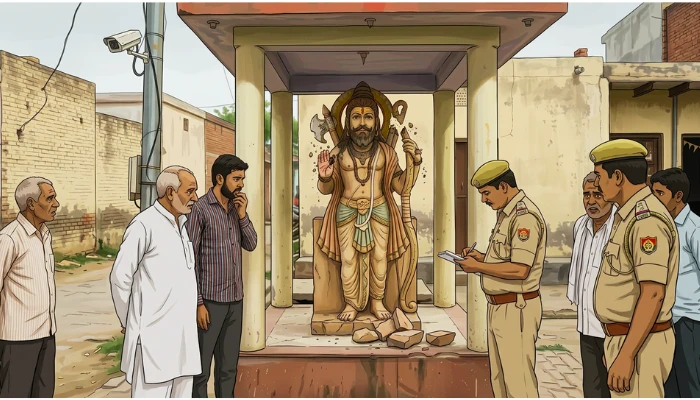
Case Summary
In Hathras, Uttar Pradesh, a statue of the revered idol, Lord Shri Parashuram, was targeted with stones by an unknown man. The attack damaged the sacred idol’s axe and bow and caused tension in the area. The incident came to light on 16 September 2026 after it was reported in the media. According to the report, a man arrived at the spot on a motorcycle and attacked the sacred statue of Lord Shri Parashuram with stones before fleeing from the scene. The attack broke the statue's axe and bow and damaged the sacred idol. Following the incident, tension prevailed in the area. Upon receiving the information, police immediately arrived at the scene and assessed the situation. They retrieved footage from nearby CCTV cameras, which clearly showed the accused arriving on a bike, throwing stones at the statue, and then fleeing. The police formed five special teams to identify and arrest the man. The Special Operations Group (SOG) and Anti-Theft Team were also assigned to assist with the investigation and trace the accused. Additional Superintendent of Police, Hathras, Ram Chand Kushwaha, said police found an idol of Lord Parshuram near Burj Wala Kuan under Kotwali Nagar police station, and acknowledged that someone had damaged its axe and bow. He stated that the police immediately reached the spot after receiving information about the incident. At the time of writing the report, the unknown man had remained absconding, and the investigation was underway.
Why it is Hate Crime ?
The primary category selected in this case is: Attack on Hindu religious representations. The subcategory selected is: Desecration of Hindu religious symbols. Icons and symbols, or religious representations of a spiritual ideal, are widely revered in Hinduism. Iconography is of vital significance in the Hindu milieu. It helps connect people’s spiritual beliefs with the real world. Iconography within the Hindu faith takes several shapes and forms. Murtis are of great significance to Hindus, to which daily rituals, prayers and offerings are performed. Besides the murtis, there are several other symbols which have deep significance in the Hindu faith – the Om and Swastika, for example. Since these Hindu religious symbols hold paramount importance in Hinduism, any desecration of symbols, icons, murtis, religious representations and manifestations is driven by animosity towards the faith itself, which manifests itself through these murtis, icons and symbols. Therefore, any desecration of these Hindu religious symbols and representations is considered religiously motivated hate crimes under this category. This case was a clear example of a religiously driven hate crime against Hindus because the attacker deliberately targeted the idol of Lord Parashuram, a revered Hindu deity, and desecrated its sacred form. The deliberate targeting of a Hindu religious representation made the religious nature of the act clear and showed that the object of the attack was not merely physical property, but an attack on Hindu faith. In Hinduism, murtis are sacred objects of worship and are not treated as ordinary statues. Lord Parashuram is regarded as the sixth avatar of Lord Vishnu and is revered as a divine protector of Dharma who confronted adharma. His murti therefore represents an important manifestation of the Divine and holds deep devotional significance for Hindu devotees. The sacred axe and bow associated with his divine form further embody his religious identity and role as a protector of Dharma. The desecration of Lord Parashuram's idol was not merely damage to an object. It amounted to an insult to the deity himself and to the Hindu faith placed in his divine presence. The desecration of his sacred attributes struck at the reverence, devotion and sense of sanctity that Hindu devotees associated with Lord Parashuram. It conveyed that something Hindus held sacred could be violated openly, causing deep religious hurt and creating a sense of vulnerability over the safety and dignity of their religious symbols. The intent was to provoke Hindus by deliberately causing religious hurt, outrage and humiliation. By violating something held sacred, the accused sought to offend Hindu sentiments and provoke a reaction from the community. The deliberate desecration also communicated disregard for the sanctity of Hindu faith and created an atmosphere in which Hindus were made to feel that their religious symbols could be targeted with impunity. The act therefore reflected a clear intention to insult, provoke and disturb communal peace through deliberate offence to Hindu religious sentiments. The deliberate targeting and desecration of a sacred representation of Lord Vishnu’s avatar therefore amounted to an attack on a visible expression of Hindu faith and religious identity. The act was directed at something deeply revered by Hindus and carried the clear intent of causing religious hurt and provoking the community. This case was therefore added to the Hinduphobia Tracker as a religiously driven hate crime. It is important to mention here that, though the last update stated that the miscreants were unknown, the action stemmed from hatred against Hinduism and resulted in the desecration of the sacred idol and would therefore be considered a religiously motivated hate crime.


Case Status
Unknown


Perpetrators Details
Perpetrators
Unknown
Perpetrators Range
One Person
Perpetrators Gender
male
 Sources




