Hindu woman lured into marriage and pressured to convert to Islam by Muslim man; attacked with hot oil for refusing conversion
 Karbi Anglong, Assam, India
  14 August, 2026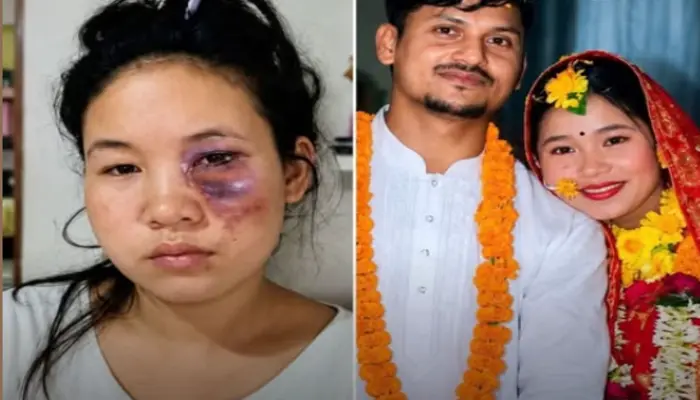
Case Summary
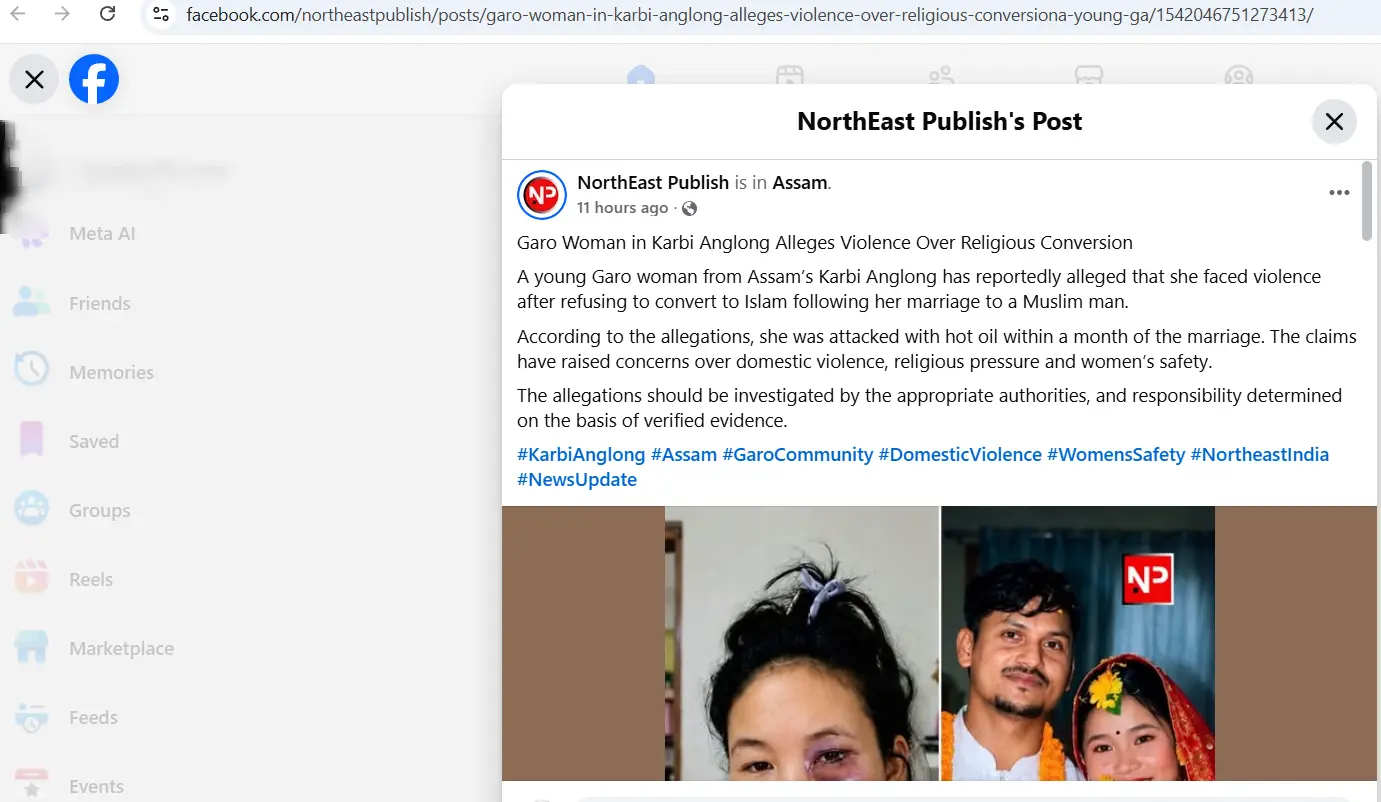
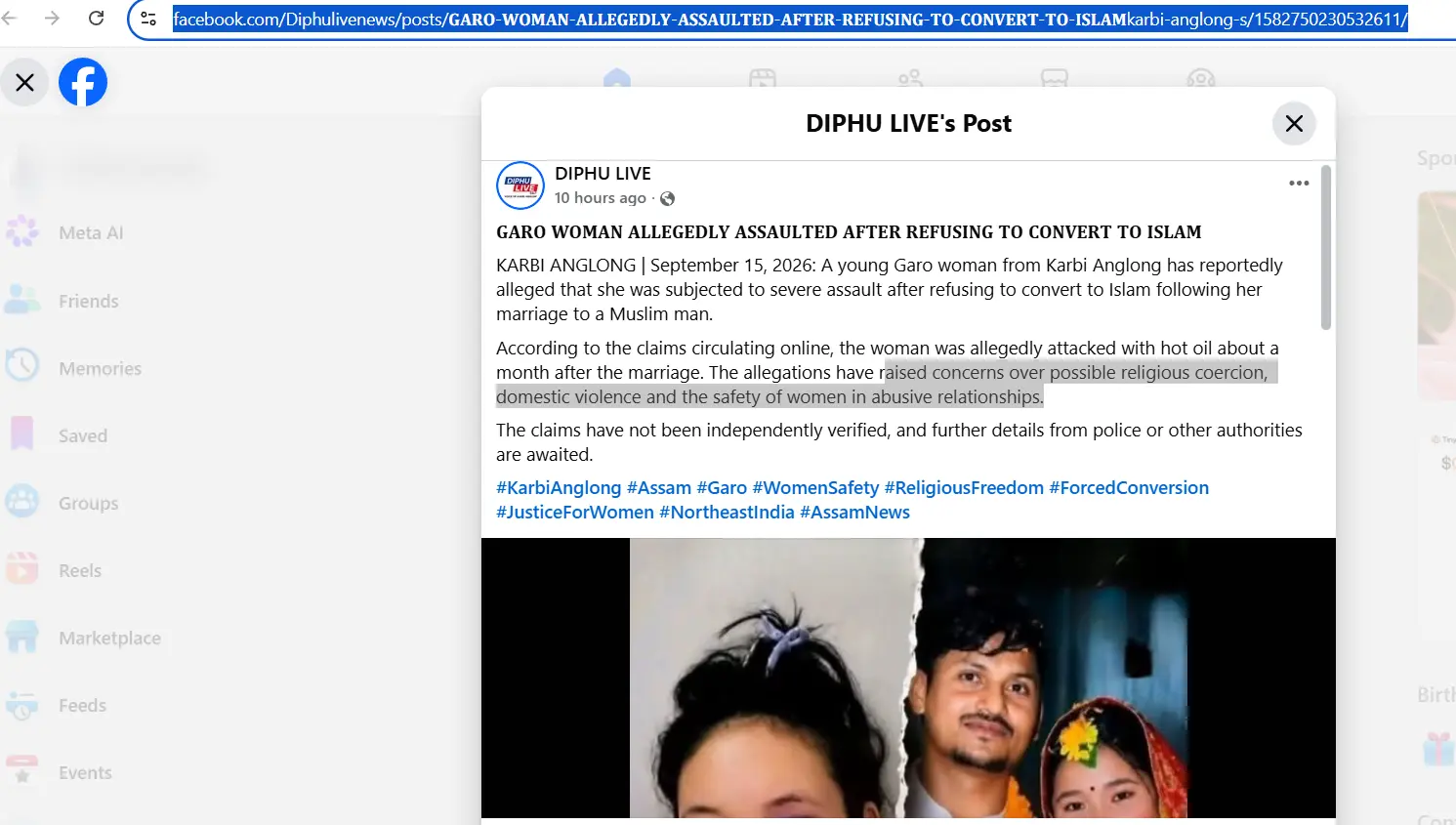
In Karbi Anglong, Assam, a Hindu woman belonging to the Garo tribal community was lured into marriage by a Muslim man. Following the marriage, the accused pressured her to abandon her Hindu faith and convert to Islam. According to media reports, the woman refused to give up her religion despite the pressure. Within a month of their marriage, the situation escalated when the accused attacked her by throwing hot oil on her face after she refused to comply with his demand to convert. In addition to the hot oil attack, the woman was subjected to severe physical assault over her refusal to convert to Islam. The woman subsequently approached the authorities and brought the matter to their attention. At the time of writing, the authorities were investigating the victim's complaint, and further details were awaited. As the incident came to light, it caused outrage among local Hindu residents and also raised concerns over domestic violence, forced conversions and women's safety.
Case Images

Why it is Hate Crime ?
The first primary category selected is: Crimes against women in relationships and other sexual crimes. The subcategory selected is: Forced conversion after marriage. In such cases, a non-Hindu man marries a Hindu woman, and the force/pressure to convert to any Abrahamic faith, like Islam, begins after marriage. In such cases, typically, two patterns emerge. First, when the relationship is consensual, and the religious identity of the perpetrator is known to the Hindu woman in the relationship. The marriage could be under the Special Marriages Act, where neither parties are required to convert their religion for the marriage to be considered legitimate. While the victim in such cases enters matrimony assuming that religious identity is not a barrier, the non-Hindu man starts to pressure the woman to convert her religion after marriage. The second is when the woman gets into a marriage with the man, pretending to share her faith. Later, when the truth is revealed, the man starts pressuring the woman to convert her religion and give up her religious identity. In both situations, there is application of force by the perpetrator, including the denial of the woman’s religious rights. Some of the means by which the woman is forced/pressured to convert include force-feeding beef, being forced to read the Kalma, being forced to wear a hijab, forced to undergo Halala, etc. There are several instances where, after marriage, the woman voluntarily converts to Islam. Such cases are often argued to be a result of religious brainwashing, however, for the purpose of documenting religiously motivated hate crimes, in the absence of the victim complaining of forced conversion, such cases do not form a part of the database. The other subcategory selected is: Assault or threat upon refusal to convert. When Hindu women are in a relationship with non-Hindu men, there are cases where the woman faces threats or assault after she refuses to convert and change her religious identity owing to pressure/force by the non-Hindu man. Such relationships may be consensual with the religious identity of the non-Hindu man known to the victim. Somewhere along the relationship, the non-Hindu man starts pressurizing the Hindu woman to convert to Islam and upon her refusal, assaults or threatens the victim. Such cases are driven by specific religious motivations and against the religious identity of the victim and are therefore qualified as hate crimes. Cases where the Hindu woman converts to Islam and does not file a complaint about the force or threat, are not considered a part of the hate tracker, even though, it may be argued that the woman was brainwashed or threatened to convert to Islam. The second primary category selected is: Attack not resulting in death. The subcategory selected is: Attacked for refusal to convert. When there is pressure, threat or coercion employed upon the Hindu victim to convert to a different religion, in several cases, the victim refuses to succumb to the pressure/threats. Once the victim refuses, the perpetrator proceeds to attack/assault the victim owing to his/her refusal to convert. In such cases, the pressure/threat/intimidation/coercion/violence itself is driven by animosity towards the victim’s Hindu faith. The violence then is another hate crime driven by the victim’s refusal to abandon his professed faith, Hinduism, and convert to the religion of a non-Hindu perpetrator. Since the victim’s faith is at the heart of the pressure to convert and the ensuing violence towards the victim, such cases are considered religiously motivated hate crimes. This case was a clear example of a religiously driven hate crime because a Hindu woman belonging to the tribal community was lured into a marriage and subsequently pressured to convert to Islam by the Muslim man she married. When she refused to abandon her Hindu faith, she was subjected to brutal physical violence, including an assault in which hot oil was thrown on her face. The sequence of events established a direct connection between her Hindu identity, the demand that she abandon it, and the violence that followed her refusal. The circumstances therefore indicated that her religious identity was central to the suffering she endured, making this a clear case of a religiously driven hate crime. In this case, the nature of the relationship through which the victim was brought into the marriage was significant. Although the Muslim perpetrator did not conceal his religious identity, the relationship was built in a manner that led the Hindu woman to enter the marriage without giving up her own faith. The subsequent demand that she convert to Islam showed that her Hindu identity was not accepted or respected as part of the relationship, but was instead treated as an obstacle that had to be removed. The perpetrator exploited the trust and vulnerability associated with an intimate relationship and used the marriage as a means to pressure her into abandoning her religion. The fact that the demand for conversion followed the marriage demonstrated that the relationship itself was a means of subjecting the victim to religious coercion. Targeting a Hindu woman through an intimate relationship and subsequently seeking to change her faith reflected religiously profiled targeting of Hindu women and a predatory dynamic centred on religious conversion. The circumstances therefore established that the relationship was not merely a private marital dispute, but was intrinsically connected to the attempt to alter the victim's religious identity. After marrying her, the perpetrator began pressuring the victim to convert to Islam. This was a direct religious marker in the incident because the demand was specifically directed at changing the victim's Hindu faith. Conversion can only be voluntary when it is undertaken through a person's own free will and without coercion or intimidation. A conversion demanded after a person has been brought into a marriage, and enforced through pressure, coercion or violence, cannot be treated as a genuinely voluntary exercise of religious choice. In this case, the victim's refusal to abandon Hinduism was not respected; instead, her religious autonomy was challenged because she continued to retain her Hindu identity. The repeated attempts to make her give up that identity demonstrated a disregard for her right to determine her own faith and practise it according to her conscience. The conversion pressure therefore reflected hostility towards the victim's Hindu identity, treating her religion as an obstacle that had to be removed rather than an integral part of her personhood. In the context of the subsequent violence, the demand for conversion demonstrated a deeply coercive and anti-Hindu dynamic, consistent with a religiously driven hate crime. When the victim refused to convert to Islam, the coercion escalated into brutal physical violence, including the throwing of hot oil on her face. This escalation was significant because it demonstrated that the perpetrator responded to her exercise of religious choice with severe physical harm. The violence was not separate from the conversion demand; it followed her refusal to comply with it. When a person's refusal to surrender their faith is met with such extreme violence, the religious hostility underlying the incident becomes particularly clear. The use of hot oil, which caused physical injury and targeted the victim's face, represented an exceptionally severe form of assault and showed the extent to which the perpetrator was prepared to use violence when the victim resisted the demand placed upon her. The sequence of pressure, refusal and violent retaliation therefore demonstrated that the victim was being punished for exercising her right to retain her Hindu faith. The assault consequently amounted not merely to physical violence within a marital relationship, but to religiously motivated violence in which her Hindu identity and refusal to abandon it were central to the abuse she suffered. Overall, the circumstances of the case meet the parameters of a hate crime. Therefore, it is being added to the hate crime database of the Hinduphobia Tracker. Disclaimer: Hinduphobia Tracker records incident dates based on when the victim's ordeal begins rather than when the incident is reported by the media. However, in this case, the media reports did not specify the exact date on which the victim's ordeal began. The incident was reported in the media on 15 September 2026, and the reports stated that the perpetrator threw hot oil on the victim's face after she refused to convert, approximately one month after their marriage, following which the authorities began investigating the matter. Considering these details, an indicative incident date of 15 August 2026 has been selected as the estimated date marking the beginning of the victim's ordeal. This date has been recorded for documentation purposes only.
Victim Details
Total Victim
1
Deceased
0
Gender
- Male 0
- Female 1
- Third Gender 0
- Unknown 0
Caste
- SC/ST 1
- OBC 0
- General 0
- Unknown 0
Age Group
- Minor 0
- Adult 1
- Senior Citizen 0
- Unknown 0


Case Status
Complaint filed


Perpetrators Details
Perpetrators
Muslim Extremists
Perpetrators Range
One Person
Perpetrators Gender
male
 Sources




