Hindu families pressured to convert, objected on Hindu practices and assaulted in Baruipur, West Bengal
 Baruipur, West Bengal, India
  14 September, 2026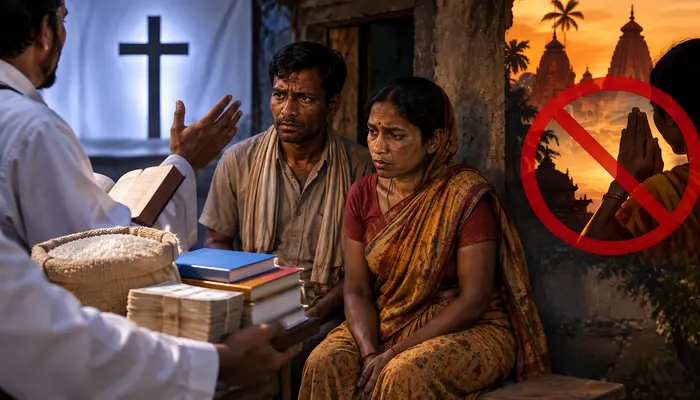
Case Summary
In Baruipur, West Bengal, three Hindu families were pressured to convert to Christianity while their Hindu religious practices were objected to, including the recitation of Vande Mataram. During the confrontation surrounding a Christian prayer gathering, women who opposed the activities were assaulted. The incident was reported on 15 September 2026. The controversy centred on the presence of Christian religious activity in the locality where impoverished and vulnerable Bengali Hindu families were being targeted for conversion. Rampada Biswas, an office-bearer of the Vishwa Hindu Parishad's Sundarban Eastern District unit, spoke to media representatives at the site. He said families were being approached with financial assistance, rice and schooling for their children in connection with conversion efforts. Biswas said those who converted were discouraged from reciting Vande Mataram and were instructed to direct their prayers exclusively towards Jesus. He also objected to the practice of telling people to depend on faith and prayer for healing instead of medical treatment when they became ill. Referring to this, he questioned how illness could be cured simply by taking Jesus's name if medicines were not required. He demanded action against what he described as door-to-door proselytisation campaigns. The controversy escalated during a Christian prayer gathering, when members of the Vishwa Hindu Parishad (VHP) and Bajrang Dal intervened. Their protest drew large numbers of residents and curious onlookers, creating a tense atmosphere in the neighbourhood. Parts of the area were cordoned off with yellow tape, with police or local organisers present as the situation developed. During the demonstration, VHP and Bajrang Dal members displayed books and pamphlets, which were recovered from the location and were used in the conversion activity. Activists raised slogans as crowds gathered around the residential structures connected with the incident. The VHP and Bajrang Dal demanded that the three families be brought back into the Hindu fold. The organisations also called for government, administrative and legal intervention, saying their local units were monitoring systematic, foreign-funded, door-to-door conversion campaigns targeting poor communities across West Bengal. The reports also included the account of Tushimoni Mondal, a resident who said she and her family had turned to Christianity during the COVID-19 pandemic, when her children had become critically ill. The family's financial resources had been exhausted. She described the family's religious change in terms of personal spiritual experiences, gratitude following recovery and a search for solace.
Why it is Hate Crime ?
The primary category selected in this case is: Predatory Proselytisation. The selected subcategory is: Conversion/attempts to convert by inducement. Predatory Proselytisation is not limited to threat, harassment, force and violence, but it also has contours of stealth. In several cases, the Hindu victim is exploited to convert, with non-Hindus taking advantage of their poverty. In such cases, the Hindu victim who is suffering financially is offered monetary benefits, including lucrative offers for jobs, health treatment, education, etc., to induce the victim to change his/her religion. In such cases, the religious identity of the victim and the aim to disenfranchise him from his faith form the heart of the crime. Also, taking advantage of and exploiting an individual’s economic vulnerabilities is widely acknowledged as exploitation, forms of which are often penalised by law. Such cases therefore are considered religiously motivated hate crimes since the victim’s religious identity forms the very heart of the crime itself. This case has been added to the tracker because three Hindu families were pressured to convert to Christianity during a prayer gathering in Baruipur. What was presented as a simple prayer gathering was part of efforts to persuade vulnerable Hindu families to abandon their faith through financial assistance, food, and educational support. Those who converted were discouraged from reciting Vande Mataram and instructed to pray exclusively to Jesus, raising alarm that the gathering was aimed at facilitating religious conversion rather than serving as a simple prayer meeting. The objections to Hindu religious practices further indicate that the gathering was centred on religious conversion rather than genuine community prayer. Firstly, the pressure placed on three Hindu families to adopt Christianity was directed at their religious identity and continuity as Hindus. Conversion in this context meant moving away from Hindu religious belief and practice and adopting Christianity in its place. Such pressure was significant because it did not merely involve exposure to another faith; it sought to persuade Hindu families to relinquish their existing religious identity. This was a direct challenge to their ability to retain and practise their Hindu faith within their own community. Secondly, the use of inducements such as financial assistance, rice and schooling was directed towards economically vulnerable Hindu families and connected material support with the prospect of religious conversion. When essential assistance is being offered alongside efforts to bring people into another faith, the material circumstances of Hindu families can become a means of encouraging them to move away from Hinduism. This was particularly significant for families facing financial hardship, as dependence on such assistance increased the pressure to accept Christianity and weakened their ability to remain within their Hindu religious tradition. Moreover, discouraging converted families from reciting Vande Mataram was significant because it sought to distance them from an expression associated with India's Hindu cultural and civilisational identity. While Vande Mataram is not exclusively a religious prayer, its imagery, language and historical association with the motherland have long given it a particular significance within Hindu cultural consciousness. This becomes even more significant in a context where India is viewed as a Hindu civilisational and cultural collectivity, and expressions such as Vande Mataram are understood as affirming that connection to the land and its heritage. Preventing converted families from reciting it therefore went beyond changing personal religious belief. It discouraged them from retaining an expression of their earlier Hindu cultural identity while encouraging practices associated with their newly adopted Christian faith. In this context, conversion was not limited to a change in religious belief; it also involved distancing individuals from cultural expressions associated with their Hindu identity and their connection to India's Hindu civilisational heritage. Lastly, instructing those who had converted to direct their prayers exclusively towards Jesus represented a move away from Hindu modes of worship and towards exclusive Christian devotion. Hinduism encompasses diverse forms of worship, deities, prayers and devotional traditions, and directing a Hindu family away from those practices towards exclusive devotion to Jesus was therefore incompatible with continuing those aspects of Hindu religious life. The instruction reinforced the expectation that accepting Christianity meant abandoning established Hindu devotional practices rather than simply adding another form of spiritual belief. These markers demonstrated hostility towards the preservation and expression of Hindu religious identity, particularly where Hindu families were being encouraged to abandon their faith, Hindu cultural expressions were being discouraged, and established Hindu devotional practices were being replaced with exclusive Christian worship. Together, these actions sustainedly challenged the religious autonomy, cultural identity, and continuity of the affected Hindu families. Accordingly, this case has been documented in the Hinduphobia Tracker's Hate Crime Database as an instance of religiously motivated hostility directed against Hinduism and the religious identity of the Hindu community.


Case Status
Unknown


Perpetrators Details
Perpetrators
Christian Extremists
Perpetrators Range
Unknown
Perpetrators Gender
unknown
 Sources




